 Aura: Looksmaxxing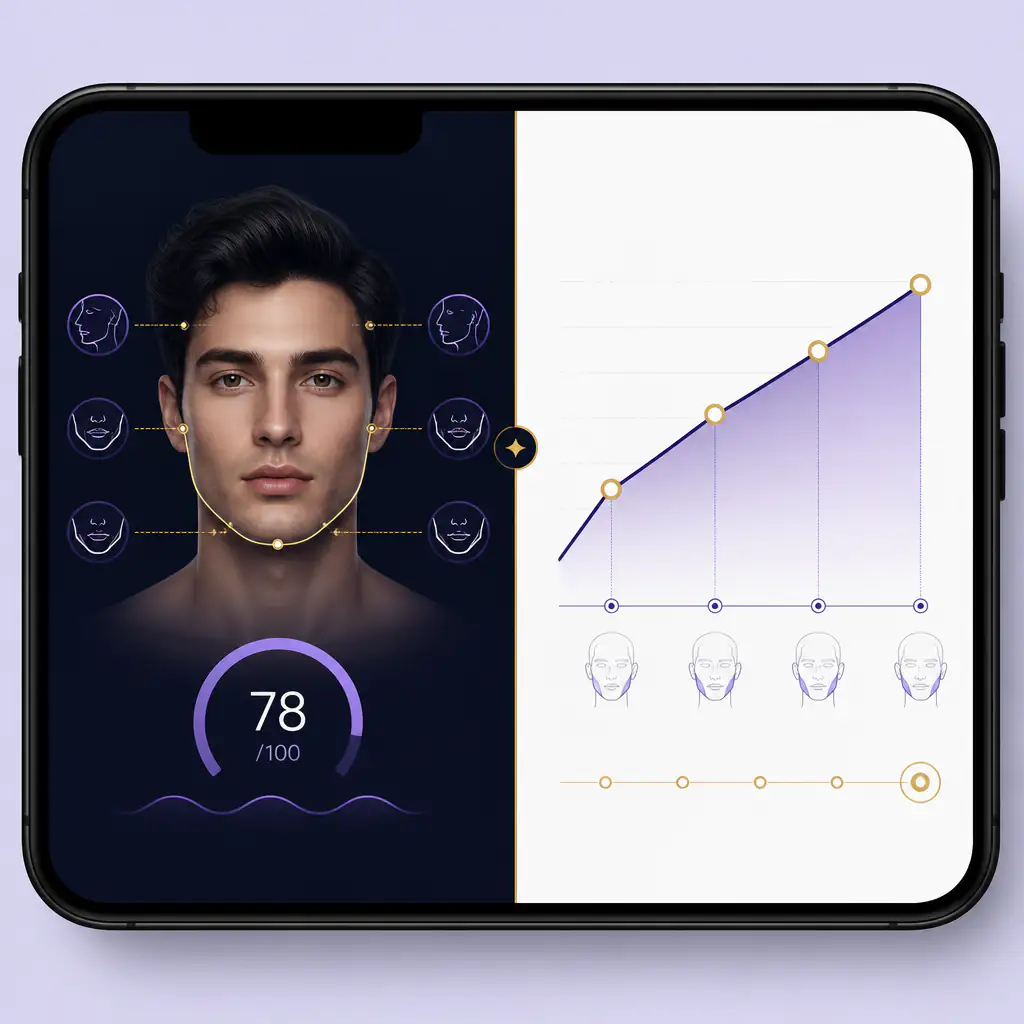
What Mewing Results Actually Look Like
Mewing refers to the practice of resting the entire tongue flat against the roof of the mouth as a default posture. Proponents suggest that maintaining this position consistently over months or years may gradually influence the position of the maxilla, the shape of the palate, and the overall appearance of the lower face. Research into orthotropics, the broader field this practice draws from, is still limited and ongoing, but some users report noticeable changes in jawline definition and facial structure after sustained practice.
The challenge is that these changes, when they occur, tend to be slow and subtle. Without a structured way to track them, it’s easy to either dismiss real progress or convince yourself something is happening when it isn’t. That’s where objective photo analysis becomes useful.
Why Photos Alone Are Not Enough
Most people who track mewing progress do so by comparing selfies over time. The problem is that selfie comparisons are highly unreliable. Small differences in camera angle, lighting, facial expression, and even the time of day can create the illusion of dramatic change or hide real progress entirely. A slightly more extended neck angle can make your jaw look sharper. Overhead lighting adds definition that disappears indoors.
This is why AI-assisted measurement adds real value. Instead of eyeballing two photos, the Aura tracker identifies specific anatomical landmarks and calculates distances, angles, and ratios between them. If your gonial angle appears sharper or your jawline score increases across multiple check-ins taken under similar conditions, that signal is more meaningful than a subjective impression.
What the Tracker Measures
Aura’s mewing progress tracker evaluates several facial dimensions that are relevant to structural change:
- Jawline definition score: Measures edge sharpness along the mandible from the chin to the angle of the jaw.
- Facial symmetry: Compares left and right halves of the face across key landmarks.
- Midface ratio: Tracks the vertical proportions of the face, which some practitioners believe shift with consistent tongue posture.
- Chin projection: Monitors forward projection of the chin relative to the rest of the face in profile shots.
These scores are not diagnostic tools. They reflect visible structural appearance in photos, not underlying bone position. They are useful for tracking relative change over time, not for making clinical conclusions.
How to Get Accurate, Comparable Photos
The quality of your tracking depends almost entirely on photo consistency. Here are the practices that produce the most reliable comparisons:
Same environment each time. Use the same room, the same wall behind you, and the same light source. Natural daylight from a window, shot from the same angle, is a reasonable standard.
Neutral expression, relaxed jaw. Don’t clench your teeth or exaggerate your jawline. A relaxed, lips-together expression gives the most honest reading of your resting structure.
Consistent distance and angle. Hold your phone or camera at eye level, arm’s length away. Avoid shooting upward or downward. For profiles, rotate exactly 90 degrees to the camera.
One photo per angle per session. Front-facing and left profile are the two most useful angles for this type of tracking. Some users also add a three-quarter view.
Consistent frequency. Monthly check-ins are a reasonable interval. More frequent photos tend to show noise rather than signal, since day-to-day variation in water retention and sleep can affect facial appearance.
How Long Before Mewing Shows Results
There is no universal timeline. Variables include age, starting facial structure, how consistently the technique is practiced, and whether other habits like chewing harder foods or nasal breathing are also being maintained. Younger users whose facial bones are still developing may see changes, if any, sooner than adults whose skeletal structure is fully set.
Some users report visible changes in soft tissue definition, such as reduced puffiness under the jaw or improved neck posture, within a few months. Skeletal changes, if they occur at all in adults, would require significantly longer timeframes and are not guaranteed. Treat any reported results from other users as anecdotal rather than predictable outcomes.
If you are interested in more significant structural changes, speak with an orthodontist or maxillofacial specialist who can assess whether orthotropic appliances or other clinical approaches might be appropriate for your situation.
Using Aura Alongside Your Mewing Practice
Aura is designed for people who want to take a more analytical approach to their appearance. Beyond the mewing tracker, the app provides a full PSL score breakdown, hunter-eye analysis, and a personalized improvement plan based on your facial features. Using these tools together gives you a clearer picture of which aspects of your appearance are changing and which areas might benefit from other strategies alongside mewing.