 Aura: Looksmaxxing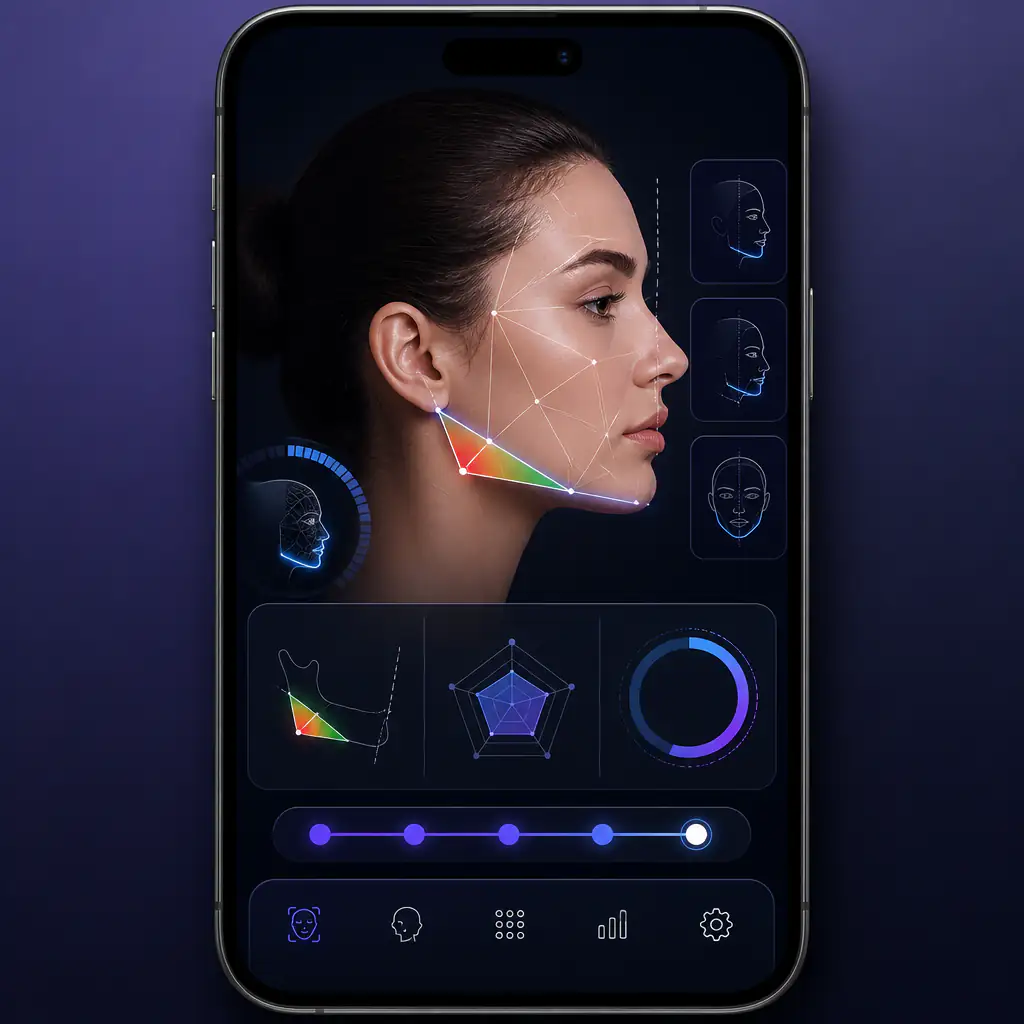
What Jawline Analysis Actually Measures
When people search for mewing exercises for jawline improvement, they often skip a critical first step: understanding what their jaw currently looks like in measurable terms. A jawline is not just “strong” or “weak.” It is defined by several distinct traits that can be identified and tracked.
The gonial angle is the angle formed where the jaw body meets the ascending ramus. Research in facial attractiveness consistently shows that lower gonial angles (roughly 120 to 130 degrees) tend to be associated with a more defined, angular jaw. A higher angle creates a softer, rounder lower face. Knowing your gonial angle tells you what you are working with before you invest time in any exercise routine.
The face-width-to-height ratio (FWHR) measures the ratio of bizygomatic width (cheekbone to cheekbone) to the height of the middle face. FWHR meaning has been studied in psychology and evolutionary biology as a marker of perceived dominance and sexual dimorphism. A higher FWHR is generally associated with a broader, more masculine midface. This number, combined with your jaw shape, gives a much clearer picture than any single measurement alone.
Jaw shapes also vary significantly. Some people have square jaws, others have tapered or oval shapes, and others fall into categories sometimes described as V-shaped or round. Different jaw shapes respond differently to soft-tissue and bone-remodeling stimuli, which is why a one-size-fits-all mewing routine often produces inconsistent results.
Mewing and Jawline Improvement: What the Evidence Says
Mewing refers to the practice of resting the entire tongue against the roof of the mouth (the palate) as a default posture. The concept was popularized by orthodontist John Mew, who proposed that improper tongue posture contributes to mid-face recession and poor jaw development over time.
Research on mewing is still limited, and most studies focus on orthodontic appliances rather than tongue posture alone. That said, some practitioners and researchers suggest that consistent proper oral posture may influence soft-tissue positioning and, in younger individuals whose bones are still developing, potentially contribute to wider palate development. In adults, the effects are more modest and primarily involve muscle tone and soft-tissue appearance.
The most evidence-backed mewing exercises for jawline definition include:
- Full tongue-palate contact: Pressing the back third of the tongue against the soft palate is considered the complete version of proper tongue posture. Many people only press the tip, which provides less stimulus.
- Chin tucks: Pulling the chin back while keeping the jaw level engages the submental muscles and may improve the neck-to-jaw angle over time.
- Chewing resistance training: Using harder foods or specialized chewing tools may increase masseter muscle size, creating a wider-looking jaw in some individuals.
- Swallowing pattern correction: Mewing proponents argue that correcting a tongue-thrust swallow pattern reduces inward pressure on the dental arch over thousands of daily swallows.
None of these practices should replace professional orthodontic or medical advice. If you suspect a significant jaw misalignment or bite issue, consult a qualified dental or medical professional before attempting self-directed correction.
How to Increase Jawline Definition: Practical Starting Points
Beyond mewing, several other factors influence how defined the jaw appears:
Body fat percentage has one of the strongest short-term effects. As overall body fat drops, facial fat around the jowls and submandibular area decreases, making existing bone structure more visible. For many people, this produces more visible jawline improvement than any exercise.
Neck and posture training matters because a forward head posture compresses the neck and obscures the jaw angle. Strengthening the deep neck flexors and improving posture can change how the jaw reads visually without any change to the jaw itself.
Sleep position is often overlooked. Consistently sleeping on one side can contribute to asymmetric masseter development or soft-tissue asymmetry over time. Some practitioners recommend back sleeping.
How Aura’s Jawline Analyzer Fits Into This
Aura measures your jaw shape, estimates your gonial angle from your photo, calculates your FWHR, and classifies your jaw category. From there, the app generates a prioritized plan based on your actual numbers rather than averages.
For example, someone with a high gonial angle and low FWHR gets different exercise priorities than someone with a near-ideal gonial angle who primarily needs to reduce facial fat to reveal existing structure. The distinction matters because mismatched advice wastes time.
Some users use the jawline analyzer alongside Aura’s broader PSL scoring and hunter-eye detection tools to build a complete picture of their facial structure and track changes over weeks and months. Progress photos can be re-analyzed at any point to see if measurements have shifted.
Realistic Expectations
Jawline improvement through non-surgical means is a slow process. Most people who report visible changes from mewing exercises and posture work describe timelines of six months to several years. Adults see more modest changes than adolescents due to reduced bone plasticity. The exercises are most useful when combined with body composition improvements and consistent posture habits.
If you are considering surgical options such as jaw implants, genioplasty, or orthognathic surgery, speak with a board-certified maxillofacial or plastic surgeon before making any decisions. Aura’s analysis is a useful reference point for self-education, not a substitute for clinical evaluation.