 Aura: Looksmaxxing
 Wide vs Narrow Palate: What It Means for Your Face
Learn the key differences between a wide vs narrow palate, how each affects facial aesthetics, breathing, and what you can do about it.
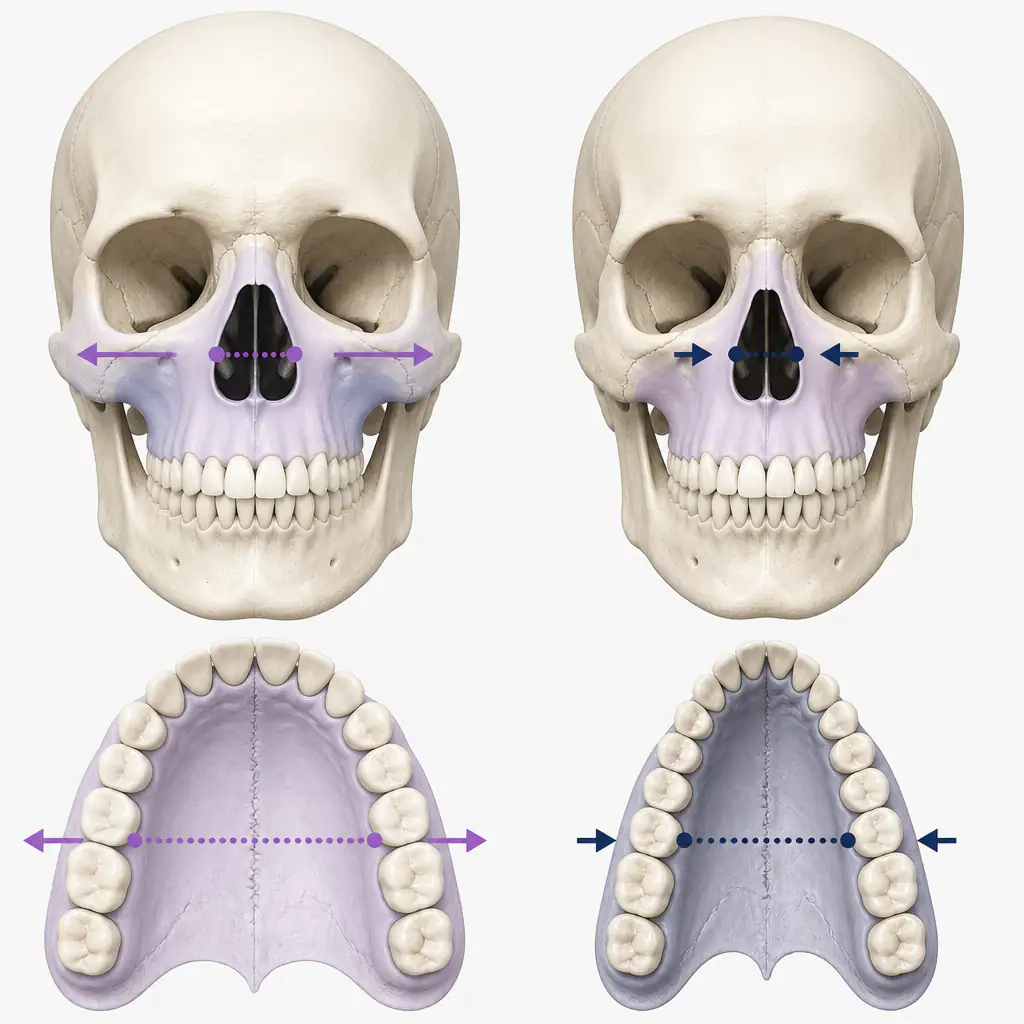
Your palate, the bony roof of your mouth, does far more than separate your oral and nasal cavities. Its width directly influences the shape of your midface, the width of your nose, the position of your teeth, and even how well you breathe at night. Most people never think about it until an orthodontist brings it up, but palate width is one of the foundational variables in facial structure.
This guide breaks down what separates a wide palate from a narrow one, what each looks like in the face, and what options actually exist if you want to change things.
What Is the Palate and Why Does Width Matter?
The palate has two parts. The hard palate is the bony shelf at the front and middle of your mouth, formed primarily by the maxillary bones. The soft palate is the muscular tissue at the back. When people talk about palate width in the context of facial structure or orthodontics, they almost always mean the hard palate, specifically the transverse (side-to-side) dimension of the maxilla.
The maxilla is arguably the most important bone in facial aesthetics. It forms the upper jaw, the base of the nose, the floor of the eye sockets, and the midface projection. Its width, how broad or narrow it is from left to right, determines a surprising number of things:
- How wide your dental arch is
- Whether your upper teeth fit over your lower teeth properly
- The internal volume of your nasal cavity
- The width of the base of your nose
- The overall breadth of your midface
A palate that is too narrow tends to compress everything inward. A palate with sufficient width gives the face a more open, balanced appearance.
Signs of a Narrow Palate
A narrow palate (sometimes called a high-arched palate, because when width is compressed, the arch grows taller and more domed) typically produces several recognizable features.
Dental and Oral Signs
- Crowded teeth, because there is not enough arch length for all teeth to erupt in alignment
- A crossbite, where upper teeth sit inside the lower teeth on one or both sides instead of outside them
- A high, domed arch shape when you look at the roof of your mouth
- A narrow dental arch that looks like a V-shape rather than a U-shape
Facial and Aesthetic Signs
- A midface that appears pinched or compressed from the front
- A narrower nose base
- Visible crowding or protrusion of front teeth affecting lip posture
- In some cases, a longer, narrower face shape overall
Functional Signs
This is where narrow palates create real, measurable problems. A narrow palate reduces the volume of the nasal cavity, which sits directly above it. Research suggests this contributes to:
- Mouth breathing, because nasal airway resistance is higher
- Sleep-disordered breathing and, in more severe cases, obstructive sleep apnea
- Chronic nasal congestion that is structural rather than allergy-related
If you have always been a mouth breather without a clear allergic cause, your palate width may be part of the picture.
Signs of a Wide Palate
A wide palate generally means the maxilla has adequate or above-average transverse dimension. This tends to produce:
- A broad, U-shaped dental arch with room for teeth to align naturally
- Proper overjet and overbite (upper teeth fitting correctly over lower teeth)
- A wider nose base
- A fuller, more projected midface from the front view
- Better nasal airway volume and easier nasal breathing
In facial aesthetics, a broad midface is generally considered attractive because it creates forward projection and structural width that balances the rest of the face. This is part of why mewing and palate expansion have attracted so much attention in the looksmaxxing space.
That said, a palate can theoretically be too wide relative to the lower jaw, creating its own occlusal problems. Width needs to be proportional, not just maximal.
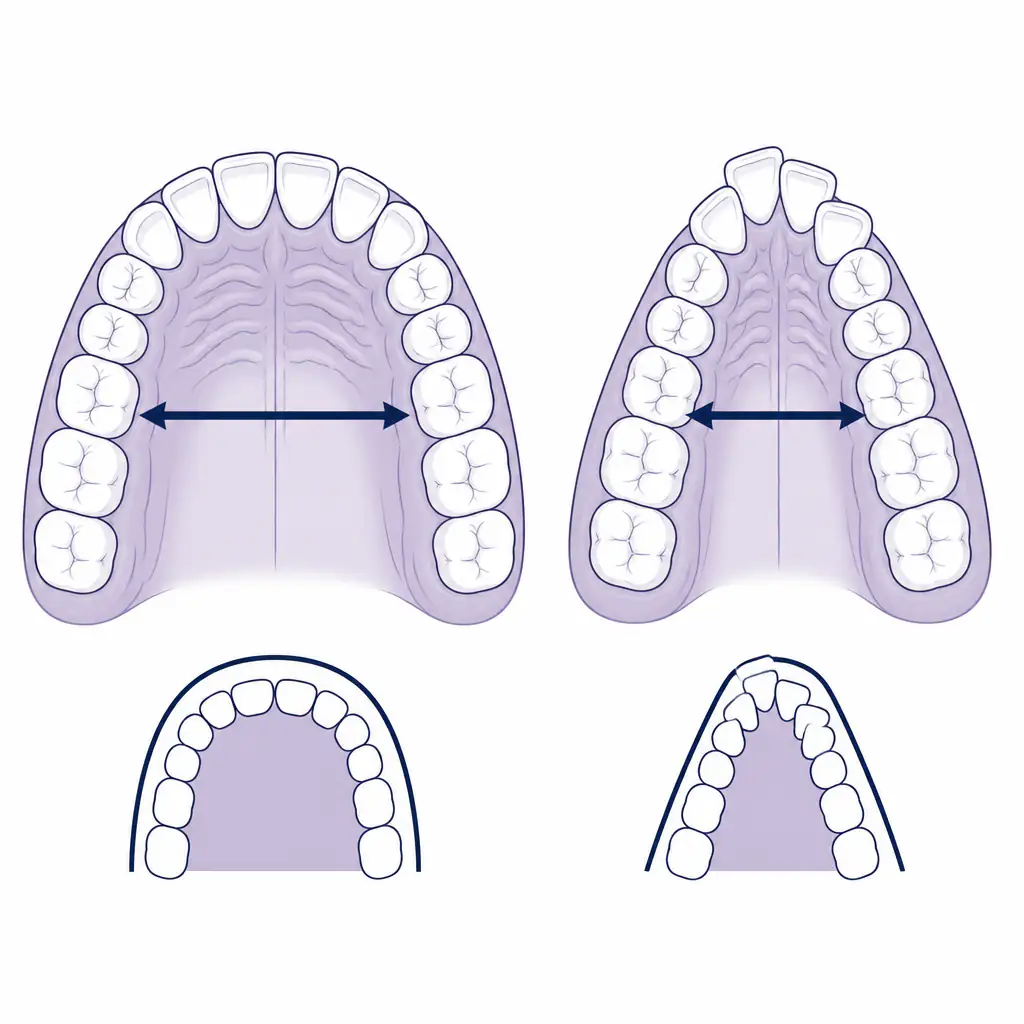
Wide vs Narrow Palate: Side-by-Side Comparison
| Feature | Narrow Palate | Wide Palate |
|---|---|---|
| Arch shape | V-shaped, high dome | U-shaped, flatter arch |
| Dental crowding | Common | Rare |
| Crossbite risk | High | Low |
| Nasal airway volume | Reduced | Normal to good |
| Nose base width | Narrower | Broader |
| Midface appearance | Pinched or elongated | Fuller, broader |
| Mouth breathing tendency | More common | Less common |
| Sleep quality impact | Potentially negative | Neutral to positive |
| Typical intervention needed | Expansion (palatal expander, MARPE, surgery) | Often none |
What Causes a Narrow Palate?
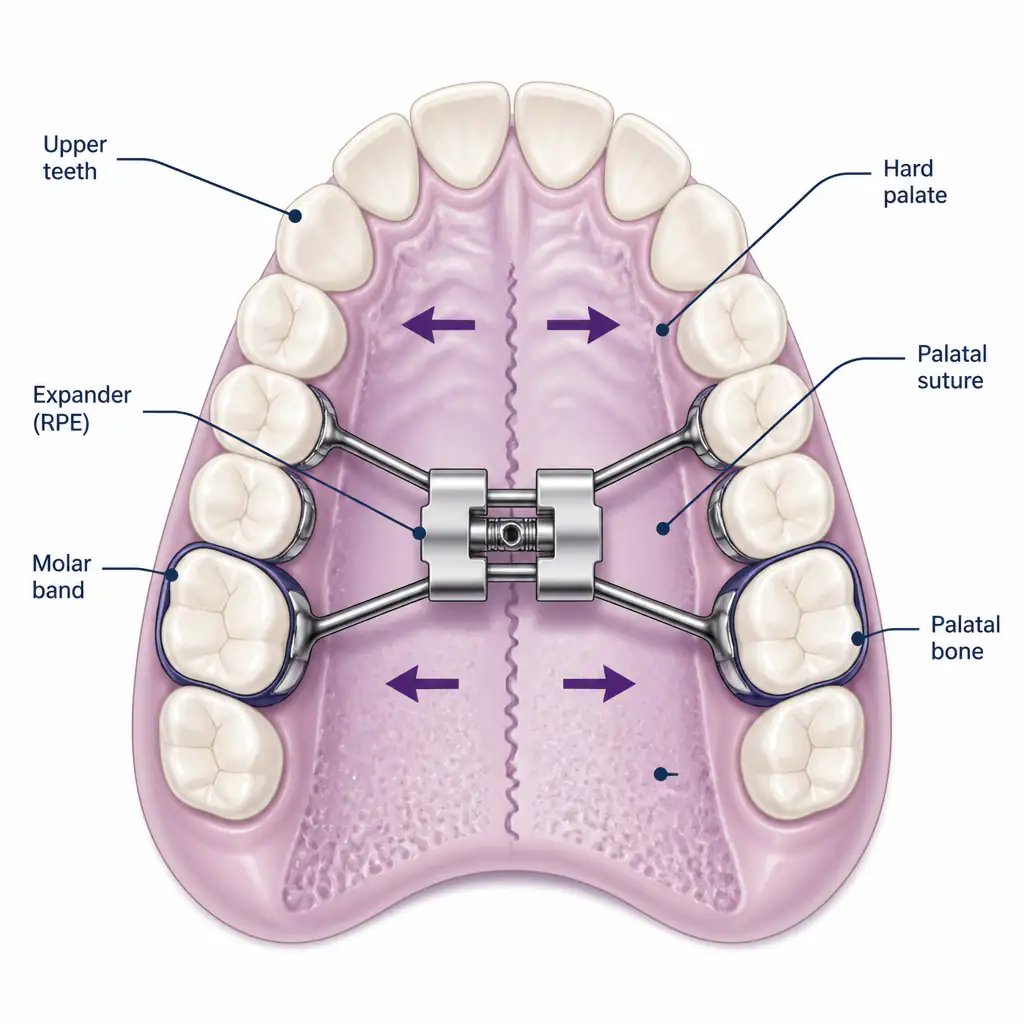
Palate width is determined by a mix of genetics and early developmental habits. The palate forms and fuses in stages, with the mid-palatal suture (the growth plate running down the middle of the hard palate) remaining open and responsive to pressure during childhood and into adolescence.
Key contributing factors include:
- Genetics: Maxillary width is heritable. If one or both parents have a narrow arch, the likelihood increases.
- Mouth breathing in childhood: Nasal breathing creates gentle upward and outward pressure from the tongue on the palate. Mouth breathers lose this stimulus, and the palate tends to narrow over time.
- Thumb sucking or prolonged pacifier use: These habits can alter the shape of the developing arch.
- Early loss of baby teeth: Can cause arch collapse before the adult teeth erupt.
- Tongue posture (mewing): Proper tongue-to-palate contact may support palate width during development. This is why tongue posture has become a significant topic in facial development discussions.
In adults, the mid-palatal suture is fused or nearly fused (typically by the mid-twenties, though the timeline varies), which is why expansion becomes progressively more complex with age.
Can You Change Palate Width?
This depends heavily on age and the degree of narrowing.
In Children and Adolescents
The mid-palatal suture is still open, making expansion relatively straightforward. A rapid palatal expander (RPE) is a fixed appliance attached to the upper molars that applies lateral pressure to gradually widen the palate. Treatment usually takes three to six months, followed by a retention period. Results are stable and well-documented. This is one of the most effective orthodontic interventions available.
In Older Adolescents and Young Adults
As the suture begins to interdigitate (the bone edges become interlocked), conventional RPEs become less effective. Surgically assisted rapid palatal expansion (SARPE) involves a minor surgical procedure to release the suture before applying expander forces. This approach extends the window for non-surgical expansion into the mid-twenties for some patients.
In Adults
For fully fused sutures, the most reliable option is MARPE (miniscrew-assisted rapid palatal expansion). This uses small titanium screws anchored directly into the palatal bone to apply force without relying on the teeth. Research on MARPE in adults is still accumulating, but results in younger adults (late twenties and early thirties) are generally promising. Outcomes vary with age and individual bone density.
For severe skeletal discrepancies, Le Fort I osteotomy (a form of orthognathic surgery that repositions the maxilla) combined with surgically assisted expansion is the most definitive approach.
Talk to a qualified orthodontist or oral and maxillofacial surgeon before considering any of these procedures. The right intervention depends on your age, the degree of narrowing, your occlusion, and your airway anatomy. There is no one-size-fits-all protocol.
Mewing and Palate Width: What the Evidence Says
Mewing refers to maintaining proper tongue posture, specifically resting the entire tongue flat against the palate rather than letting it drop to the floor of the mouth. The theory is that sustained tongue pressure supports and potentially widens the palate, particularly in younger individuals whose sutures are still active.
The evidence here is nuanced. In children and adolescents, there is reasonable support for the idea that tongue posture influences arch shape. In adults with fused sutures, the mechanical argument for significant structural change is weaker, since bone remodeling requires forces beyond what the tongue can generate against fused bone.
That said, proper tongue posture does support nasal breathing, which has well-documented benefits for airway health. For adults, mewing is unlikely to dramatically expand a narrow palate, but it is also unlikely to cause harm and may support facial muscle tone and posture.
If you are unsure where your own facial structure stands and want an objective look at your midface width, jawline proportion, and overall facial balance, Aura provides AI-based facial analysis that can give you a concrete starting point before you decide whether professional intervention is worth pursuing.
Practical Tips Based on Your Situation
If You Are Under 18
- See an orthodontist for an evaluation. This is the optimal window for palate expansion with minimal intervention.
- Address mouth breathing with an ENT if needed. Enlarged adenoids or turbinate hypertrophy may be correctable and will support better tongue posture and nasal breathing.
- Focus on establishing correct tongue posture and nasal breathing habits now, when they have the most structural influence.
If You Are 18 to 30
- Get a CBCT (cone beam CT) scan, which shows the suture status and bone density in 3D. This tells you and your provider what is actually possible.
- Ask specifically about MARPE as an option before assuming nothing can be done.
- If crowding or crossbite is affecting your bite, orthodontic correction is worthwhile regardless of palate width changes.
If You Are Over 30
- Surgical options (SARPE or orthognathic surgery) are available but involve more commitment in terms of recovery and cost.
- Focus on what is controllable: nasal breathing, tongue posture, sleep quality, and overall facial muscle use.
- Cosmetic orthodontics can address dental alignment without changing bone.
For Everyone
- Prioritize nasal breathing. This is the single most accessible habit change with documented health benefits.
- If you snore heavily or feel unrefreshed after sleep, ask a doctor about a sleep study. Narrow-palate-related airway restriction is treatable.
- Use a tool like Aura to track changes in facial structure objectively over time if you are working on long-term improvement.
Palate Width and Overall Facial Aesthetics
It is worth stepping back and noting that palate width is one variable among many. Facial attractiveness research consistently points to a combination of factors including symmetry, forward projection, skin quality, and proportionality. A wide palate contributes to midface breadth and nasal volume, which are positive attributes, but they exist within a larger picture.
People with naturally narrow palates often have other strong features that balance the face. And people with structurally broad maxillas can still have other areas worth addressing. The goal is to understand your own anatomy clearly, make informed decisions about what is worth pursuing, and avoid chasing interventions based on idealized templates that may not suit your individual proportions.
Frequently asked questions
How do I know if I have a narrow palate? +
Look at the roof of your mouth in a mirror. A narrow palate typically appears high and domed, with a V-shaped arch rather than a broad U-shape. Crowded teeth, a crossbite, or a history of mouth breathing are also common indicators. An orthodontist can confirm this with a clinical exam or imaging.
Can adults expand their palate without surgery? +
For adults with partially or fully fused mid-palatal sutures, conventional expanders are generally ineffective. MARPE (miniscrew-assisted rapid palatal expansion) is a non-surgical option that has shown results in younger adults, typically those in their late twenties. A CBCT scan is needed to assess whether the suture is still amenable to expansion. Talk to a qualified orthodontist or oral surgeon to determine what is appropriate for your specific anatomy.
Does a narrow palate affect breathing? +
Yes, it can. The nasal cavity sits directly above the hard palate, so a narrow maxilla reduces the internal volume of the nasal airway. This increases nasal resistance, which may contribute to mouth breathing, nasal congestion, and in some cases sleep-disordered breathing. Research suggests that palate expansion in appropriate candidates can improve nasal airflow.
Does mewing widen the palate in adults? +
The evidence for significant palate widening through mewing in adults is limited. Once the mid-palatal suture is fused, tongue pressure alone is unlikely to produce measurable transverse expansion. However, proper tongue posture supports nasal breathing habits and may contribute to facial muscle tone and posture over time. For structural changes in adults, professional intervention is more reliable.