 Aura: Looksmaxxing
 Forward vs Downward Growth: What It Means for Your Face
Learn how forward vs downward facial growth shapes your jawline, cheekbones, and overall attractiveness, plus what you can do about it.
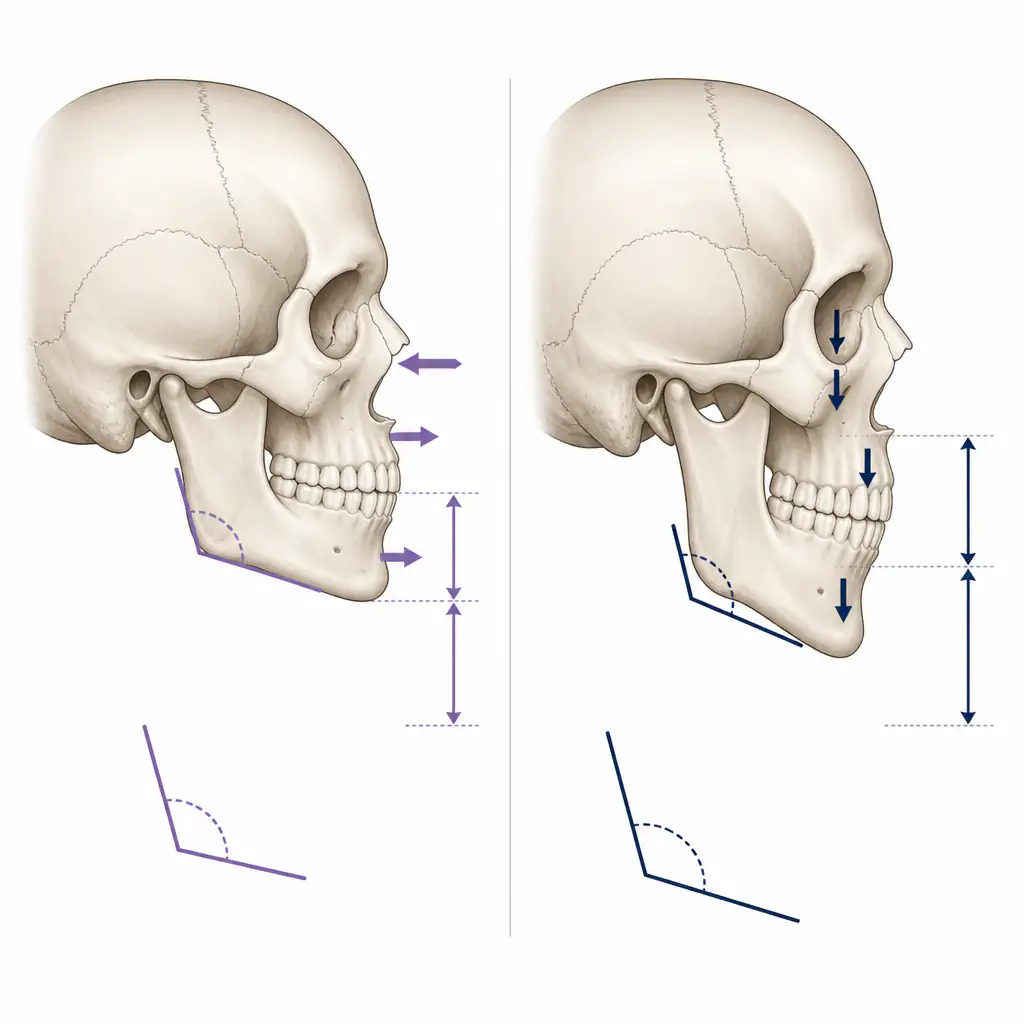
The direction your face grew during development has more influence on how you look than most people realize. Two people with the same genetics can end up with noticeably different faces depending on one variable: whether their facial bones grew primarily forward (anteriorly) or downward (vertically).
This is not a niche concept. Orthodontists, maxillofacial surgeons, and researchers have studied facial growth vectors for decades because they affect breathing, bite function, and yes, aesthetics. Understanding forward vs downward growth gives you a clearer picture of your own face and what, if anything, you can realistically work with.
What Facial Growth Direction Actually Means
During childhood and adolescence, the bones of the face, specifically the maxilla (upper jaw), mandible (lower jaw), and surrounding structures, grow along vectors. A vector is simply a direction and magnitude. Facial growth is never purely in one direction, but the dominant vector shapes the final result significantly.
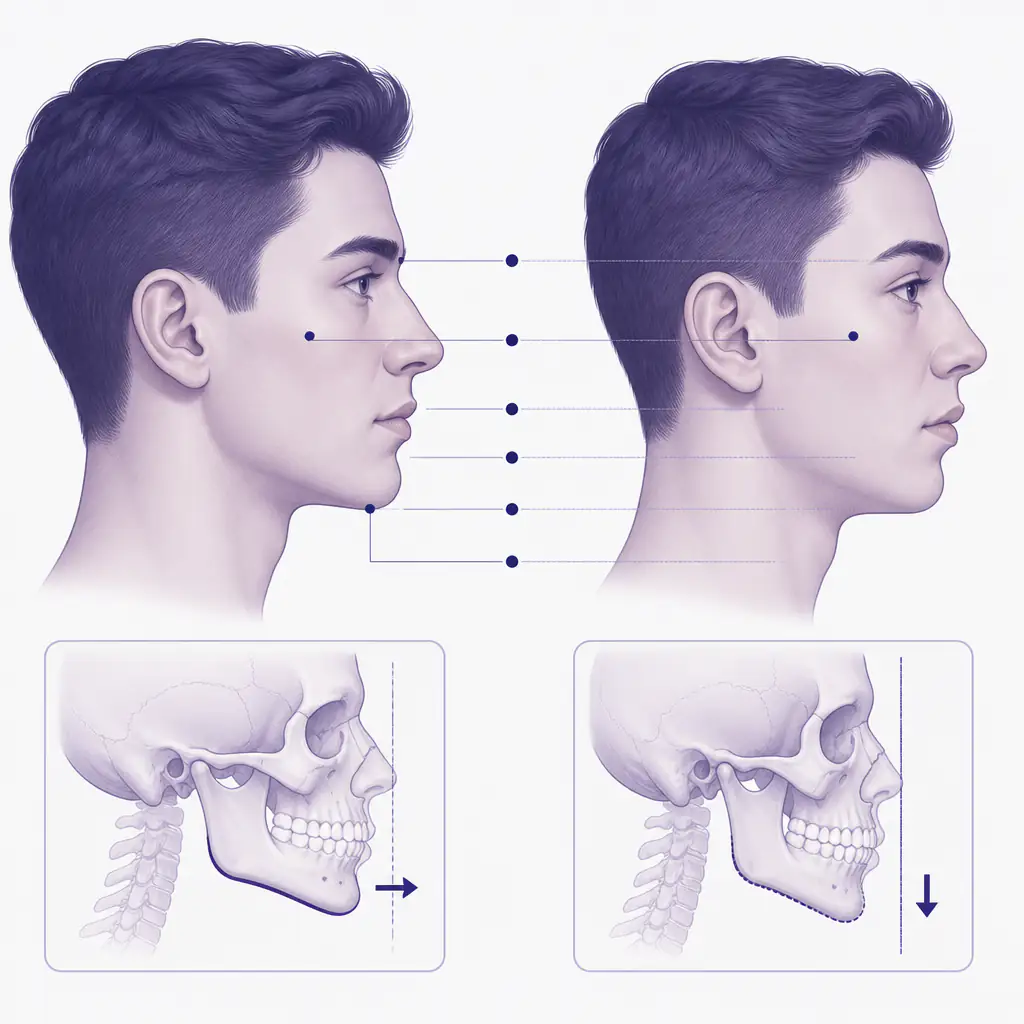
- Forward growth (anterior rotation): The face grows more horizontally. The chin comes forward, the jaw closes with a tighter angle, and the midface tends to be compact and projected.
- Downward growth (posterior rotation or vertical growth): The face grows more vertically. The lower jaw drops away from the skull at a steeper angle, the face appears longer, and the chin sits further back relative to the forehead.
Craniofacial researchers measure this using the gonial angle, which is the angle formed at the back of the jaw where the ramus (vertical part) meets the body (horizontal part) of the mandible. A smaller gonial angle generally signals forward growth. A larger, more open gonial angle signals vertical, downward growth.
The Aesthetic Difference Between the Two
This is where it gets practical. Forward and downward growth patterns produce very different facial appearances, and most people can identify them intuitively once they know what to look for.
Forward Growth Characteristics
- Defined, projected chin
- Strong, angular jawline visible from the front and side
- Compact midface with the nose sitting closer to the eyes
- Prominent cheekbones that do not appear sunken
- Naturally closed lips at rest (teeth come together without strain)
- Deep-set or more horizontal eye area
Forward growth tends to produce what is often described as a more structured or masculine appearance in men, and a well-defined oval or heart-shaped face in women. The face looks like it is built outward rather than pulled downward.
Downward Growth Characteristics
- Longer lower third of the face (between the nose and chin)
- Recessed or weak chin relative to the nose and forehead
- Open bite tendencies, meaning the teeth do not meet cleanly
- Narrower palate and possibly crowded teeth
- Visible strain when closing the lips at rest
- Flatter cheekbones, more prominent nasolabial area
- Eyes that appear more exposed or “round” due to orbital rim position
Downward growth is also associated with mouth breathing during development, which is one reason researchers and clinicians take it seriously beyond aesthetics alone.
Why Growth Direction Diverges
Facial growth direction is influenced by a combination of genetics, mechanical forces, and environmental factors during development. It is not purely predetermined at birth.
Genetic factors set a baseline. Your skeletal growth pattern broadly follows your parents’ craniofacial structure. If both parents have forward-grown, compact faces, you are statistically more likely to follow suit.
Mechanical forces during development shape how those genetic instructions express. The pressure and direction of muscles, tongue posture, and bite forces all influence bone remodeling. The tongue resting against the palate generates upward and forward force on the maxilla. When this is absent, because of chronic mouth breathing or low tongue posture, vertical growth may become dominant.
Airway function plays a documented role. Enlarged tonsils or adenoids in childhood can force mouth breathing, which changes the resting posture of the jaw and tongue, shifting the growth vector downward. This is not speculation; orthodontic literature has tracked these patterns for decades.
Chewing load matters too. Harder, more fibrous diets require more masticatory (chewing) force, and research in populations with such diets shows broader palates and more forward-grown faces on average compared to populations consuming soft, processed food.
How to Identify Your Own Growth Pattern
You do not need an X-ray to get a rough sense of your facial growth direction, though a lateral cephalometric radiograph (a standardized side-view skull X-ray) is the definitive tool professionals use.
For a practical self-assessment, look at a clear side-profile photo and consider the following:
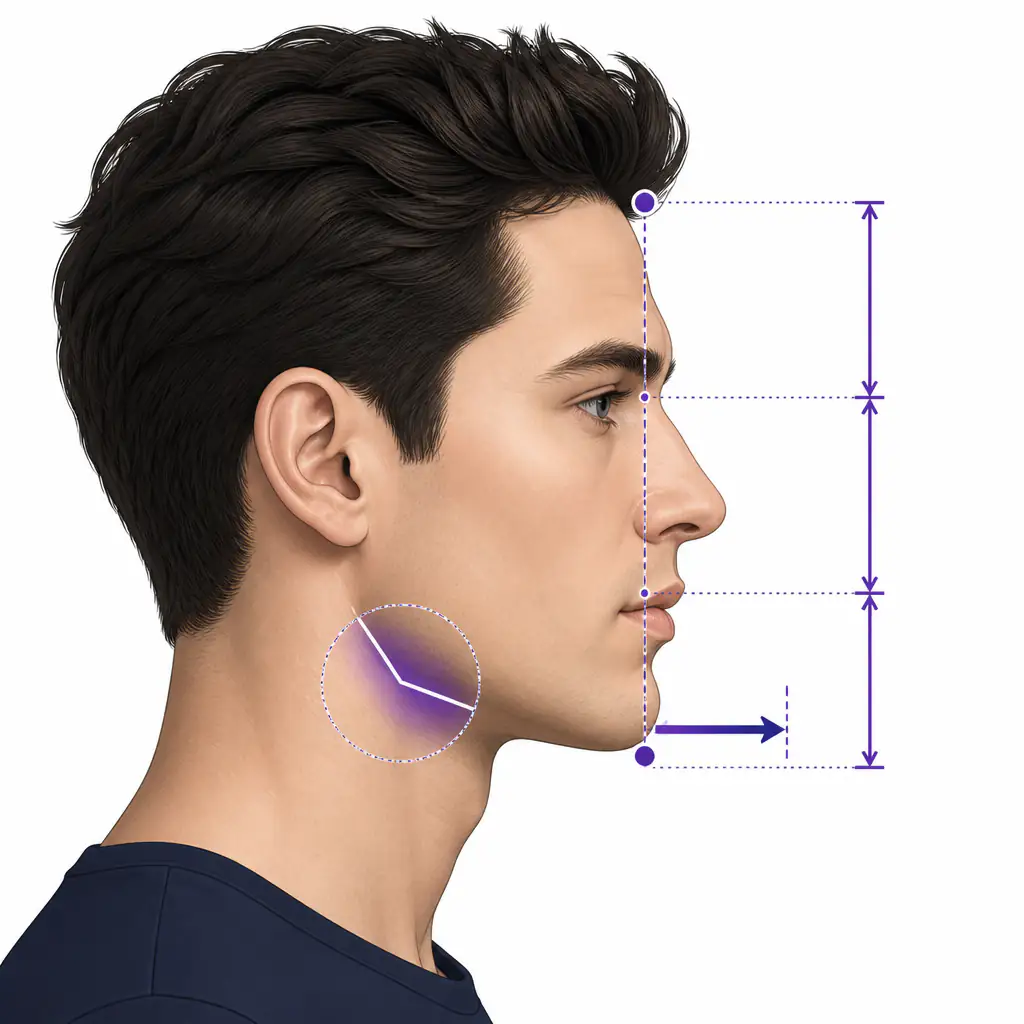
- Lower third proportion: Is the distance from your nose base to your chin roughly equal to the distance from your eyebrows to the nose base? If your lower third is significantly longer, vertical growth is likely dominant.
- Chin projection: Does your chin sit forward of your nose when viewed from the side, roughly in line with it, or noticeably behind it?
- Lip closure: Can you close your lips without any muscular strain or effort?
- Jaw angle visibility: From a three-quarter view, is there a visible angle where your jaw turns from vertical to horizontal near the ear?
For a more structured analysis of your facial proportions, including jawline definition and midface structure, Aura provides an AI-based assessment that breaks down these features with specific scores, which can help you identify where your face sits on the forward-to-vertical spectrum before deciding on any interventions.
Forward vs Downward Growth: Side-by-Side Comparison
| Feature | Forward Growth | Downward Growth |
|---|---|---|
| Gonial angle | Smaller (more acute) | Larger (more open) |
| Chin position | Projected forward | Recessed or dropped |
| Lower face length | Shorter, compact | Longer, elongated |
| Jaw definition | Sharp, angular | Softer, less defined |
| Palate width | Typically broader | Often narrower |
| Lip closure | Effortless | May require strain |
| Tooth contact | Full occlusion | Open bite risk |
| Associated habits | Nasal breathing | Mouth breathing |
Can You Influence Facial Growth?
The honest answer depends heavily on age. During active growth (childhood through mid-adolescence), there is meaningful clinical evidence that interventions can shift growth direction. After growth plates close, typically in the late teens for most people, the skeleton is largely set.
During Development
Orthodontic and orthopedic appliances like the Herbst appliance, palatal expanders, and myofunctional therapy are used with the specific goal of redirecting growth. These are legitimate clinical tools with documented outcomes. If you are a parent of a child showing early vertical growth patterns, consulting a craniofacial orthodontist early is worth doing.
Myofunctional therapy, which retrains tongue posture and nasal breathing habits, is also used during development and has some supporting research for its role in promoting more favorable growth patterns.
In Adulthood
For adults, the underlying bone structure is not going to change from habit adjustments alone. However, several approaches may improve the visual appearance of the face within the existing structure:
- Mewing (proper tongue posture): Some adults report subtle changes with consistent practice. The evidence in adults is limited and largely anecdotal. It will not restructure bone, but maintaining correct tongue posture supports posture and muscle tone around the jaw.
- Masseter hypertrophy: Consistent chewing of harder foods or using chewing tools may increase masseter (jaw muscle) size, adding width and definition to the lower face.
- Body fat reduction: A lower body fat percentage reveals existing jaw definition that may be obscured by subcutaneous fat.
- Surgical options: Orthognathic surgery (jaw surgery) can physically reposition the maxilla and mandible. Chin implants and genioplasty (surgical chin advancement) address chin projection directly. These are significant procedures requiring specialist evaluation.
If you are considering any surgical or clinical route, talk to a qualified maxillofacial surgeon or craniofacial specialist before making any decisions. Results depend heavily on your individual anatomy, and no outcome can be guaranteed.
Practical Steps Based on Your Situation
Here is a grounded approach depending on where you are:
If you are still in your teens:
- Prioritize nasal breathing at all times, including during sleep. Address any airway obstruction with a medical professional.
- Maintain proper tongue posture (tongue flat on the roof of the mouth, lips closed, teeth lightly together).
- Consider a consultation with an orthodontist who specializes in growth guidance if you notice significant vertical growth patterns.
- Eat foods that require real chewing as a regular part of your diet.
If you are an adult:
- Assess your baseline honestly using a clear side profile and three-quarter-view photo.
- Optimize what is within reach: body composition, masseter development, posture.
- Research surgical options only if the concern is significant and functional, not just aesthetic, and always consult a specialist.
- Use objective tools to track changes. Running a periodic facial analysis through Aura can give you measurable feedback on jawline definition and facial proportions over time, which is more reliable than subjective self-assessment.
The Bigger Picture
Forward vs downward growth is a real structural difference with real aesthetic consequences. Understanding it moves you away from vague dissatisfaction with your appearance and toward specific, accurate knowledge about your facial anatomy.
Forward growth is generally considered more favorable from both an aesthetic and functional standpoint, but downward growth is also common and does not define a ceiling on how you look. Soft tissue, body composition, grooming, and muscle development all interact with underlying structure in ways that matter.
Knowing your growth pattern is the first step toward making informed decisions rather than chasing interventions that do not address your actual situation.
Frequently asked questions
What is the difference between forward and downward facial growth? +
Forward growth means the face developed more horizontally, producing a compact structure with a projected chin, defined jaw angle, and strong midface. Downward growth means the face developed more vertically, resulting in a longer lower face, a more recessed chin, and a wider gonial angle. Both patterns affect aesthetics and function.
Can adults change their facial growth direction? +
No, adults cannot meaningfully redirect bone growth once the skeleton has matured. What adults can do is optimize soft tissue, muscle development, and body composition within their existing structure, or explore surgical options like orthognathic surgery or genioplasty for more significant changes. Always consult a qualified specialist before considering surgery.
Does mouth breathing cause downward facial growth? +
Research suggests a consistent link between chronic mouth breathing during childhood and more vertical facial growth patterns. Mouth breathing alters tongue posture and jaw position, which changes the mechanical forces acting on developing bone. Addressing airway issues early in development may help reduce the impact.
How do I know if I have forward or downward facial growth? +
A lateral cephalometric X-ray measured by an orthodontist is the definitive method. For a practical self-check, look at your side profile and assess your lower face length, chin projection relative to your nose, ease of lip closure, and visibility of your jaw angle. These give a reasonable indication without clinical tools.