 Aura: Looksmaxxing
 How to Grow Your Maxilla: What Actually Works
Learn how to grow your maxilla through mewing, chewing, posture, and orthodontic options. Practical steps backed by anatomy and research.
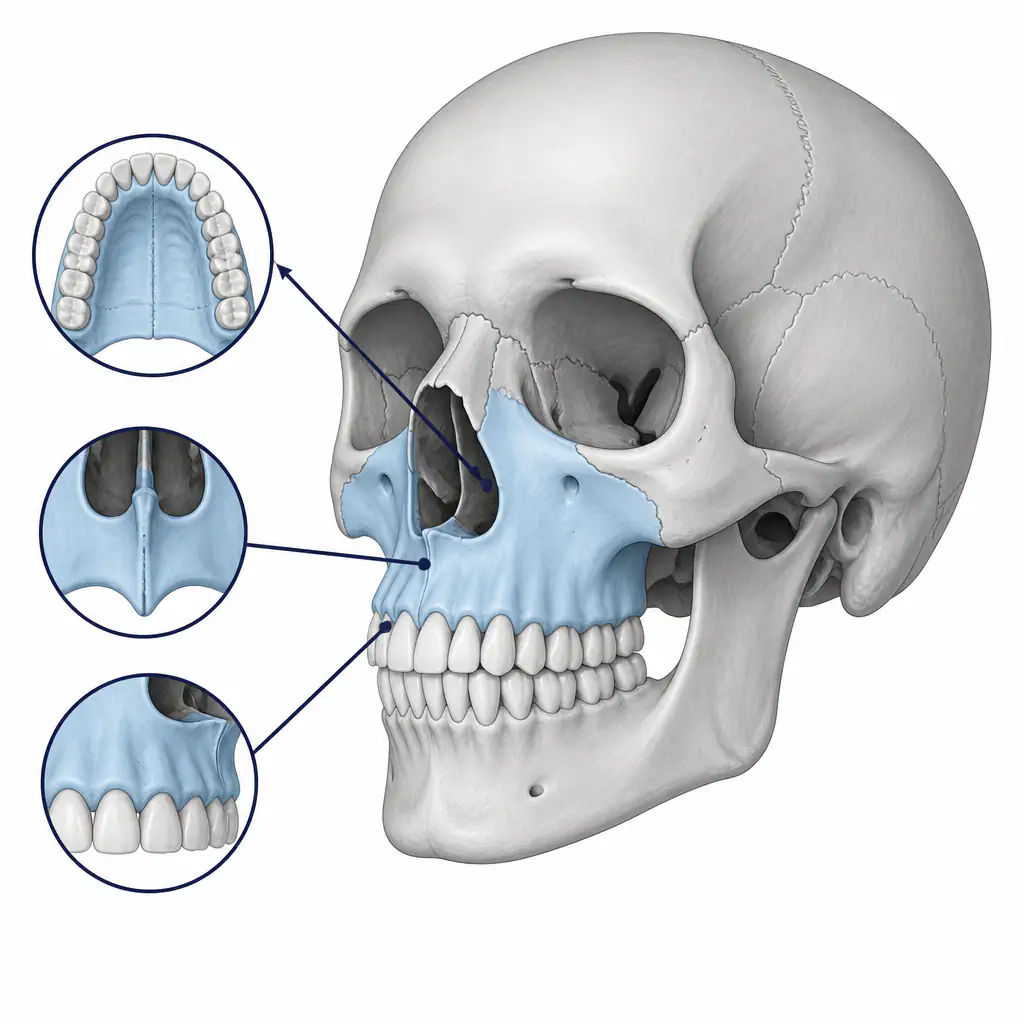
The maxilla is one of the most structurally important bones in your face. It forms your mid-face, supports your cheekbones, anchors your upper teeth, and defines the projection of your entire lower third. Yet most people have never thought about it consciously until they start noticing that their face looks flat, recessed, or undefined in photos.
If you have been searching for how to grow your maxilla, you are asking a legitimate anatomical question, not a vanity one. Maxillary development affects breathing, bite alignment, facial aesthetics, and even sleep quality. This guide covers what the research actually says, what you can realistically do at different life stages, and where professional intervention becomes necessary.
What the Maxilla Is and Why It Matters
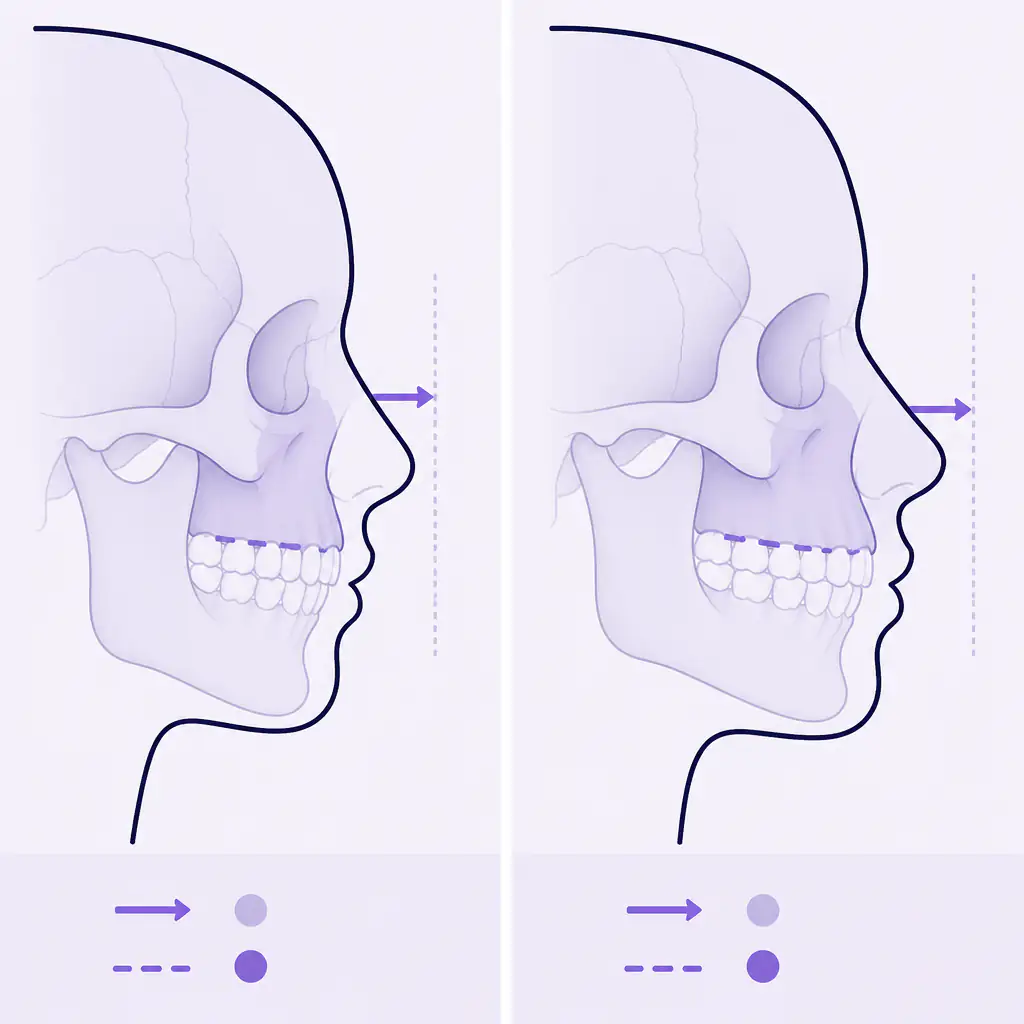
The maxilla is a paired bone (two halves fused at the midpalatal suture) that forms the upper jaw, the floor of the nasal cavity, and a significant portion of the orbital floor. When it is well-developed, it pushes the mid-face forward and upward, creating what is often described as strong cheekbone projection and a balanced profile.
When the maxilla is underdeveloped or recessed, the effects show up as:
- A flat or sunken mid-face
- Lack of cheekbone definition
- A long lower-third appearance
- Mouth breathing tendencies due to a narrow palate
- Crowded upper teeth
- A retruded, weak-looking profile even if the chin and jaw are otherwise decent
Maxillary growth is primarily driven during childhood and adolescence, but research suggests the midpalatal suture does not fully fuse until the mid-twenties in many individuals, and possibly later in some. This matters because it means certain interventions have more biological leverage at younger ages, while adults still have meaningful options.
Can Adults Actually Grow Their Maxilla?
This is the question most people really want answered. The honest answer is: it depends on what you mean by “grow.”
In children and teenagers, the maxilla responds readily to functional forces. Orthopedic appliances, correct oral posture, and nasal breathing can all influence the direction and extent of maxillary development during these years.
In adults, the sutures are largely fused, which limits orthopedic expansion through soft-tissue forces alone. However, several options still exist:
- Surgical expansion (SARPE or maxillary osteotomy) can physically move or widen maxillary bone in adults
- MARPE (Miniscrew-Assisted Rapid Palatal Expansion) uses implanted mini-screws to apply enough force to partially expand even a fused adult palate
- Correct oral posture may help maintain and optimize existing structure, particularly in younger adults
- Orthodontic treatment can reposition teeth and alter the perceived shape of the mid-face
If you are under 25, you have more biological options. If you are older, the realistic path involves orthodontic or surgical consultation rather than lifestyle changes alone.
Mewing and Oral Posture: The Foundation
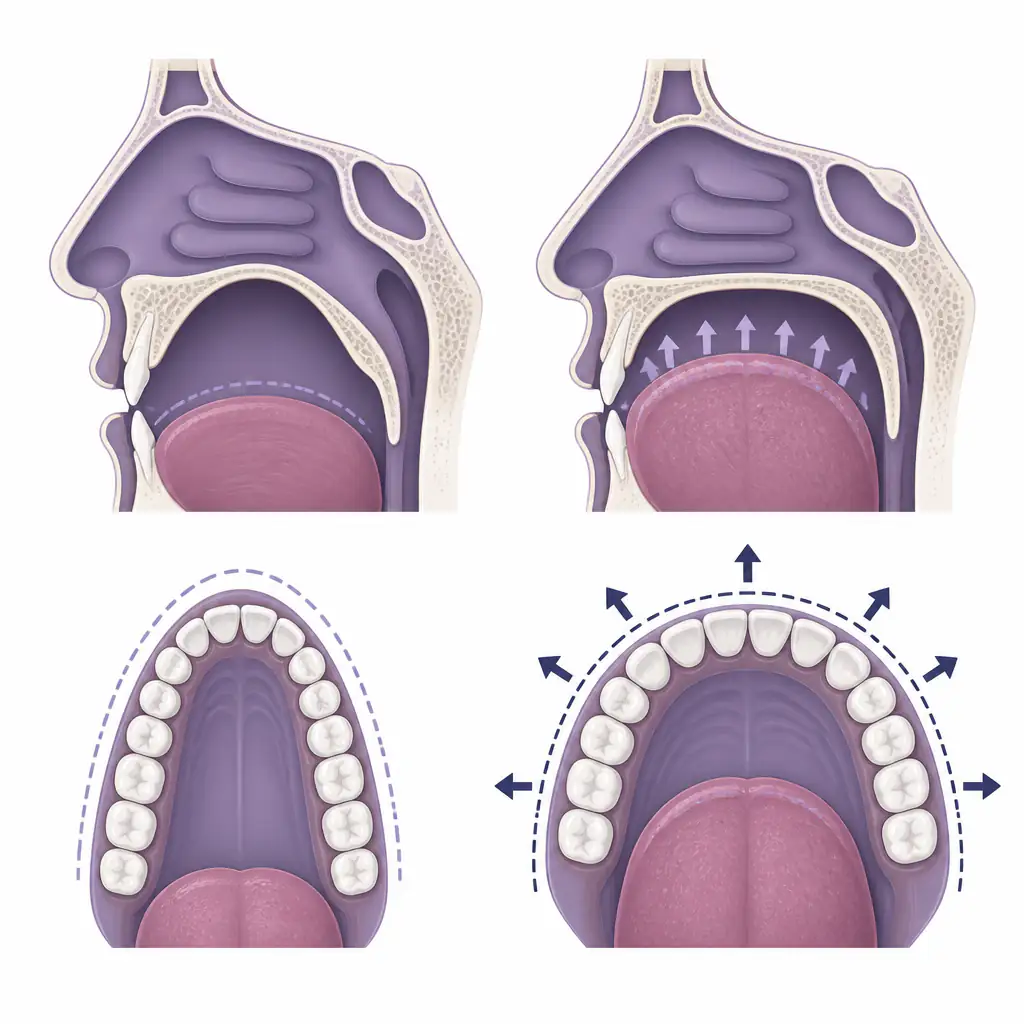
Mewing refers to the practice of resting the entire tongue flat against the roof of the mouth, keeping the lips closed, and breathing through the nose. It is based on the work of British orthodontist John Mew and his son Mike Mew, who argued that oral posture drives craniofacial development.
The theory is straightforward: the tongue exerts upward and forward pressure on the palate. Over time, this pressure may encourage the maxilla to develop forward and laterally rather than downward. Research on this is still developing, but the biomechanics are consistent with how bone remodeling works under sustained load.
How to Mew Correctly
- Full tongue contact. The entire tongue, including the back third, should rest against the palate. Most beginners only get the front portion up, which does little.
- Teeth lightly touching or slightly apart. Your back molars should be in or near contact. Your teeth should not be clenched.
- Lips sealed, breathing through the nose. Mouth breathing bypasses the tongue-palate contact entirely.
- Neutral head posture. Your ear should be stacked over your shoulder when viewed from the side. Forward head posture neutralizes much of the benefit.
- Consistent, not forced. This is a resting posture, not an exercise. Straining creates tension without added benefit.
Mewing is most likely to influence maxillary development in individuals whose sutures are still open, meaning teenagers and young adults. Some older adults report aesthetic changes over months to years, but controlled evidence for this group is limited. Approach it as a low-risk habit worth building, not a guaranteed fix.
Before going further, it is worth getting an objective look at your current facial structure. Tools like Aura can analyze your facial proportions, mid-face projection, and jawline definition, giving you a concrete baseline to track progress against rather than relying on subjective mirror checks.
Chewing and Masticatory Load
The maxilla, like all bone, responds to mechanical stress. Research on masticatory (chewing) forces shows that people who regularly chew harder foods tend to develop broader, more robust craniofacial structures. This effect is much stronger during development, but it does not switch off entirely in adulthood.
Practical Steps
- Eat harder, denser foods. Raw vegetables, tough cuts of meat, nuts, and hard fruits all require more jaw work than processed or soft foods.
- Chew on both sides evenly. Asymmetric chewing can lead to asymmetric muscle and bone development over time.
- Consider mastic gum. Mastic gum (from the Pistacia lentiscus tree) is significantly harder than regular gum and has been used in studies examining chewing muscle hypertrophy. Some users report improved masseter definition and a fuller mid-face appearance with consistent use.
- Avoid over-reliance on soft diets. Diets high in processed food reduce the mechanical demands on your jaw and palate, which may contribute to underdevelopment during critical growth windows.
This is not about extremes. You are not trying to injure your jaw. The goal is to restore the level of chewing load that a more natural diet would provide.
Nasal Breathing and Its Role in Maxillary Development
This point cannot be overstated. Chronic mouth breathing is one of the most well-documented contributors to poor maxillary development. When you breathe through your mouth, the tongue drops to the floor of the mouth, the palate receives no upward pressure, and the mid-face tends to grow downward and backward rather than forward.
Research in pediatric orthodontics consistently links mouth breathing with:
- Narrow, high-arched palates
- Retruded maxillary position
- Longer, narrower faces
- Increased prevalence of sleep-disordered breathing
If you have nasal obstruction, fixing it is arguably the single highest-leverage thing you can do for maxillary development and maintenance. Common culprits include:
- Deviated septum (requires ENT evaluation)
- Chronic allergies (manageable with antihistamines or immunotherapy)
- Enlarged turbinates (treatable with minor procedures)
- Nasal polyps (require medical treatment)
Switching to full nasal breathing, even if it takes weeks of conscious effort, changes the entire mechanical environment of your mid-face.
Orthodontic and Orthopedic Options
For those who want more than lifestyle optimization, orthodontic and orthopedic interventions offer measurable, structural results.
Palatal Expanders
A palatal expander applies lateral force to the two halves of the maxilla, gradually widening the palate. In children and early adolescents, this works by opening the midpalatal suture directly. The results are significant and relatively fast.
In adults, traditional expanders are far less effective because the suture is fused. This is where MARPE becomes relevant.
MARPE (Miniscrew-Assisted Rapid Palatal Expansion)
MARPE uses four small titanium mini-screws anchored directly into the palatal bone to apply expansion forces that exceed what soft tissue alone can transmit. Studies have shown successful suture opening in adults up to their mid-thirties and beyond in some cases. The procedure is performed by an orthodontist or oral surgeon and typically takes several months.
MARPE may help with:
- Widening a narrow palate
- Improving nasal airway volume
- Creating space for crowded teeth without extractions
- Enhancing overall mid-face width
Talk to a qualified orthodontist or oral and maxillofacial surgeon before considering any palatal expansion procedure. Individual anatomy, suture fusion status, and dental occlusion all affect whether you are a good candidate.
Orthognathic Surgery
For significant maxillary retrusion or vertical excess, orthognathic (jaw) surgery offers the most direct path to structural change. A Le Fort I osteotomy, for example, physically repositions the entire maxilla forward, upward, or downward depending on what correction is needed.
This is major surgery requiring general anesthesia, a recovery period of several weeks, and typically a combined effort from an oral surgeon and an orthodontist. Results are permanent and can be dramatic, but so is the commitment involved.
Again: consult a board-certified oral and maxillofacial surgeon if you are seriously considering this route. Do not make decisions based on online content alone.
Tracking Your Progress Realistically
One of the most common mistakes people make when working on their facial structure is relying on inconsistent mirror checks or subjective impressions. Lighting, angle, and time of day all distort your perception.
A better approach is to take standardized photos at regular intervals, ideally every 4 to 8 weeks, in consistent lighting, at a fixed distance, from the same angles (front, lateral profile, and three-quarter). This lets you compare actual changes rather than mood-dependent impressions.
For a more structured analysis, Aura uses AI to assess facial proportions including mid-face projection, cheekbone position, and jawline definition. Getting a scored baseline before you start any protocol gives you a reference point that is far more reliable than memory.
Lifestyle Factors That Support Bone Health
Bone remodeling requires the right raw materials. If you are deficient in key nutrients, even optimal mechanical loading will produce suboptimal results.
- Vitamin D3. Supports calcium absorption and bone mineralization. Most people in northern latitudes are deficient. Research suggests 2,000 to 4,000 IU daily is appropriate for many adults, but test your levels first.
- Vitamin K2. Directs calcium into bone rather than soft tissue. Often deficient in modern diets. Found in fermented foods and grass-fed animal products.
- Magnesium. Essential cofactor for bone matrix formation. Poorly absorbed from most processed foods.
- Adequate protein. Bone is approximately 30 percent protein by weight. Chronic under-eating or low protein intake impairs bone remodeling.
- Quality sleep. Growth hormone, which plays a role in bone maintenance and remodeling, is primarily secreted during deep sleep. Chronic sleep deprivation suppresses this.
None of these will move your maxilla forward on their own. But deficiencies actively limit how much your bone can respond to the right stimuli.
Setting Realistic Expectations
Maxillary development is a slow process, whether driven by posture, chewing habits, or even orthodontic appliances. Lifestyle changes like mewing and nasal breathing are measured in months to years, not weeks. Orthodontic treatment typically runs 12 to 24 months. Surgical changes are faster but carry the trade-offs of any surgery.
Age matters significantly. The younger you are, the more biological leverage you have. A 15-year-old who adopts correct oral posture and fixes chronic mouth breathing may see meaningful structural differences over two to three years. A 35-year-old doing the same will likely see modest soft-tissue and postural improvements, with more significant structural change requiring professional intervention.
Being honest with yourself about where you are starting from and what tools are appropriate for your age and anatomy is the most productive mindset you can bring to this.
Frequently asked questions
Can you grow your maxilla after 18? +
The midpalatal suture begins fusing in the late teens but may remain partially open into the mid-twenties. After that, lifestyle changes like mewing may help maintain and optimize structure, but significant skeletal change typically requires orthodontic interventions like MARPE or surgical options. Talk to an orthodontist to understand where you stand based on your specific anatomy.
How long does it take to see results from mewing? +
Most people who report visible changes from mewing describe a timeline of one to three years of consistent practice. Results vary significantly based on age, suture fusion status, and whether other factors like nasal breathing and chewing load are also being addressed. Younger individuals generally see faster and more pronounced changes.
What is the fastest way to improve maxillary projection? +
For adults, orthognathic surgery (specifically Le Fort I osteotomy) offers the most direct and significant improvement in maxillary projection. MARPE is a less invasive option that may widen the palate in adults under certain conditions. Lifestyle approaches are slower and more modest in their effects on established adult bone structure.
Does chewing gum actually help with maxilla development? +
Chewing hard gum, particularly mastic gum, increases masticatory muscle engagement and applies repetitive mechanical load to the jaw and palate. Research suggests this kind of load supports bone maintenance and may contribute to development during growth years. In adults, the effects are likely more muscular than skeletal, though consistent chewing habits may support the overall mechanical environment of the mid-face.