 Aura: Looksmaxxing
 Sharpened Canine Teeth: Smile Aesthetics Guide
Learn how sharpened canine teeth affect your smile width, palate shape, and overall facial aesthetics. Practical tips for a better smile.
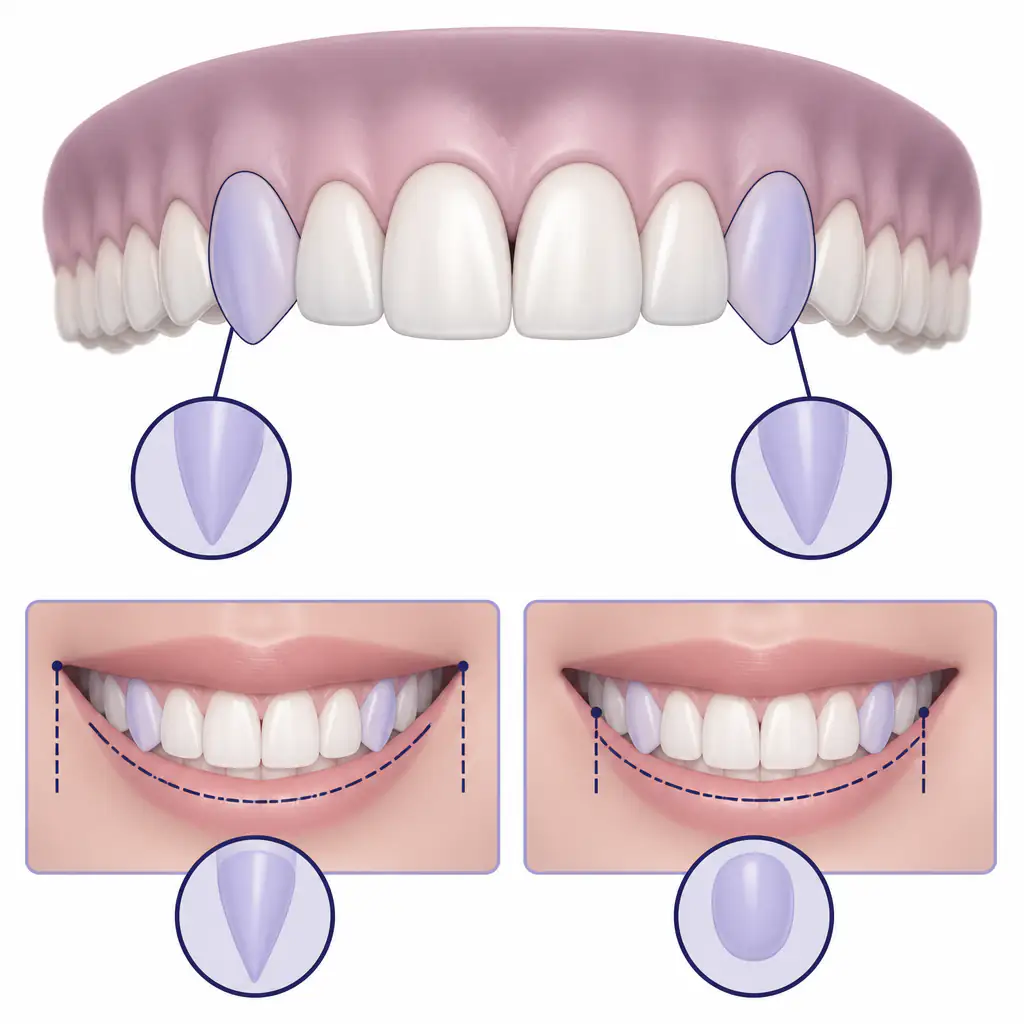
Your smile is one of the first things people register about your face, and the shape of individual teeth matters more than most people realize. Sharpened canine teeth, in particular, sit at a visual crossroads: they can read as sharp and defined, or they can disrupt the harmony of your smile depending on context. This guide covers the anatomy, the aesthetics, and the practical decisions involved, from understanding your palate width to choosing how many teeth you want to show.
What Are Sharpened Canine Teeth?
Canines are the pointed teeth located third from the center on each side of your mouth, both upper and lower. They are naturally the longest and most prominent teeth in the arch, and they serve a functional role in tearing food and guiding the jaw during lateral movement, a function dentists call canine guidance.
Sharpened canine teeth refers to canines that have been filed, reshaped cosmetically, or that naturally retain a pronounced cusp tip rather than wearing flat over time. Some people pursue this intentionally for aesthetic reasons. Others notice their canines are already sharp and wonder what that means for their overall smile.
From a facial aesthetics standpoint, canine prominence does a few things:
- It adds visual definition to the corners of your smile
- It can create a more angular or predatory appearance when the tips are acute
- It interacts directly with how wide or narrow your palate is, which changes how the teeth sit in the arch
Narrow vs Wide Palate: Why It Changes Everything
Before evaluating any individual tooth shape, you need to understand your palatal arch, because it sets the stage for everything else.
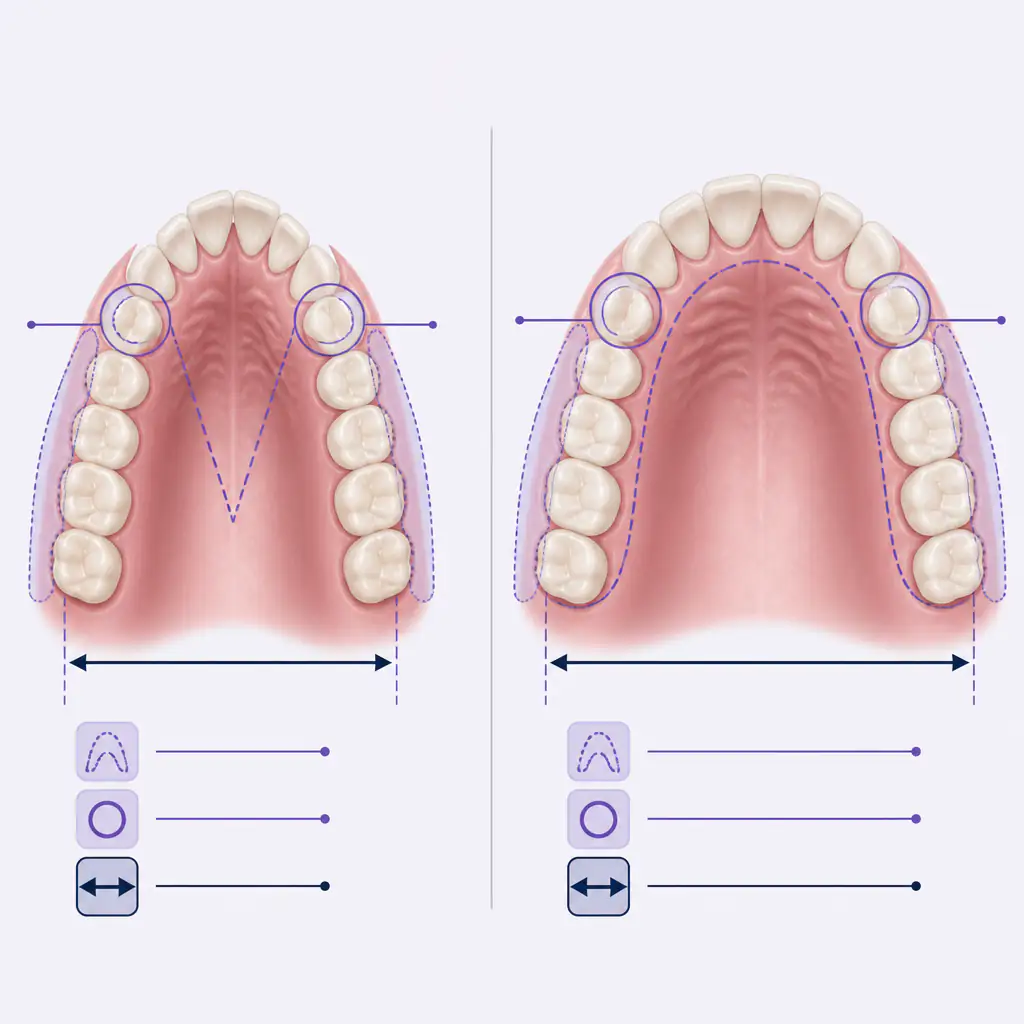
The palate is the bony roof of your mouth. The width and shape of your upper palatal arch determines how your teeth are arranged, how much of your smile is visible when you speak or laugh, and how your canines sit relative to your front teeth.
How to Know If You Have a Narrow Palate
A few self-checks can give you a rough sense of your palatal width:
- Tongue test. Rest your tongue flat against the roof of your mouth. If it feels cramped or your tongue edges touch your upper molars easily, you likely have a narrower arch.
- Mirror check. Open your mouth wide in front of a mirror and look at the curve of your upper teeth. A wide palate creates a broad, U-shaped arch. A narrow palate creates a more V-shaped or compressed arch.
- Crowding. Overlapping front teeth or teeth that are visibly tilted inward are a common sign of a narrow palate where the arch lacks the horizontal space to accommodate all teeth in alignment.
- Dental records. A dentist or orthodontist can measure your inter-molar width, the gold standard for palate classification.
Wide Palate vs Narrow Palate in Aesthetic Terms
A wide palate tends to:
- Create a broader, more visible smile arch
- Allow canines to sit more forward and prominently
- Support a natural-looking 10 or 12 teeth smile without the lateral teeth appearing hidden or dark
A narrow palate tends to:
- Push canines inward or create buccal corridors (dark spaces at the sides of the smile)
- Make a 6 teeth smile or 8 tooth smile more natural since fewer teeth are visible before the arch curves away
- Amplify the apparent sharpness of canines because the arch is more compressed
If you have a narrow arch and sharp canines, the combination can look either striking or disjointed depending on the proportions of the rest of your face. Getting an objective read on your facial structure is useful here. Aura uses AI analysis to assess facial proportions including jawline and midface structure, which provides useful context when you’re evaluating dental changes alongside overall facial harmony.
Smile Width: 6, 8, 10, and 12 Teeth Smiles Explained
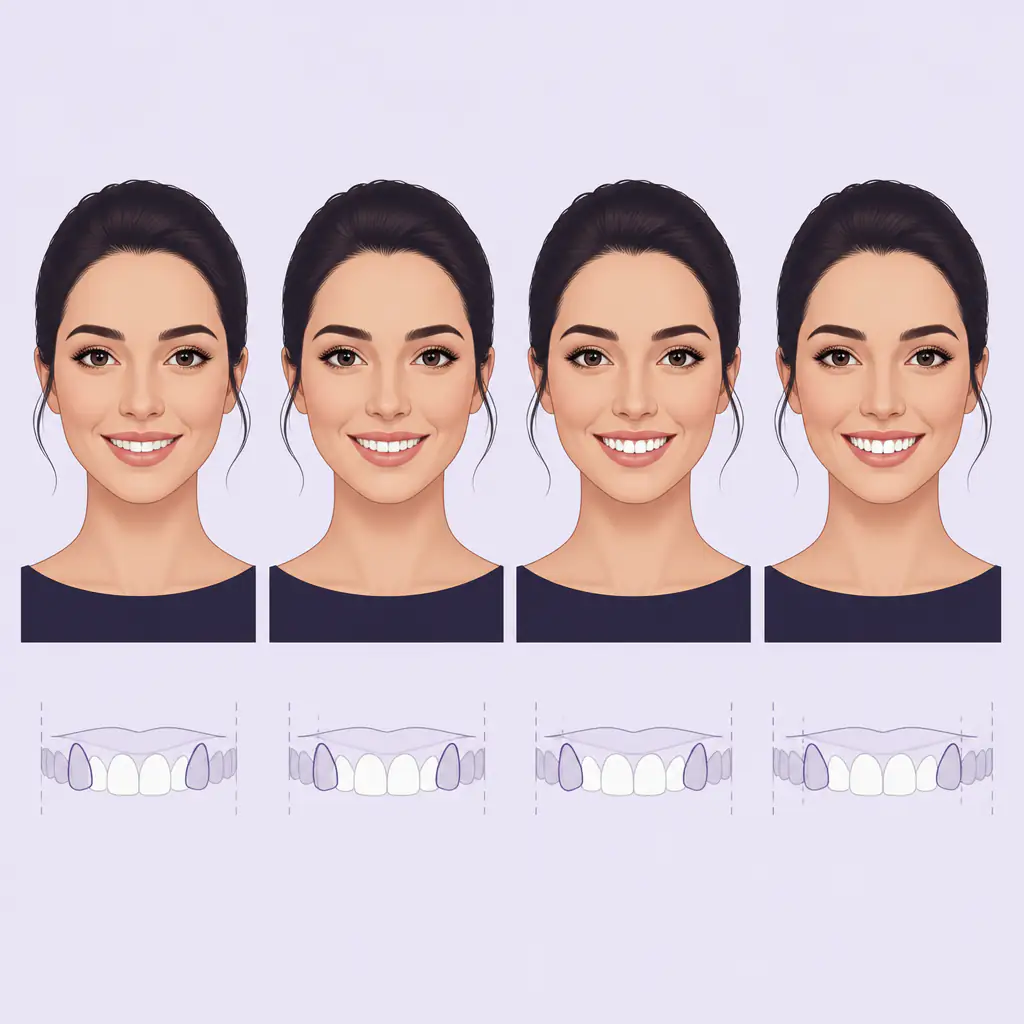
Smile width is measured by how many upper teeth are visible when you smile naturally. This is influenced by lip mobility, arch width, and tooth size, but understanding each category helps you set realistic goals.
6 Tooth Smile
A 6 teeth smile (or 6 tooth smile) shows the two central incisors, two lateral incisors, and two canines. This is a relatively narrow smile, common in people with a narrower arch or less mobile upper lip. It can look elegant and controlled, but it may also make the smile appear smaller than desired.
8 Tooth Smile
An 8 tooth smile adds the first premolars on each side. This is the most common smile width and tends to look natural across a wide range of face shapes. Canine sharpness is fully visible at this width.
10 Tooth Smile
A 10 teeth smile (or 10 tooth smile) includes the second premolars. This requires a wider arch and good lip retraction. On a wide palate, it looks full and balanced. On a narrow palate, the outer teeth may appear shadowed or angled.
12 Teeth Smile
A 12 teeth smile brings the first molars into view. This level of visibility is relatively rare and usually requires both a wide arch and significant lip mobility. It can read as warm and open, but it demands well-aligned, evenly colored teeth to look intentional rather than accidental.
Sharpened canines are most visible and most impactful in 8 to 12 teeth smiles, because at 6 teeth the canines are already at the edge of visibility and their tip shape matters less to the overall impression.
The Aesthetics of Sharpening Canine Teeth
Why do some people choose to sharpen their canines rather than blunt them? The reasoning is usually about facial type and the aesthetic they’re going for.
Arguments for keeping or enhancing canine sharpness:
- Sharp canines can reinforce a more angular, defined facial aesthetic
- They add micro-contrast within the smile, breaking up the flat line of uniform teeth
- Some research in facial perception suggests that slight canine prominence is associated with a more dominant or assertive appearance
Arguments against sharpening canine teeth:
- Filing teeth removes enamel permanently. Any reshaping that removes tooth structure cannot be reversed.
- Over-sharpening can look artificial or unbalanced, especially if the rest of the dental arch is misaligned
- Sharp canines on a narrow arch with crowding can look chaotic rather than defined
If you are considering cosmetic reshaping, talk to a qualified cosmetic dentist before proceeding. Even minor enamel removal changes the structural integrity of the tooth and should be evaluated professionally. The same applies to any orthodontic intervention aimed at changing your palate width or arch form.
How Palate Expansion Affects Canine Appearance
For people with a narrow palate who want a wider smile, palatal expansion is an option that orthodontists and oral surgeons assess on a case-by-case basis. In growing patients, a rapid palatal expander (RPE) is a common appliance. In adults, surgically assisted rapid palatal expansion (SARPE) may be required because the mid-palatal suture has fused.
Expansion changes the canine position in the arch. As the arch widens:
- Canines move laterally and may become more forward-facing
- Buccal corridors (those dark side gaps) reduce
- A 6 tooth smile can naturally evolve toward an 8 or 10 tooth smile over treatment
This is a significant orthodontic and potentially surgical process. Results vary depending on age, bone density, and the degree of narrowing. Consult a board-certified orthodontist or oral and maxillofacial surgeon before considering this route.
Practical Tips for Improving Your Smile Aesthetics
Not every improvement requires a procedure. Here are evidence-informed steps you can take at different levels of commitment:
Low commitment
- Whitening. Tooth color affects perceived sharpness. Yellowed teeth make uneven edges less visible; whitened teeth show every contour more clearly. If you want your canine shape to read, whitening helps it register.
- Lip care. Dry, uneven lips draw attention away from tooth shape. Consistent hydration and exfoliation of the lips makes a measurable difference in how your smile photographs.
- Smile practice. The Duchenne smile, which involves genuine contraction of the orbicularis oculi muscle around the eye, reads as more attractive across cultures. Practicing natural smiling in a mirror is free and has a real effect.
Medium commitment
- Clear aligners or retainers. Mild crowding and canine rotation can be addressed with clear aligner therapy, which may improve how your canines sit in the arch without any tooth removal.
- Professional cleaning and contouring. Minor smoothing of sharp edges or evening out of tooth lengths is a low-risk cosmetic procedure when done conservatively by a qualified dentist.
Higher commitment
- Orthodontics. Full orthodontic treatment addresses the arch-level issues that affect how your canines and overall smile appear.
- Palate expansion. As discussed above, for genuine arch narrowness this may be the only way to achieve a wider smile naturally.
- Veneers. Porcelain veneers can reshape canines and other teeth but involve irreversible enamel reduction. Discuss risks thoroughly with a prosthodontist.
Before committing to any of these, it helps to get a clear picture of your current facial structure. Uploading a photo to Aura can give you a structured breakdown of your facial proportions and highlight which areas have the most room for improvement, so you’re prioritizing the right changes rather than guessing.
Putting It Together: Canines, Arch Width, and Smile Design
Sharpened canine teeth are not inherently better or worse than rounded ones. Their effect on your appearance depends on:
- Your arch width. Wide palate means canines sit forward and visible. Narrow palate means they sit more inward and their sharpness may be partially hidden or may look crowded.
- Your smile width. An 8 to 10 tooth smile shows canines fully. A 6 tooth smile puts them at the edge of the frame.
- Your overall facial structure. Angular facial features tend to complement sharper canines. Softer, rounder facial profiles may look better with more uniform, slightly rounded teeth.
- Your tooth alignment. Sharp canines on a well-aligned arch look intentional. Sharp canines on a crowded, rotated arch tend to look unintentional.
The goal is coherence, not any single trait in isolation. A sharp canine that fits the arch, sits at the right height, and aligns with the facial structure it belongs to is far more effective than a sharpened canine that was modified without considering the surrounding context.
Frequently asked questions
Is sharpening canine teeth permanent? +
Yes. Any procedure that files or removes enamel from a canine tooth is irreversible because enamel does not regenerate. Minor cosmetic contouring by a dentist is low-risk when done conservatively, but you should talk to a qualified cosmetic dentist before proceeding to understand exactly how much structure would be removed.
How do I know if I have a narrow palate? +
Common signs include crowded or overlapping upper front teeth, a V-shaped upper arch when you look in a mirror, difficulty resting your tongue flat against the roof of your mouth, and visible dark spaces at the sides of your smile. A dentist or orthodontist can confirm this with a clinical measurement of your inter-molar width.
What smile width looks most attractive? +
Research on smile aesthetics generally finds that an 8 to 10 tooth smile reads as the most balanced across different face types, because it shows enough teeth to look open and warm without the outer teeth appearing shadowed. However, the right width for any individual depends on their arch shape, lip mobility, and overall facial proportions.
Can a narrow palate be widened in adults? +
In adults, the mid-palatal suture is typically fused, which means standard orthodontic expanders used in children are less effective. Surgically assisted rapid palatal expansion (SARPE) is an option some adults pursue, but it involves oral surgery and a recovery period. This is a decision that requires consultation with a board-certified orthodontist or oral and maxillofacial surgeon.