 Aura: Looksmaxxing
 Ideal Philtrum: Length, Shape & Proportions Explained
Learn what makes an ideal philtrum, how length and shape affect facial harmony, and what you can realistically do to improve yours.
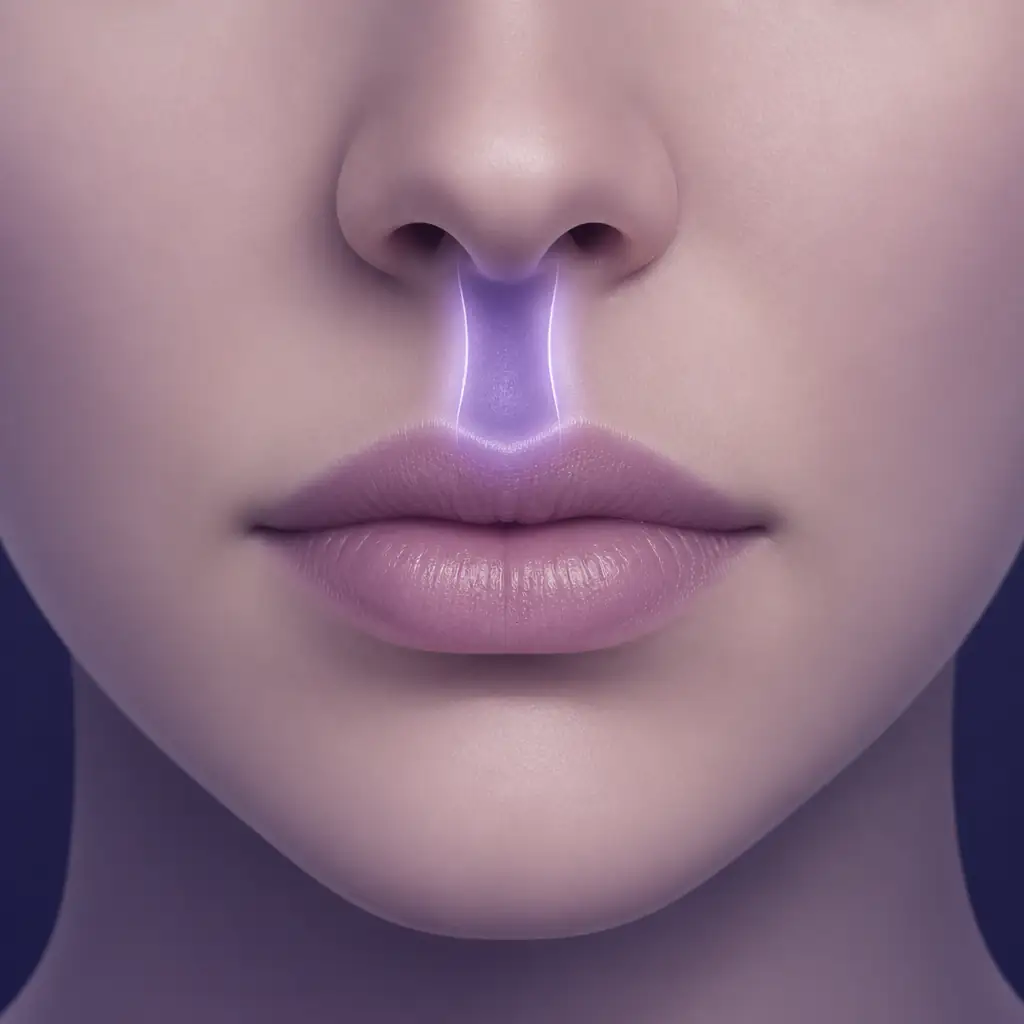
The philtrum is one of those facial features most people have never consciously thought about, yet it quietly shapes how attractive and balanced a face appears. It sits right in the center of your face, between your nose and upper lip, and its dimensions influence the perceived harmony of your entire lower third.
This guide breaks down what the ideal philtrum looks like according to aesthetic research, why proportions matter more than any single measurement, and what you can actually do about it.
What Is the Philtrum?
The philtrum is the vertical groove that runs from the base of the nose (the columella) down to the Cupid’s bow of the upper lip. It is bordered on each side by two raised ridges called the philtral columns or philtral ridges, which create the characteristic channel shape.
During fetal development, the philtrum forms when three segments of facial tissue fuse together. Incomplete fusion is what causes conditions like cleft lip. In healthy anatomy, the philtrum is fully formed and its depth, length, and width are all shaped by genetics.
Beyond biology, the philtrum serves as a visual anchor for the lower face. A well-defined philtrum draws the eye downward from the nose to the lips in a smooth, controlled line. A poorly defined or disproportionate philtrum can make the lower third of the face feel visually unresolved, even when every other feature is strong.
Why the Philtrum Matters for Facial Aesthetics
Facial attractiveness research consistently points to proportional balance as a primary driver of perceived beauty. The philtrum sits at the intersection of several key facial thirds and directly affects the apparent fullness, position, and shape of the upper lip.
Three things the philtrum influences:
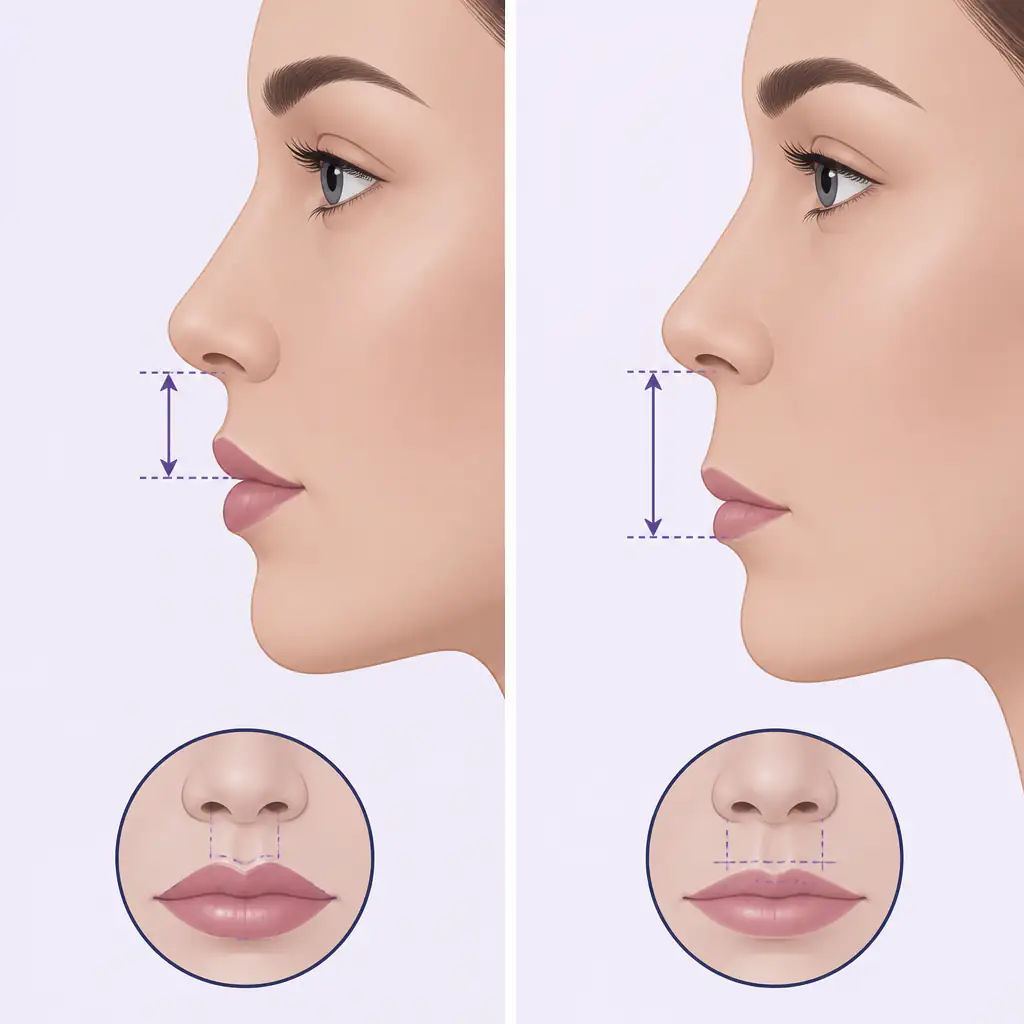
- Upper lip projection and shape. A shorter philtrum compresses the upper lip upward, increasing lip eversion (the outward roll of the lip). A longer philtrum tends to flatten this curve.
- Nose-to-lip ratio. The distance from the nose base to the top of the lip is measured partly through the philtrum. This ratio feeds into the classic facial thirds model.
- Perceived youth. Research suggests that the philtrum elongates with age as soft tissue migrates and bone resorbs. A shorter, more defined philtrum is often associated with a younger-looking face.
What Is the Ideal Philtrum Length?
This is where precision matters. There is no single universal measurement that qualifies as the ideal philtrum length, because length must be read in context of the full face.
That said, aesthetic studies do offer useful benchmarks:
- In adult women, a philtrum length of roughly 11 to 13 mm is frequently cited as aesthetically optimal in the plastic surgery literature.
- In adult men, the range tends to sit slightly higher, around 13 to 15 mm, partly because male faces are larger overall.
- A philtrum exceeding 16 to 18 mm is generally considered elongated and is one of the more common concerns people bring to maxillofacial surgeons.
These numbers come from studies analyzing facial attractiveness ratings and are averages, not hard cutoffs. Your ethnicity, jaw height, and overall facial proportions all shift what looks balanced on your specific face.
The Facial Thirds Model
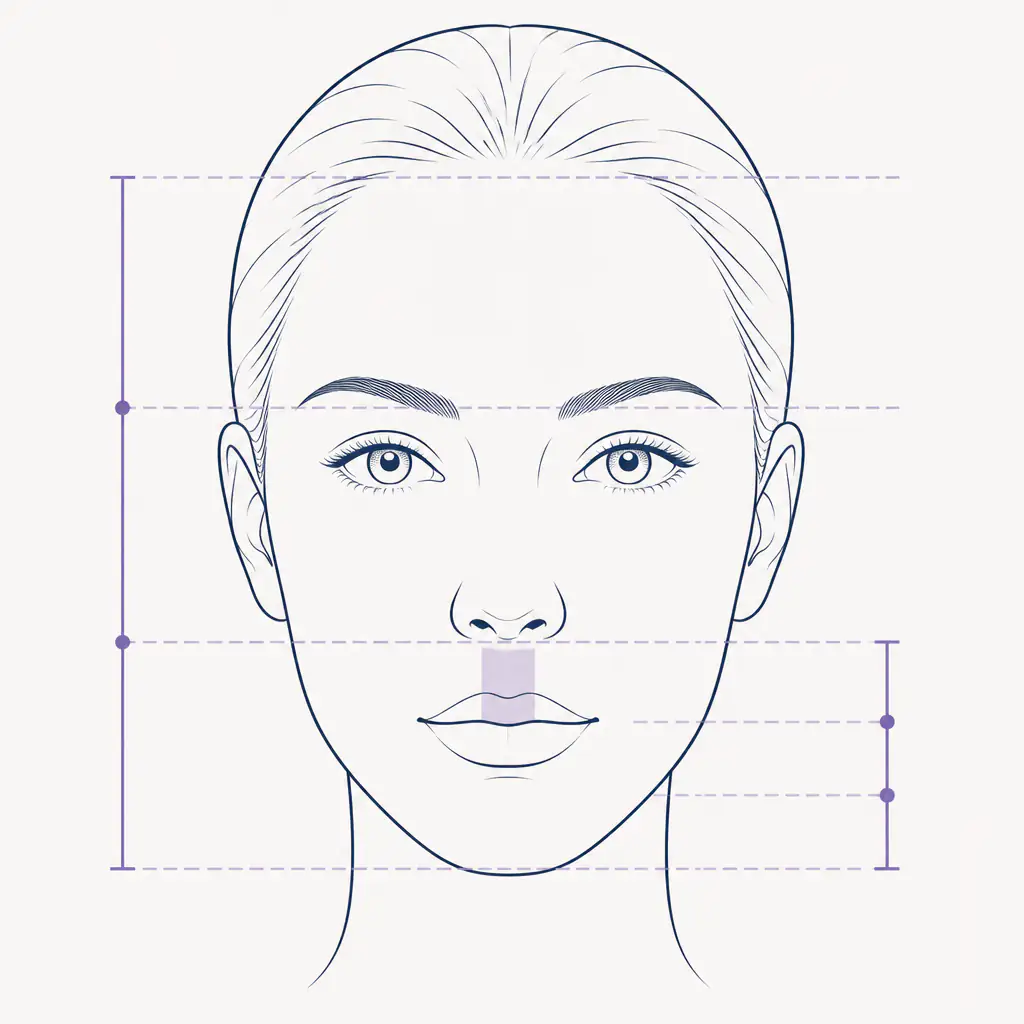
The classic facial thirds model divides the face into three roughly equal horizontal zones:
- Upper third: Hairline to brow ridge
- Middle third: Brow ridge to base of nose
- Lower third: Base of nose to chin
The philtrum occupies the top portion of the lower third. Ideally, this lower third subdivides further so that the distance from the nose base to the lower lip border is about one-third of the lower third, and the chin takes the remaining two-thirds. A philtrum that is too long collapses this sub-ratio and makes the lower face look heavy or stretched.
Ideal Philtrum Shape and Definition
Length is only one variable. Shape and definition matter just as much.
Philtral Column Definition
The ridges flanking the central groove should be visible and distinct under most lighting. Well-defined philtral columns create shadow lines that give the upper lip its characteristic Cupid’s bow shape. When these ridges are shallow or poorly defined, the upper lip can look flat and the transition from nose to lip appears amorphous.
Width Proportions
The width of the philtrum at its base (where it meets the upper lip) should approximate the width of the nose’s alar base, which is itself ideally aligned with the inner corners of the eyes in a front-facing view. A philtrum that is significantly wider or narrower than the alar base creates visual imbalance in the central face.
The Cupid’s Bow Connection
The philtrum terminates at the tubercle of the upper lip, the central fleshy projection that creates the Cupid’s bow peaks. A well-formed philtrum with distinct columns naturally accentuates this structure. When the philtrum columns are undefined, the Cupid’s bow flattens regardless of lip volume.
How to Assess Your Own Philtrum
Getting an honest, objective read on your philtrum requires more than a bathroom mirror selfie. Lighting, camera distance, and lens distortion all affect how the philtrum appears in photos.
For a useful self-assessment:
- Use a ruler or measuring app to record your philtrum length from columella base to the center of the upper lip vermillion border.
- Photograph yourself in neutral lighting at eye level with a standard focal length (not a wide-angle front camera, which distorts central features).
- Compare your lower-third proportions by dividing the face as described in the facial thirds model above.
- Look at column definition in soft side lighting, which reveals ridge depth more accurately than frontal light.
If you want a structured baseline before making any changes, Aura analyzes facial proportions including lower-third ratios and gives you a scored breakdown so you know where you actually stand rather than guessing.
What Can You Actually Do About Your Philtrum?
Here is the honest answer: the philtrum is one of the harder facial features to modify significantly without medical intervention. But there are options across a spectrum of invasiveness.
Non-Surgical Options
Lip filler placement: A skilled injector can use hyaluronic acid filler to accentuate the philtral columns and enhance the Cupid’s bow without altering the philtrum’s actual length. This works by adding volume to the ridges, making them cast more shadow and appear more defined. It does not shorten a long philtrum, but it can make an undefined one look sharper.
Lip flip with botulinum toxin: A small amount of botulinum toxin injected into the orbicularis oris muscle above the upper lip causes a slight eversion (outward roll) of the lip, which can visually reduce the apparent length of the philtrum by bringing the lip edge upward. The effect is subtle and temporary.
Makeup contouring: Strategic use of contour and highlighter along the philtral columns can enhance definition in photos and at moderate distances. This is not a structural change but is effective for image work and daily wear.
Surgical Options
For those with a significantly elongated philtrum, lip lift surgery is the most direct intervention. The most common technique is the bullhorn lip lift (subnasal lip lift), which removes a strip of skin directly beneath the nose to shorten the philtrum and elevate the upper lip.
Research suggests satisfaction rates for lip lift procedures are high when patient selection is appropriate and the procedure is performed by an experienced surgeon. Results are permanent, and the scar typically sits in the natural crease at the nose base where it becomes inconspicuous over time.
A less invasive option is the corner lip lift, which addresses the lateral lip corners rather than philtrum length directly, and is sometimes combined with a subnasal lift.
Talk to a qualified medical professional before considering any surgical or injectable procedure. Outcomes vary based on individual anatomy, and what works well for one person may not be appropriate for another.
Philtrum Aesthetics Across Facial Types
Because proportion is contextual, the ideal philtrum looks different across different facial structures.
- Longer faces can accommodate a slightly longer philtrum without it looking disproportionate, because the lower third is taller overall.
- Shorter, rounder faces benefit more from a compact philtrum, as elongation in this zone tends to visually stretch the lower face.
- Strong jaw and chin: When the chin is prominent and well-defined, a slightly longer philtrum is less visually disruptive because the lower third has strong termination points.
- Weak chin or short lower face: An elongated philtrum becomes more noticeable because there is less chin length to balance it out.
This is why looking at raw measurements alone can mislead you. Context is everything in facial aesthetics.
If you want to map your specific proportions across these variables, Aura provides a detailed analysis of your facial thirds, jawline strength, and lower-face ratios, which can clarify whether your philtrum is genuinely disproportionate or simply looks that way in certain photos.
Practical Tips for Optimizing Philtrum Appearance
Without any procedures, here are adjustments that may influence how your philtrum reads:
- Mewing and tongue posture: Proper tongue posture on the palate supports midface structure over time. Some practitioners believe it may contribute to a more compact lower third, though long-term evidence in adults is limited.
- Reduce facial bloating: Water retention around the lower face can soften philtral column definition. Reducing sodium, improving sleep, and staying hydrated may help with puffiness.
- Facial hair framing: For men, a well-groomed mustache that sits neatly above the lip can visually compress the apparent philtrum length by directing attention to the lip edge rather than the groove above it.
- Upper lip exercises: Some people report that deliberate movement exercises for the orbicularis oris may help with lip definition, though the evidence here is mostly anecdotal.
- Photograph in soft side lighting: If you are assessing your own philtrum, understand that harsh frontal flash flattens column definition while soft directional light reveals it. Your philtrum likely looks more defined in person than in most selfies.
Frequently asked questions
What is the ideal philtrum length for men and women? +
For women, research suggests an optimal philtrum length of roughly 11 to 13 mm. For men, the range is slightly higher at around 13 to 15 mm. These are averages from aesthetic studies, not absolute standards, and should be interpreted in the context of your overall facial proportions.
Can a long philtrum be fixed without surgery? +
Non-surgical options like a botulinum toxin lip flip or strategic lip filler placement can reduce the visual appearance of a long philtrum, but they do not change the actual length. For a permanent reduction, surgical lip lift procedures are the only reliable structural option.
Does the philtrum change with age? +
Yes. The philtrum tends to elongate as we age due to loss of soft tissue volume, changes in bone structure, and skin laxity. This is one reason a shorter, well-defined philtrum is often associated with a more youthful appearance.
How does the philtrum affect lip shape? +
The philtral columns (the raised ridges on either side of the groove) define the Cupid's bow of the upper lip. Well-defined columns create clear peaks in the lip border and a fuller-looking lip. A shallow or poorly defined philtrum tends to flatten the Cupid's bow and reduce the apparent lip structure.