 Aura: Looksmaxxing
 Eye Spacing: What It Means for Your Face
Learn what eye spacing reveals about facial harmony, how IPD affects attractiveness, and practical ways to optimize your appearance based on your measurements.
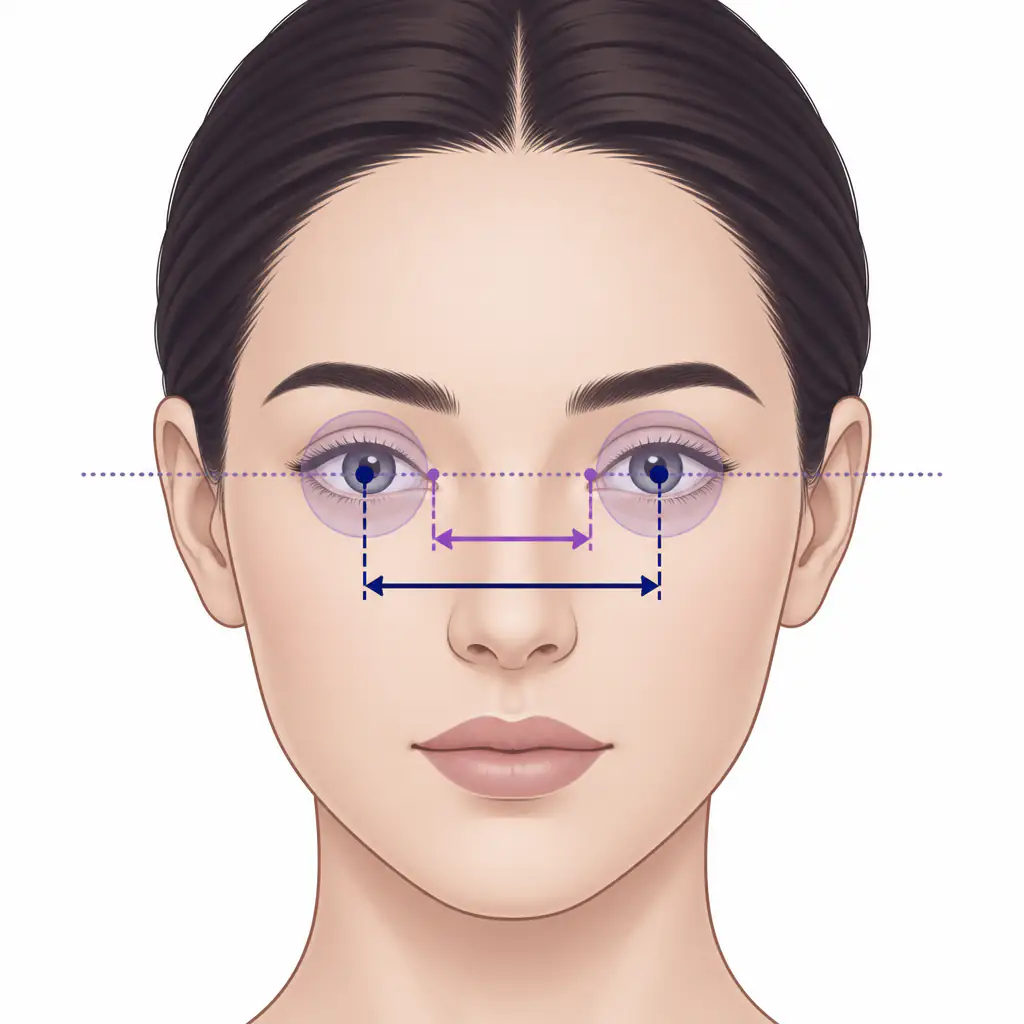
Your eye spacing is one of those features that quietly shapes how people perceive your entire face. It affects whether your nose looks wide or narrow, whether your face reads as strong or soft, and how close you come to classical ideals of facial balance. Most people have never measured it, yet it influences almost every other proportion on the face.
This guide breaks down the anatomy, the math, and the practical takeaways, without the pseudoscience.
What Is Eye Spacing (IPD)?
Eye spacing is typically discussed in two ways. The first is interpupillary distance (IPD), which is the measurement from the center of one pupil to the center of the other. The second is the distance between the inner corners of the eyes, known as the intercanthal distance.
These two numbers are related but not identical, and each tells you something different about your facial structure.
- IPD (pupil-to-pupil): The standard measurement used in optometry. In adults, this typically ranges from 54mm to 74mm, with an average around 63mm.
- Intercanthal distance (ICD): The gap between your two inner eye corners. This tends to average around 30 to 35mm in adults.
- Orbital width: The total horizontal span of each eye opening, typically 28 to 32mm in most adults.
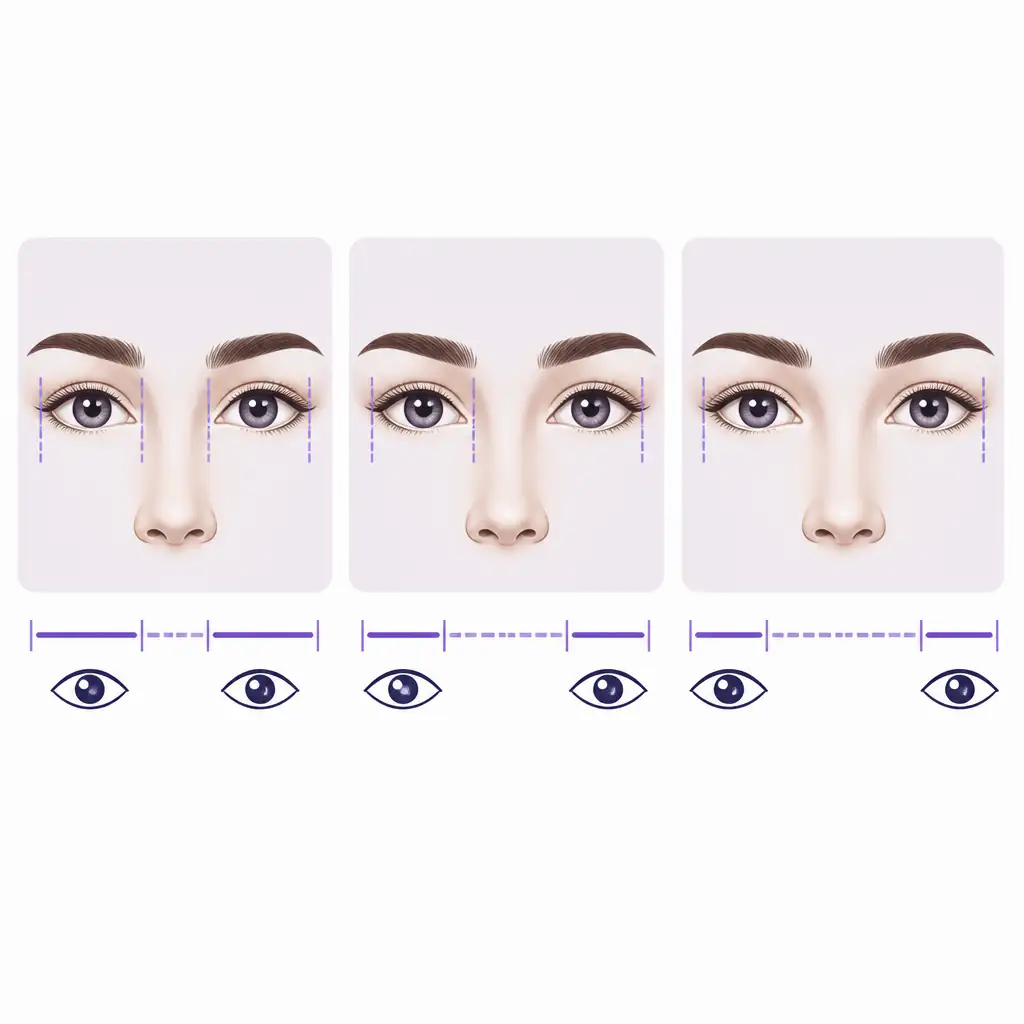
A useful rule from classical facial aesthetics is that the intercanthal distance should roughly equal the width of one eye. When this ratio holds, the face tends to look balanced across its midzone.
Wide-Set vs. Close-Set Eyes: What the Labels Mean
These terms are common in beauty discussions but often used imprecisely. Here is a cleaner way to think about them.
Close-Set Eyes
Close-set eyes have an intercanthal distance that is smaller than the width of one eye. Visually, this can make the nose appear wider by contrast, and the central face may look compressed. Some viewers read close-set eyes as intense or sharp, while others perceive them as less harmonious depending on the surrounding features.
Wide-Set Eyes
Wide-set eyes have an intercanthal distance that exceeds the width of one eye, sometimes significantly. This can widen the visual midface and, in some cases, reduce the appearance of facial definition. Extremely wide spacing may be associated with certain craniofacial conditions, though mild variation is simply normal human range.
What Is “Ideal” Spacing?
The classical standard, rooted in the proportions studied by artists from the Renaissance onward, holds that the face should be five eye-widths across at the level of the eyes. Under this model, the two inner eye corners align with the outer edges of the nostrils, and the distance between the eyes equals one eye-width.
In practice, very few faces hit this ratio exactly, and attractiveness research shows that deviations in either direction are common among people rated as highly attractive. Context matters: your eye spacing interacts with your nose width, cheekbone projection, and orbital bone structure in ways that make any single number insufficient on its own.
How Eye Spacing Affects Perceived Attractiveness
Research on facial attractiveness consistently finds that symmetry and proportion matter more than any single feature in isolation. Eye spacing contributes to both.
A few specific effects worth understanding:
Nose perception: Wider eye spacing tends to make the nose appear narrower by comparison. Closer eye spacing can make even a moderate nose look broader. This is a contrast effect, not a change in actual nose size.
Face width perception: Eyes that are set wider apart can make the face appear broader in the midzone. For faces that are already very wide, this can reduce perceived definition.
Hunter eyes vs. prey eyes: This concept, popular in facial aesthetics communities, refers to the vertical positioning and tilt of the eyes relative to the orbital rim, not spacing directly. However, the two are often discussed together because both relate to overall orbital anatomy.
Masculinity and femininity signals: Some research suggests that slightly closer eye spacing correlates with features read as more masculine, while wider spacing is often associated with more feminine faces. This is a statistical tendency, not a rule.
If you want an objective starting point, Aura analyzes your facial proportions using AI and provides specific feedback on eye positioning, orbital features, and overall midface harmony, which is more useful than eyeballing a mirror.
How to Measure Your Own Eye Spacing
You do not need professional equipment to get a useful measurement. Here is a straightforward method.
What You Need
- A ruler marked in millimeters
- A mirror or a front-facing camera with a neutral expression
- Good, even lighting
Steps
- Position yourself directly in front of a mirror, eyes at the same level as the reflection. Tilt or angle will distort your measurement.
- Hold the ruler horizontally just below your eyes, flush against your face if possible.
- Close your right eye. Align the zero mark of the ruler with the center of your left pupil.
- Open your right eye and close your left. Read the measurement at the center of your right pupil. This is your IPD.
- To measure intercanthal distance, align the zero mark with the inner corner of one eye and read the ruler at the inner corner of the other eye.
Repeat the process two or three times and average the results. Slight variation between attempts is normal.
For a photo-based approach, take a straight-on photo with your face parallel to the camera, then use free tools like ImageJ or a simple pixel-ratio calculation to estimate proportions.
Bone Structure vs. Soft Tissue: What Determines Your Eye Spacing
This distinction matters because it affects which interventions are even theoretically relevant.
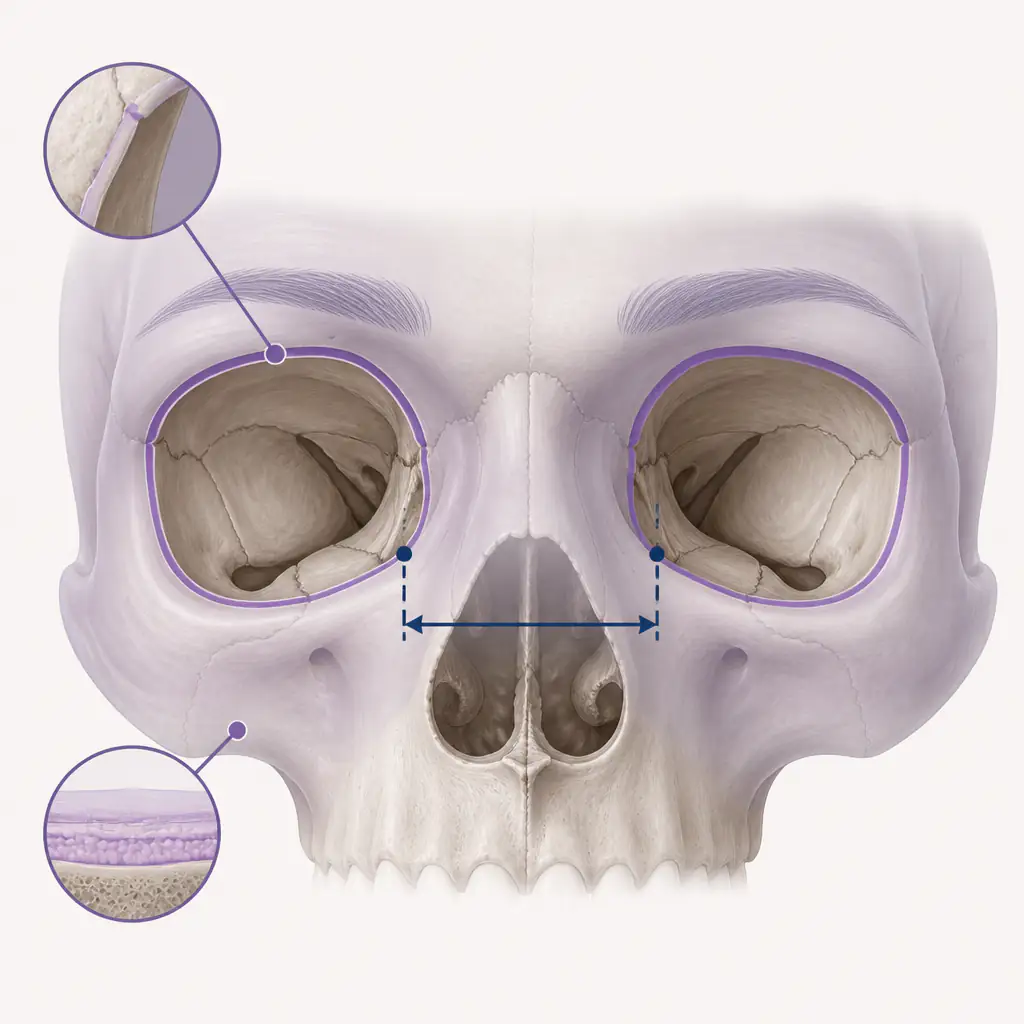
Orbital bones are the bony ridges and sockets that house your eyeballs. The distance between these structures is set during skeletal development and is fixed in adulthood. You cannot change actual orbital spacing through exercise, diet, or topical treatments.
Soft tissue around the eyes, including the eyelids, periorbital fat, and skin, can change with age, body composition shifts, and some cosmetic procedures. Puffiness, fat redistribution, and skin laxity can all affect how your eye spacing appears, even though the underlying bones have not moved.
Eyebrow shape and placement is one of the biggest soft-tissue levers. Brows that are shaped to arch toward the center can visually narrow wide-set eyes. Brows that extend further outward and have more horizontal shape can create the appearance of wider spacing.
Nose width also plays into perception. Rhinoplasty or non-surgical nose contouring can shift how your eye spacing reads without touching the eye area at all.
Talk to a qualified medical professional before considering any surgical or injectable procedure related to orbital or nasal anatomy.
Practical Ways to Optimize the Appearance of Your Eye Spacing
Most adjustments in this category are cosmetic and reversible. Here is what actually moves the needle.
For Close-Set Eyes
- Extend eyeliner or eyeshadow outward beyond the outer corner of the eye. This draws the visual endpoint further apart.
- Apply lighter highlighter to the inner corners of the eyes to open up the space visually.
- Avoid heavy makeup concentrated at the inner corners, which can make the eyes appear to converge further.
- Shape brows to have more tail extending outward, which increases the perceived width of the eye area.
- Hairstyles with volume at the sides help frame the face in a way that balances a narrow midzone.
For Wide-Set Eyes
- Apply darker eyeshadow or liner to the inner corners to draw the gaze inward.
- Keep brow arches more centered, reducing the horizontal extension of the tail.
- Nose contouring applied to the sides of the nose can make the nose appear slightly narrower, reducing the contrast that emphasizes wide spacing.
- Center-parted hairstyles direct attention inward and can balance wide-set features.
Structural Approaches (Non-Cosmetic)
- Mewing and oral posture: There is ongoing debate about whether consistent proper tongue posture during growth phases influences midface development. Evidence in adults is limited, and results, if any, are slow and modest.
- Body fat reduction: Reducing periorbital puffiness through lower overall body fat and reduced sodium intake can sharpen the appearance of the eye area, though it does not change spacing.
- Sleep and recovery: Chronic sleep deprivation causes periorbital swelling and dark circles, both of which affect how the eye area reads.
How Eye Spacing Fits Into Overall Facial Assessment
Eye spacing is one input among many. A complete picture of your facial structure includes:
- Canthal tilt (the angle of the eye from inner to outer corner)
- Orbital rim projection (how far the bone around the eye extends forward)
- Midface height (the vertical distance from eyes to upper lip)
- Nose width and projection
- Cheekbone position and forward projection
- Overall facial symmetry
Looking at eye spacing in isolation, without accounting for these other variables, leads to conclusions that do not hold up when you see the whole face. A measurement that reads as “wide” on paper may look perfectly balanced in context, and vice versa.
If you want a structured breakdown of how your eye spacing interacts with your other features, Aura provides a detailed AI-based facial analysis covering these proportional relationships, including hunter-eye detection and midface harmony scoring.
Key Takeaways
- Eye spacing is measured either as IPD (pupil-to-pupil) or intercanthal distance (inner corner to inner corner).
- The classical ideal holds that the gap between the eyes should equal the width of one eye, placing the face at five eye-widths across.
- Actual orbital bone spacing is fixed in adulthood; soft tissue, grooming, and cosmetics are the main levers available without surgery.
- Eye spacing affects how the nose, face width, and midzone features are perceived, making it worth understanding in context rather than in isolation.
- No single measurement defines attractiveness. Proportion, symmetry, and how features interact are what matter most.
Frequently asked questions
What is the average eye spacing for adults? +
The average interpupillary distance (IPD) in adults is approximately 63mm, with a typical range of 54mm to 74mm. Intercanthal distance, measured between the inner corners of the eyes, averages around 30 to 35mm. Both measurements vary by sex and ethnicity.
Can you change your eye spacing without surgery? +
You cannot change the actual bone structure that determines eye spacing in adulthood. However, makeup techniques, eyebrow shaping, hairstyle choices, and nose contouring can significantly shift how your eye spacing appears to others. These are reversible and low-risk options worth exploring first.
Does eye spacing affect how attractive a face looks? +
Research suggests that deviation from classical proportional ratios, including eye spacing, can influence attractiveness ratings, but the effect is modest and highly context-dependent. Eye spacing interacts with nose width, cheekbone structure, and overall symmetry in ways that make it impossible to evaluate in isolation.
What is the difference between IPD and intercanthal distance? +
IPD (interpupillary distance) measures from the center of one pupil to the center of the other and is the standard measurement used in optometry and VR headset fitting. Intercanthal distance measures from the inner corner of one eye to the inner corner of the other. IPD is always larger than intercanthal distance by roughly the width of one eye's iris.