 Aura: Looksmaxxing
 Ideal FWHR: What the Research Actually Says
Learn what the ideal FWHR is, how to measure it, and what facial width-to-height ratio research says about attractiveness and masculinity.
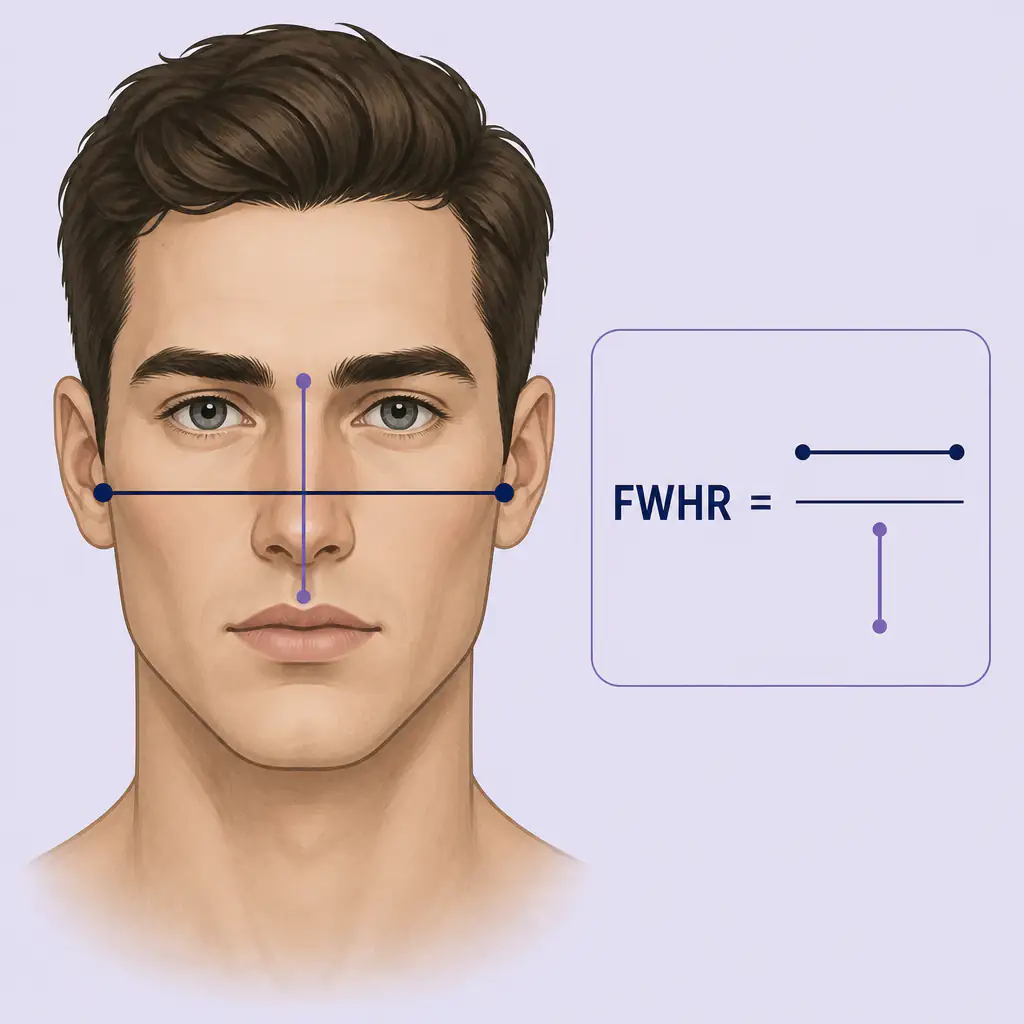
Your face has a shape, and that shape can be measured. One of the most studied facial measurements in attractiveness research is the facial width-to-height ratio, or FWHR. It shows up in studies on perceived dominance, testosterone exposure, and physical attractiveness. But what does it actually mean, what is the ideal FWHR, and can you do anything about yours?
This guide breaks it down without the noise.
What Is FWHR?
FWHR stands for facial width-to-height ratio. It is a biometric measurement that compares two distances on the face:
- Width: measured from the left to the right zygion, which are the outermost points of the cheekbones
- Height: measured from the upper lip to the midpoint of the brow ridge (not the full face height)
The formula is simple:
FWHR = Bizygomatic Width / Upper Face Height
A higher FWHR means a wider face relative to the height of its upper portion. A lower FWHR means a narrower or longer upper face.
This ratio became widely studied after researchers noticed it differed between males and females after puberty, suggesting a link to androgenic (testosterone-driven) development during adolescence.
Where Does the “Ideal” FWHR Come From?
The concept of an ideal FWHR originates from a body of evolutionary psychology and physiognomy research. Several peer-reviewed studies examined large samples of men and women, comparing their FWHR measurements to observer ratings of dominance, trustworthiness, aggression, and attractiveness.
The Key Numbers
In most published studies, the average adult male FWHR falls between 1.8 and 2.0. The average for adult females is typically lower, around 1.6 to 1.8.
When researchers asked participants to rate faces for attractiveness and dominance:
- Men with FWHRs in the range of 1.9 to 2.1 were rated as more dominant and, in many studies, more physically attractive by female raters
- FWHRs significantly below 1.8 were associated with a softer, less defined facial structure
- Very high FWHRs above 2.2 were sometimes rated as more aggressive-looking but not necessarily more attractive
So if you are looking for a single number, an FWHR of around 1.9 to 2.0 is generally considered the masculine sweet spot based on the available research. It is wide enough to signal strong bone structure without crossing into an extreme that reads as disproportionate.
For women, a slightly lower FWHR, around 1.7 to 1.8, tends to correlate with higher attractiveness ratings in heterosexual samples, though this varies more with cultural context.
How to Measure Your FWHR
You can get a rough measurement at home, though professional calipers or photogrammetric software will always be more accurate.
Steps for a DIY Measurement
- Take a front-facing photo in neutral expression, eyes forward, head level. Lighting should be even with no tilt.
- Import it into any image editor (even free tools like GIMP or Paint.NET work).
- Draw a horizontal line between your outermost cheekbone points (zygions). Measure its pixel length.
- Draw a vertical line from the center of your upper lip to the midpoint of your brow ridge. Measure its pixel length.
- Divide width by height. That is your FWHR.
Keep in mind that photo angle matters a lot. Even a slight downward or upward tilt of the chin will distort the measurement. Repeat the process with 2 to 3 photos and average the results.
If you want a more structured analysis of your facial proportions alongside other metrics like jawline definition, midface ratio, and eye area, Aura can give you an AI-based breakdown from a single photo, which takes the guesswork out of where you actually stand.
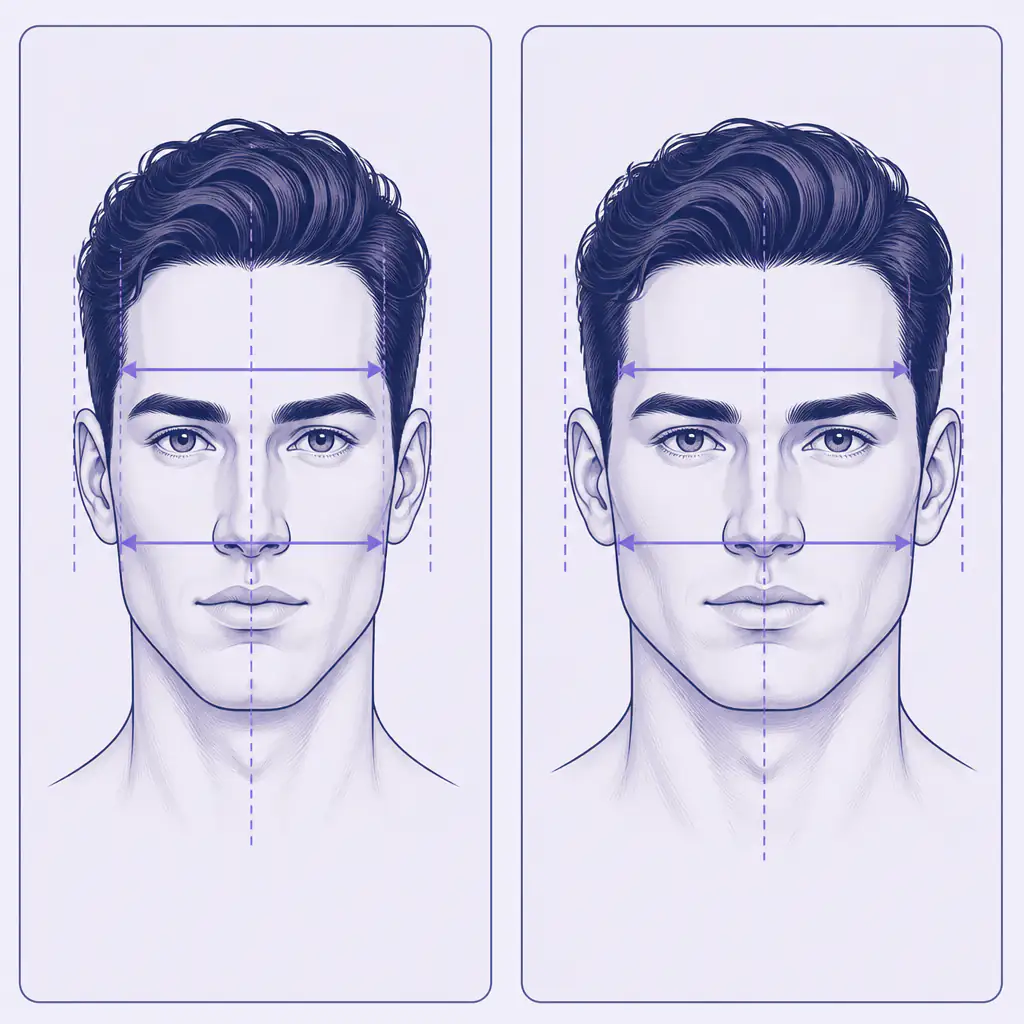
What FWHR Actually Predicts (And What It Does Not)
It is worth being honest about what the research does and does not show.
What the Research Supports
- Higher FWHR in men correlates with perceived dominance across multiple studies and cultural samples
- Some research suggests men with higher FWHR are rated as more masculine by both male and female observers
- FWHR appears to be influenced by prenatal androgen exposure and pubertal testosterone, meaning it reflects real hormonal history to some degree
- Higher FWHR has been associated with greater grip strength and physical formidability in some datasets
What the Research Does Not Cleanly Support
- FWHR alone does not reliably predict actual behavior like aggression or leadership ability, despite some early claims
- The attractiveness effect of higher FWHR is context-dependent. In some studies it matters significantly; in others the effect size is small
- FWHR is just one variable. Skin quality, eye shape, facial symmetry, and jaw definition all contribute independently to how a face is perceived
- Studies using self-reported vs. measured data often conflict
The takeaway: FWHR is a real and meaningful metric, but it is one piece of a larger puzzle. Obsessing over a single ratio while ignoring other facial traits is not a productive approach.
What Influences Your FWHR
Your FWHR is largely determined by skeletal structure, which is primarily genetic. However, several factors modulate how wide your face appears relative to its upper height.
Bone Structure
The bizygomatic width, the distance between your cheekbones, is set by the zygomatic arch. This develops primarily during puberty under androgenic influence. People who went through puberty with higher testosterone exposure tend to develop wider, more prominent zygomatic arches, which pushes FWHR higher.
Body Fat Distribution
Facial fat, particularly in the buccal (cheek) region, can increase apparent width without increasing actual bone width. Losing body fat often reduces the perceived FWHR slightly but reveals the underlying skeletal structure more clearly, which may improve overall facial definition even if the raw ratio changes.
Masseter Development
The masseter muscles, which run along the sides of the jaw, contribute to facial width lower down. While they do not directly change the bizygomatic measurement, a well-developed masseter creates a more angular, wider-looking lower face that complements a high FWHR.
Regular chewing, mastic gum, and jaw-focused exercises are often cited as ways to develop masseter hypertrophy. Some users report noticeable changes over several months of consistent effort, though results vary significantly by individual.
Mewing and Palate Expansion
Proper tongue posture, commonly called mewing, is theorized to support the palate and midface structure over time. The evidence is still debated, but it costs nothing to maintain correct tongue posture against the roof of the mouth. It may contribute to a slightly wider palate expression over years, particularly in younger individuals whose bone is still more malleable.
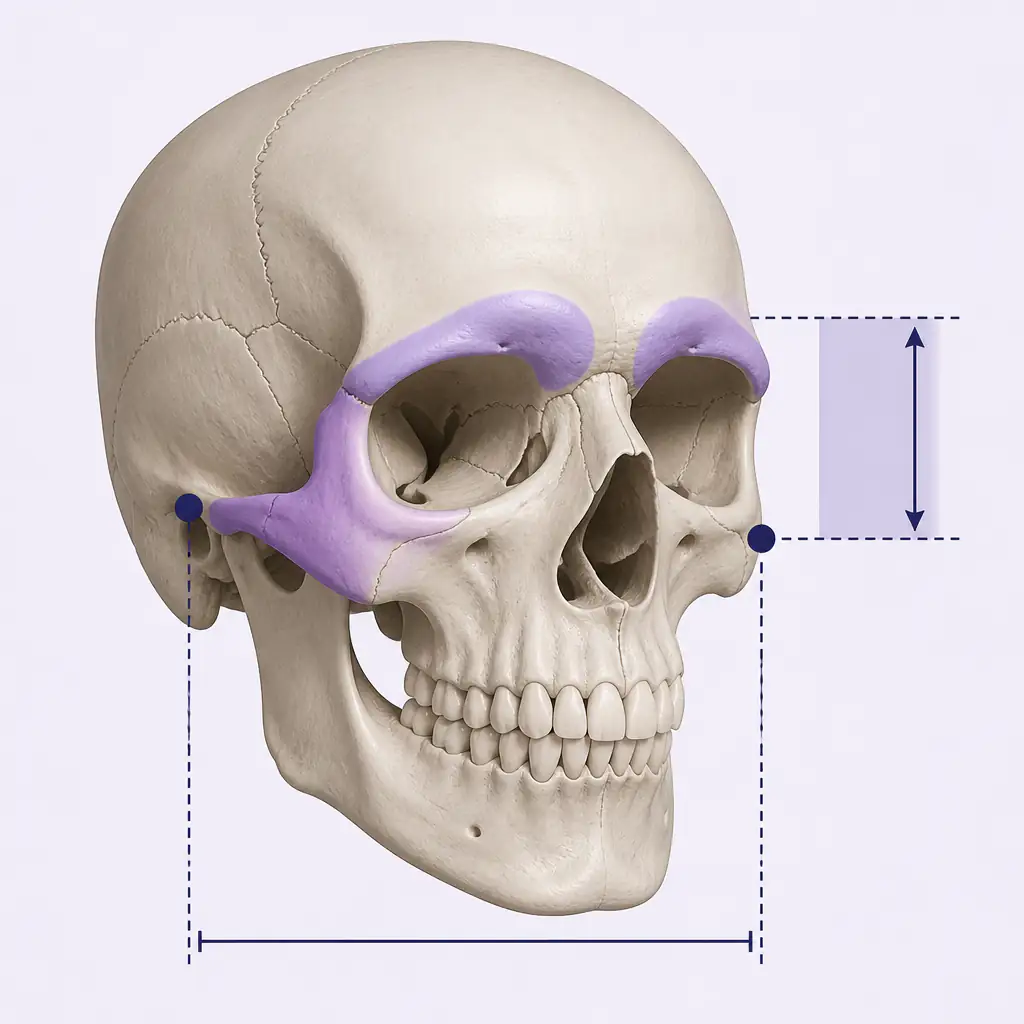
Practical Ways to Work With Your FWHR
If your FWHR is on the lower end and you want to improve your facial aesthetics without surgery, here are evidence-adjacent strategies worth considering.
1. Reduce Body Fat
Bring your body fat percentage down to a range where facial fat is not obscuring your underlying bone structure. For most men, this means somewhere below 15%. As your face leans out, the definition of your cheekbones and jaw becomes more visible.
2. Masseter Hypertrophy
Consistent chewing of harder foods or mastic gum may help develop the masseter. This widens the lower and mid face slightly and adds to a more structured appearance. Be patient, this is a slow process measured in months.
3. Hairstyle and Grooming
A hairstyle with volume on the sides can visually reduce apparent FWHR, while styles with height and less width can make a narrower face look more elongated. For those wanting to increase apparent width, styles that sit flat on top and build width at the sides may help. This is not structural change, but visual framing matters in real social contexts.
4. Facial Hair
A defined beard can restructure the apparent shape of the lower face significantly. A full beard with clean lines along the cheek can add the impression of a wider, more angular face even if the upper face FWHR does not change.
5. Track Your Baseline
Before making any changes, it helps to know exactly where you are starting from. Getting an objective facial analysis, including your FWHR alongside other key ratios, gives you a clear baseline. Aura provides AI-generated facial scoring and structure analysis that covers multiple ratios at once, so you can see which traits are already strong and which ones have the most room for improvement.
On Surgical Options
For those considering more significant structural changes, options like zygomatic implants or bichectomy (buccal fat removal) do exist and can meaningfully alter FWHR. Always consult a qualified maxillofacial surgeon or board-certified plastic surgeon before considering any procedure. These are irreversible decisions with real risks that require professional evaluation.
Is There a Single “Perfect” FWHR?
Not exactly. The research points to a range, not a magic number. What matters more is whether your facial features work together coherently. A man with an FWHR of 1.85 but strong jaw definition, good skin, and prominent brows may look more attractive than someone with a 2.05 FWHR and a weak chin or poor skin texture.
Facial attractiveness is multidimensional. FWHR is a useful lens for understanding one dimension of facial masculinity and structure, but it should not be treated as the single metric that determines your appearance.
Focus on what you can actually influence, track progress objectively, and build habits that compound over time. That is a more productive framework than chasing a specific ratio.
Frequently asked questions
What is the ideal FWHR for men? +
Research suggests that a FWHR between 1.9 and 2.0 is associated with high perceived dominance and masculinity in men. This range tends to score well in attractiveness ratings across multiple studies, though it is one metric among many that contribute to overall facial aesthetics.
Can you increase your FWHR naturally? +
You cannot change your underlying bone structure without surgical intervention, but you can improve the appearance of facial width. Reducing body fat to reveal cheekbone definition, developing the masseter muscles through consistent chewing, and strategic facial hair can all make the face appear wider and more structured.
Is a high FWHR always more attractive? +
Not necessarily. Very high FWHRs above roughly 2.2 are sometimes associated with an aggressive appearance that does not always translate to higher attractiveness ratings. The effect also depends heavily on other facial features, symmetry, and individual variation in observer preferences.
Does FWHR differ between men and women? +
Yes. After puberty, men typically develop higher FWHRs than women due to greater androgenic bone development, particularly in the zygomatic arches. The average male FWHR is around 1.9 to 2.0, while the average female FWHR is typically in the 1.6 to 1.8 range.