 Aura: Looksmaxxing
Oblong Face Shape: How to Tell and What Suits It
Learn how to tell if you have an oblong face shape, how it differs from oval and square, and which haircuts and glasses add width without adding height.
Maybe your face looks long in photos, and the advice in every oval-face guide feels slightly off. If so, you may be following advice written for a different shape. The oblong face shape is one of the standard categories in hair and eyewear advice, and it is the one most easily mixed up with oval.
This guide covers:
- what defines an oblong face
- how to check yours honestly
- why the label is less precise than many sites suggest
- which haircuts and glasses tend to work, and why
Once you understand the reasoning, you can adapt the advice instead of copying a list.
What an Oblong Face Shape Is
An oblong face has two traits at the same time:
- It is clearly longer than it is wide.
- Its width stays fairly even from top to bottom. The forehead, cheekbones and jaw are all roughly the same width.
Because the width holds steady, the sides of the face tend to run in fairly straight, near-parallel lines instead of curving inward. The chin is usually softly rounded or lightly squared rather than pointed.
Three measurements come up in face shape discussions:
- Face length: from the hairline to the bottom of the chin. Anatomists call the lowest point of the chin the menton.
- Cheekbone width: the distance across the widest part of the cheekbones. Anatomists call this bizygomatic width, after the zygomatic (cheek) bones.
- Jaw width: the distance between the two angles of the jaw, called bigonial width. The gonion is the corner where the jaw turns upward toward the ear.
In an oblong face, the forehead, cheekbone and jaw widths sit close together, while the length clearly exceeds them.
This is a styling shorthand, not a medical category. Nothing is wrong with an oblong face, and no face shape is more attractive than another. The label is useful only because it helps you predict which haircuts and frames will balance your proportions in the way you prefer.
The Ratio Problem
Many face shape guides give a length-to-width cutoff for oblong. The trouble is that they disagree. Cutoffs published on face shape sites include about 1.5:1 and 1.6:1 or higher. Some of the same sites put oval at about 1.45:1, very close to the lower oblong cutoff.
We did not find a clinical or professional standard behind any of these numbers. Treat any single ratio as a rough guide, not a definition. If your face sits near a boundary, you are not misreading yourself. The boundary is fuzzy.
Oblong vs Oval, Square and Rectangle
Oblong overlaps with three neighboring shapes. Here is how they compare.
| Shape | Length vs width | Width pattern | Sides | Jaw and chin |
|---|---|---|---|---|
| Oblong | Clearly longer than wide | Forehead, cheeks and jaw similar | Fairly straight, near-parallel | Soft jaw, rounded or lightly squared chin |
| Oval | Longer than wide, less so | Widest at cheekbones, tapering above and below | Gently curved | Narrower, rounded chin |
| Square | About as long as wide | Forehead, cheeks and jaw similar | Straight | Angular jaw corners |
| Rectangle | Clearly longer than wide | Forehead, cheeks and jaw similar | Straight | Stronger, angular jaw corners |
Oblong vs oval. Look for taper below the cheekbones. An oval face narrows noticeably toward the jaw and chin. An oblong face keeps nearly the same width all the way down. If you trace your outline and see a soft curve from cheekbone to chin, oval is the better fit. If you see fairly straight lines, oblong fits better.
Oblong vs square. Both have even widths. A square face is about as long as it is wide, while an oblong face is clearly longer.
Oblong vs rectangle. Guides don’t agree here:
- Some separate the two by jaw shape: oblong has a softer jaw, and rectangle has strong angular corners.
- Others treat “rectangle” as another name for oblong.
In practice, the styling advice for both is nearly identical. If your jaw is very angular, you can add a few softening choices, which are covered below.
How to Check If Your Face Is Oblong
You need a mirror or a phone camera and a few minutes.
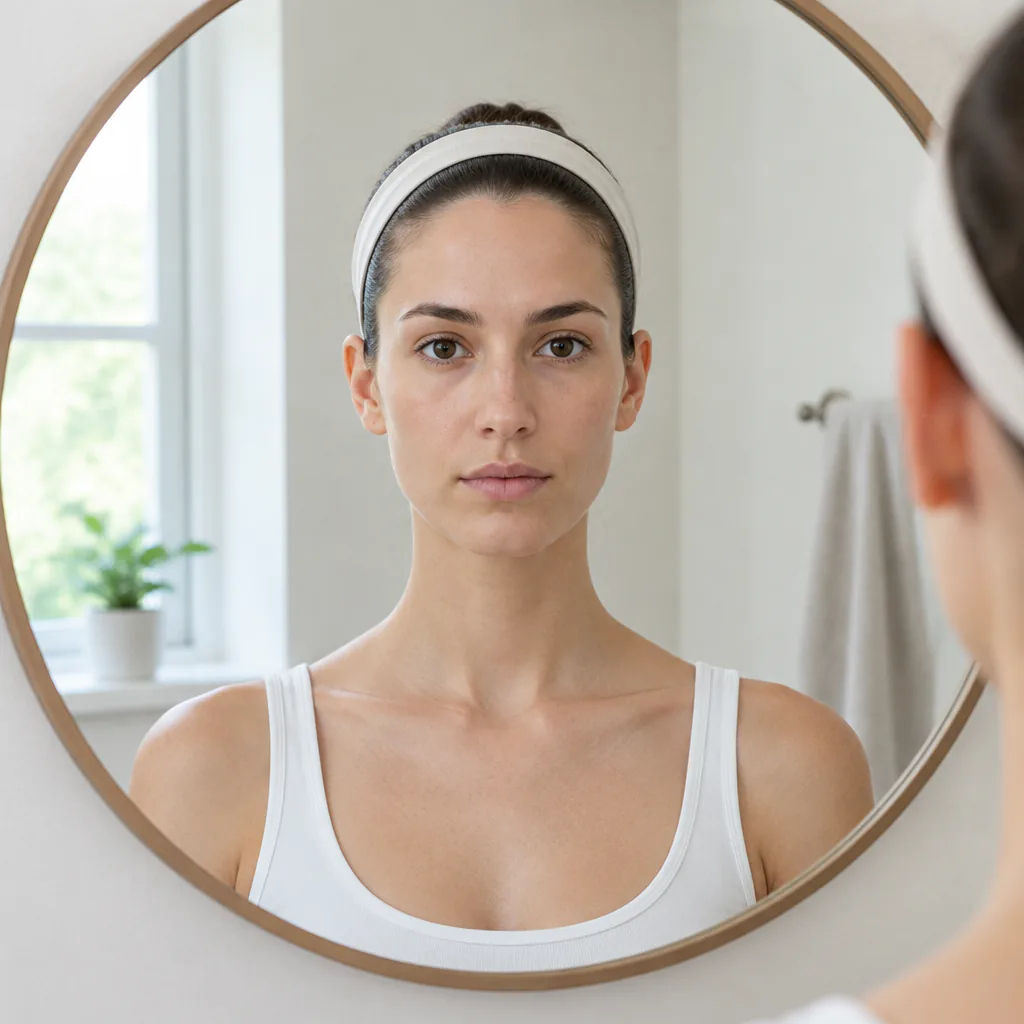
- Pull all your hair back. Use a headband or tie it tightly so your hairline, temples and jaw are fully visible. Hair framing the face changes how its shape reads.
- Set the camera at eye level, a bit more than arm’s length away. Face it straight on with a neutral expression. Close-up selfies taken with the camera tilted up or down distort how long the face looks.
- Trace the outline from temple to jaw. Note whether the sides curve inward below the cheekbones or run fairly straight.
- Compare three widths: forehead, cheekbones and jaw. Note whether one zone clearly dominates or whether all three are close.
- Judge the length. Ask whether the face reads as clearly longer than wide, or only moderately longer.
- Repeat with two or three photos on different days. If your answer flips between oval and oblong, you are probably borderline. The good news is that advice for borderline faces overlaps heavily.
A soft tape measure can help with steps 4 and 5, but don’t over-trust the numbers. As noted above, nobody agrees on where oval ends and oblong begins.
Why Face Shape Labels Are Fuzzier Than They Look
If face shapes were clear-cut categories, software would sort them perfectly. Research on automated face shape classification shows it does not.
These studies place facial landmarks on a photo. Landmarks are named reference points such as the chin tip, the jaw corners and the cheekbone edges. From these points the software calculates distances, ratios and angles, then assigns a shape. Some examples:
- A small landmark study. One machine learning study used 13 landmarks to calculate 14 features. It sorted faces into five shapes, including oblong and oval, and reported 70% accuracy.
- A deep learning classifier. Another project sorts faces into five shapes: heart, oval, square, oblong and circle.
- A transformer-based model. It reports over 99% accuracy on its own dataset. Numbers from different datasets are not directly comparable.
- Shaky ground-truth labels. One earlier study trained its models on 500 internet photos of female celebrities whose face shapes were “known.” Those labels come from informal sources, not measurement.
- Confusion between neighbors. A recent study on makeup face templates found that its algorithms confused structurally similar categories, especially rectangle and square.
The takeaway is practical. If trained software confuses neighboring shapes, a single selfie judged by eye can confuse them too. Camera angle, lens distance and hairstyle all shift the impression.
Treat your result as a likely shape, not a verdict. Choose styling that works across the shapes you might be.
If you want a second read alongside your mirror check, you can use the Aura Face Shape Finder. It works in two parts:
- The free part is an on-device preview that estimates face shape in your browser without uploading your photo.
- The fuller AI report is part of Aura Pro, a paid subscription. It gives your likely face shape with its uncertainty, explains your forehead, cheek and jaw proportions, and suggests haircut and accessory options. It does not claim exact physical measurements.
Haircuts for an Oblong Face Shape
Nearly every style guide gives oblong faces the same principle: add width at the sides and avoid adding height on top. This is a styling convention based on how lines and volume draw the eye. It is not a tested, measured outcome.
Before you choose a cut, decide whether you want to balance your length at all. Some people like an elongated look and choose to lean into it. That is a valid choice.
Longer and Feminine Styles
- Chin-length to shoulder-length cuts. Bobs and lobs end in a horizontal line near the jaw, which interrupts the face’s vertical length.
- Curtain bangs or side-swept bangs. These cover part of the forehead, so less vertical length shows. Wispy, layered bangs look softer than a heavy blunt line, though a blunt fringe also works if you like the look.
- Layers that start at the cheekbone or jaw. They put movement and volume exactly where width helps. Layers that start too high can add height at the crown instead.
- Waves and curls. Texture expands outward and adds horizontal fullness that straight hair cannot.
- A side part. It adds a diagonal line that breaks up the face’s vertical symmetry.
If your hair is long and you want to keep it, ask for face-framing layers that begin around cheek level. That keeps your length while adding width where it counts.

Shorter and Masculine Styles
- A fringe. French crops and textured crops bring hair forward over the forehead. The aim is texture rather than height.
- Side-swept styles and side parts. These serve the same purpose as for longer hair, adding a diagonal instead of a straight vertical line.
- Some length and volume at the sides. Guides consistently favor fuller sides over a tall top. As an editorial suggestion, a very tight fade under a tall top tends to stretch the silhouette further.
- Beards (editorial suggestion). Fuller sides with moderate length at the chin keep the line horizontal. A long or pointed beard extends the face downward.
What Usually Works Against Length
These choices tend to emphasize length. They are only worth avoiding if your goal is balance:
- very long, flat, straight hair with a center part
- height at the crown: high updos, top knots, tall pompadours and quiffs
- tightly pulled-back or slicked-back styles with no fringe, which show the full height of the forehead
Glasses and Accessories for an Oblong Face
Frames follow the same logic as haircuts. Look for frames that add a horizontal band across the middle of the face and cover some vertical space.
- Width. One common rule of thumb is that the frame should be at least as wide as the widest part of your face.
- Depth. Taller lenses cover more of the face’s vertical length.
- Strong upper lines. Browline frames, bold acetate and wide wayfarer-style shapes add a clear horizontal line.
- Frames to avoid. Small, narrow or shallow frames leave large areas of face visible above and below them, which emphasizes length.
Guides disagree about round frames:
- Some recommend large round or oval frames because the curves add width.
- Others list oversized frames as something to skip.
The honest answer is that it depends on your features and taste, so try both.
Above all, check fit. The bridge should sit comfortably on your nose, and the temple arms shouldn’t pinch. A well-fitting frame in a so-so shape usually beats a “correct” shape that slides down your nose all day.
If your jaw is angular, as with rectangle faces, rounder frames and softer hairstyles soften those corners. This is an editorial suggestion. For accessories, wider earrings and a horizontal neckline follow the same width-over-length idea, also as an editorial suggestion.

A Practical Plan for Your Next Haircut
Most people get poor results because they arrive at the salon or barber with a vague request. Use these steps instead.
- Take two or three clear front-facing photos with your hair pulled back, as described in the checking steps above.
- Pick one main horizontal element rather than changing everything at once. Choose a fringe, side volume at cheek level, or a side part. One clear change is easier to judge than three.
- Collect reference photos of the cut on people whose hair texture is similar to yours. Hair texture matters more than face shape for whether a cut will hold its form.
- Brief your stylist in plain terms. For example: “I’d like more width around cheek level and less height at the crown. Can we add a fringe or a side part?” Stylists can work with a clear goal far more easily than with a face shape label.
- Give it two to three weeks. Cuts settle as they grow slightly, and you’ll learn how to style them.
- Adjust at the next appointment. Keep what worked, and change one thing that didn’t.
For glasses, try frames in person and take a straight-on photo of each pair. Photos remove the mirror bias that comes from seeing yourself up close.
The Bottom Line
An oblong face is clearly longer than it is wide, with fairly even width from forehead to jaw and straight-ish sides. It is easily mixed up with oval. The main difference is the taper below the cheekbones, which oval faces have and oblong faces lack.
The label is fuzzier than face shape sites admit. Ratio cutoffs vary between guides, and even classification software confuses neighboring shapes. Use the label as a starting point, not a verdict.
The styling principle is simple and flexible: add width, go easy on height. Pick one change, brief your stylist clearly, and judge the result in real photos.
Sources & further reading
- (PDF) Human Face Shape Classification with Machine Learning
- Face Shape Classification Using Swin Transformer Model - ScienceDirect
- (PDF) FACE SHAPE CLASSIFIER USING DEEP LEARNING
- (PDF) Face shape classification using Inception v3
- Geometric Feature Enhancement for Robust Facial Landmark Detection in Makeup Paper Templates
Frequently asked questions
How do I know if I have an oblong face shape? +
Pull your hair back and take a straight-on photo at eye level. If your face is clearly longer than it is wide and your forehead, cheekbones and jaw are all about the same width, with fairly straight sides, oblong is a likely fit. Check two or three photos, because angle and lighting change how the shape reads.
What is the difference between an oblong and an oval face? +
Both are longer than they are wide. An oval face tapers below the cheekbones toward a narrower chin. An oblong face keeps nearly the same width from forehead to jaw, with straighter sides.
Is there an exact ratio that defines an oblong face? +
No widely accepted one. Face shape guides give different length-to-width cutoffs, such as about 1.5:1 or 1.6:1 and higher, and we found no clinical standard behind them. Treat any ratio as a rough guide.
What hairstyles suit an oblong face shape? +
Styles that add width at the sides and avoid height on top are the usual recommendation. Examples include chin-length to shoulder-length cuts, curtain or side-swept bangs, layers starting at the cheekbones, waves, side parts and textured crops with a fringe. This is styling convention rather than a tested outcome, so choose based on your hair texture and preference.
What glasses work best for an oblong face? +
Frames that are wide and fairly deep, with a strong horizontal line such as browline or bold acetate styles, are commonly recommended. Small, narrow or shallow frames tend to emphasize length. Guides disagree about round frames, so try them on, and prioritize a comfortable fit at the bridge and temples.