 Aura: Looksmaxxing
The 7 Face Shapes: Find Yours in 30 Seconds
The seven face shapes, how to pin yours down from one straight-on photo, and how to use the answer for glasses and haircuts without it becoming a rule.

Most haircut guides, glasses guides and contouring tutorials start with the same question: what is your face shape? The usual answer is a list of seven. It is a useful vocabulary for talking about proportions. It is also less precise than most guides admit.
This guide covers the 7 face shapes, how to identify yours at home and what the categories can and cannot tell you. It also shows how to turn the result into practical choices about frames and hair.
The 7 Face Shapes at a Glance
The seven shapes most guides use are oval, round, square, heart, diamond, oblong and triangle (Calqora). Some names vary. Oblong is also called rectangular, and triangle is sometimes called pear (SymmetryIQ).
Every shape is a different combination of four things:
- Forehead width, measured across the upper face near the hairline or brow.
- Cheekbone width, measured across the zygomatic arches. These are the bony ridges that form the outer cheek, roughly in line with the outer corners of your eyes.
- Jaw width, measured across the lower face near the jaw angles, below the ears.
- Face length, from hairline to chin.
Here is how the common descriptions compare:
| Shape | Widest area | Length vs. width | Jaw and chin |
|---|---|---|---|
| Oval | Cheekbones, gently tapering | Longer than wide | Softly rounded |
| Round | Cheekbones | Roughly equal | Soft, few angles |
| Square | Forehead, cheeks and jaw similar | Roughly equal | Angular, defined |
| Oblong | Similar widths top to bottom | Clearly longer than wide | Varies |
| Heart | Forehead | Varies | Narrow, often pointed chin |
| Diamond | Cheekbones, narrow above and below | Usually longer than wide | Narrow chin |
| Triangle | Jaw | Varies | Broad jaw, narrower forehead |
Treat the table as a set of tendencies, not a scoring system. No standard ratio separates a long oval from an oblong face.
Why “Seven” Is a Convention, Not a Rule
The number seven is popular, but it is not universal. Different sources sort faces in different ways:
- A computer vision paper on face shape classification works with five basic shapes: heart, oblong, oval, round and square (Inception v3 paper, arXiv). The authors note those five are the ones most often cited online.
- The same paper mentions a 2014 study that proposed adding further categories, such as kite, teardrop and heptagon. The study’s list also includes rectangle and oblong, which overlap with shapes already in common use. That overlap is a good reminder that naming schemes are inconsistent.
- An ophthalmology practice writes that there are six recognized shapes for choosing frames (Astorino & Associates Eye Center).
The categories also aren’t easy to apply consistently, even for software. Researchers who build face shape classifiers report these results:
- One hybrid system reached 70.3% accuracy sorting women’s faces into five groups based on expert guidelines (ScienceDirect).
- A transformer-based model reached 86.34% accuracy. Its authors note that it can be tricky to establish one’s genuine facial shape (ScienceDirect).
- Another project reported 85% accuracy on 100 images (ResearchGate).
Those figures measure how often a model agrees with the labels humans assigned. They don’t prove the labels are objectively correct. In other words, two careful people can look at the same face and disagree.
The same caution applies to claims about how common each shape is. One site estimates oval faces at about 24% of people (Face Shape Tool). Another reports about 46%, based on scans from its own users (Face Shape Detector). When numbers differ that much, the honest summary is simple. Oval is often described as common, and nobody has a reliable global count.
The useful takeaway: your face shape is a shorthand for where your face carries width and length. It is not a fixed identity or a grade.
How to Find Your Face Shape at Home
You don’t need calipers. You need a decent photo and a few honest comparisons. These steps are an editorial method built on the common definitions above.
- Take a straight-on photo. Hold the camera at eye level with your face pointed directly at it. Pull your hair back off your forehead and away from your jaw (SymmetryIQ). A slightly distant shot with mild zoom distorts less than a close wide-angle selfie.
- Ignore temporary volume. Don’t count hair volume or puffiness as part of your outline (Refine Bothell). Look at the outer edge of the face itself.
- Compare the three widths. Look at forehead, cheekbones and jaw in the photo. Decide which is widest, which is narrowest and whether any two look about equal.
- Compare length to width. Is your face clearly longer than it is wide, or close to even?
- Check the jaw angle. Are the corners of your jaw sharp and defined, or soft and rounded?
- Match to the closest shape, then pick a runner-up. Widest at the forehead points to heart. Widest at the jaw points to triangle. Roughly as wide as long with soft angles points to round (SymmetryIQ). Even widths split into square (shorter) or oblong (longer). Cheekbones widest with narrow ends point to oval or diamond, depending on how sharp the taper is.
A second opinion is useful when you can’t decide between two shapes. Aura’s Face Shape Finder gives a likely face shape with its uncertainty stated, rather than a verdict. It explains your forehead, cheek and jaw proportions and suggests styling options based on your preferences. You can upload a photo before creating an account. The free result is an on-device preview of your face shape and proportions; the full findings are part of Aura Pro ($9.99 a month or $49.99 a year).

The 7 Face Shapes in Detail
The hair and frame notes below follow common stylist and optician conventions. Many hairstyle recommendation systems are built on guidelines from an expert rather than tested outcomes (ScienceDirect). Treat the notes as starting points and adapt them to your taste, hair texture and the look you want, feminine, masculine or anything in between.
Oval
Oval faces are longer than they are wide, with cheekbones slightly wider than the forehead and a softly rounded jaw. Oval is often called the most versatile shape because it doesn’t have one strong feature to balance.
- Hair (convention): Most lengths and parts work. The main thing to watch is hiding the face entirely with heavy fringe.
- Glasses: Guidance disagrees, which is covered below.
Round
Width and length are close to equal, and the angles are soft, including the jaw.
- Hair (convention): Stylists often add height at the crown or use longer layers that fall past the chin to create vertical lines.
- Glasses (editorial suggestion, based on the contrast rule): Angular or rectangular frames add definition.
Square
The forehead, cheekbones and jaw are similar in width. The jaw has defined corners.
- Hair (convention): Texture, soft layers around the jaw and side parts soften angles. Some people prefer to emphasize a strong jaw instead, and that is a valid choice.
- Glasses: Round or oval frames are a common recommendation because they balance sharp angles (Optometrists.org).
Oblong (Rectangular)
The widths are fairly even from top to bottom, and the face is clearly longer than it is wide.
- Hair (convention): Fringe and volume at the sides visually shorten length. Very tall styles do the opposite.
- Glasses (editorial suggestion): Frames with some depth, rather than thin narrow lenses, break up the vertical line.
Heart
The forehead is the widest area, and the face tapers to a narrower, often pointed chin (SymmetryIQ).
- Hair (convention): Side-swept fringe and volume around the jaw or chin balance a wider top.
- Glasses: Frames that are wider at the bottom reduce the apparent width of the upper face (All About Vision).
Diamond
The cheekbones are clearly the widest point, with a narrower forehead and chin. It’s often described as the least common shape, but the counts are unreliable.
- Hair (convention): Fullness near the forehead and chin offsets the width at the cheekbones. Tucking hair behind the ears shows off the cheekbones if you like them.
- Glasses (editorial suggestion): Frames with a stronger brow line, such as cat-eye shapes, add width at the top.
Triangle (Pear)
The jaw is the widest area, and the forehead is narrower (SymmetryIQ).
- Hair (convention): Volume at the crown and temples, plus lengths that don’t end right at the jaw.
- Glasses: Bold-top frames are commonly recommended to draw attention upward (Optometrists.org).
Glasses: The Contrast Rule and Where It Breaks Down
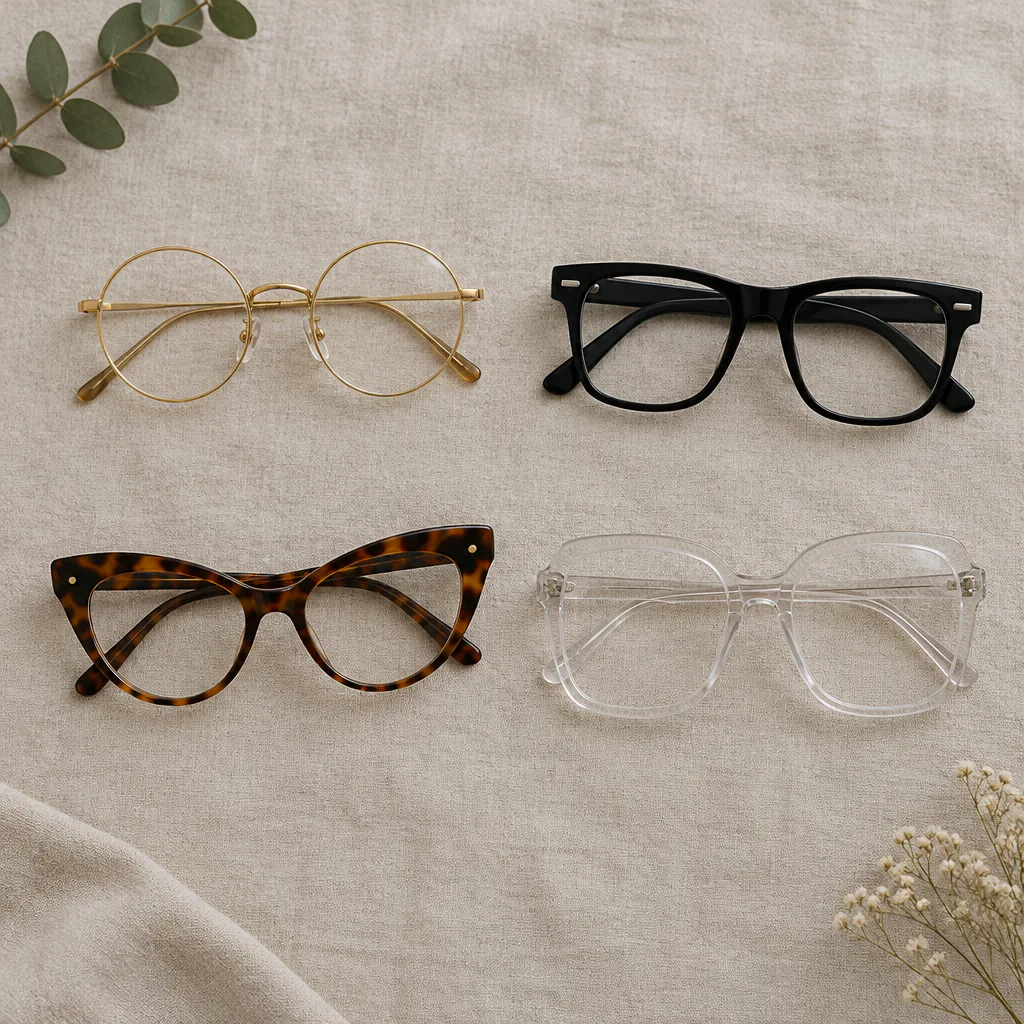
The most repeated principle in frame guides is that eyewear should contrast with the shape of the face (CareCredit). Round frames go on angular faces, angular frames on soft faces, and extra weight goes wherever the face is narrower.
It is a good rule of thumb, but sources don’t always agree on the details. Oval faces show this clearly:
- One optometry guide says oversized frames, or frames widest near the eyes, complement oval faces (Optometrists.org).
- An eye clinic advises the opposite. It says to avoid oversized frames because they can overwhelm the face (Access Eye).
Both can be true for different people. The difference often comes down to overall face size, how bold you want the frames to look, and fit.
Fit matters as much as shape. Shape rules don’t cover it, but in practice you should check these points (editorial suggestions):
- The frame width roughly matches the width of your face at the temples, with no gaps or pinching.
- The bridge rests on your nose without sliding.
- Your eyes sit roughly in the center of the lenses.
- The frame doesn’t press on your cheeks when you smile.
A frame that fits well and suits your style will usually beat a “correct” shape that pinches or slides.
When You Sit Between Two Shapes
Most faces are not textbook examples. Many people have a primary shape with secondary traits from a neighboring one (Calqora). Common overlaps include:
- Round and square: soft cheeks with a more defined jaw.
- Oval and oblong: balanced widths but a long face.
- Oval and heart: a slightly wider forehead than the oval description.
- Diamond and oval: prominent cheekbones with gentler taper.
If you land between two, don’t force a choice. Read the guidance for both shapes and look for advice they share. For example, round and square both point toward some vertical lines in hair. When the two shapes give opposite advice, test both options rather than trusting a chart.
Also remember that the visible outline changes with things that have nothing to do with bone structure. Haircut, facial hair, camera lens distance and head angle all change it. If two photos give you different shapes, the setup of the photos is the likely cause.
Practical Tips for Using Your Face Shape
These are editorial suggestions for getting value from the label without letting it box you in.
- Use it to describe your face, not to set rules. “My forehead is my widest point” is more useful to a stylist than “I’m a heart.” Bring both.
- Show your barber or stylist photos. Pair two or three reference haircuts with your shape notes. Ask which ones will work with your hair texture and growth pattern, since texture often matters more than outline.
- Try on frames in two categories. Pick one frame that follows the contrast rule and one that ignores it. Take straight-on photos in the same light and compare them a day later.
- Decide what you want to emphasize. Balancing is only one goal. If you like your strong jaw or high cheekbones, choose styles that show them off.
- Re-check after big changes. A new haircut, a beard or a major change in body weight can change which category feels closest.
- Ignore rarity talk. Being an “uncommon” shape is not a status marker, and the percentages floating around online conflict too much to mean anything.
The 7 face shapes give you a shared language for proportions. Use them to narrow your options, then let fit, hair texture and personal style make the final call.
Sources & further reading
- Face shape classification using Inception v3
- A hybrid approach to building face shape classifier for hairstyle recommender system - ScienceDirect
- Face Shape Classification Using Swin Transformer Model - ScienceDirect
- (PDF) Hairstyle Recommendation Based on Face Shape Using Image Processing
- Choosing Glasses for Your Face Shape - Optometrists.org
Frequently asked questions
What are the 7 face shapes? +
The seven most guides use are oval, round, square, heart, diamond, oblong and triangle. Oblong is also called rectangular, and triangle is sometimes called pear. Some sources use five or six categories instead, so seven is a convention rather than a fixed standard.
How do I know my face shape for sure? +
You usually can't be fully certain, and that is normal. Take a straight-on photo with your hair pulled back, then compare forehead, cheekbone and jaw width along with overall length. Many people fall between two shapes, so pick a closest match and a runner-up.
Can your face shape change? +
Your bone structure doesn't change from day to day, but your visible outline can. Haircuts, facial hair, body weight changes, camera distance and head angle all affect which shape looks closest, so re-check after a big change.
Do I have to follow face shape rules for glasses and haircuts? +
No. The rules are stylist and optician conventions, such as choosing frames that contrast with your face shape, and sources sometimes disagree. Use them to narrow your options, then let fit, hair texture and personal preference decide.
What is the rarest face shape? +
Diamond is often described as uncommon, but published prevalence figures conflict widely between sites, so no reliable global count exists. Rarity also says nothing about attractiveness or how well styles will suit you.