 Aura: Looksmaxxing
Best Glasses for a Diamond Face: Frames That Fit
Which frames balance prominent cheekbones, how to confirm you are actually diamond, and the fit checks that matter more than the shape rule.
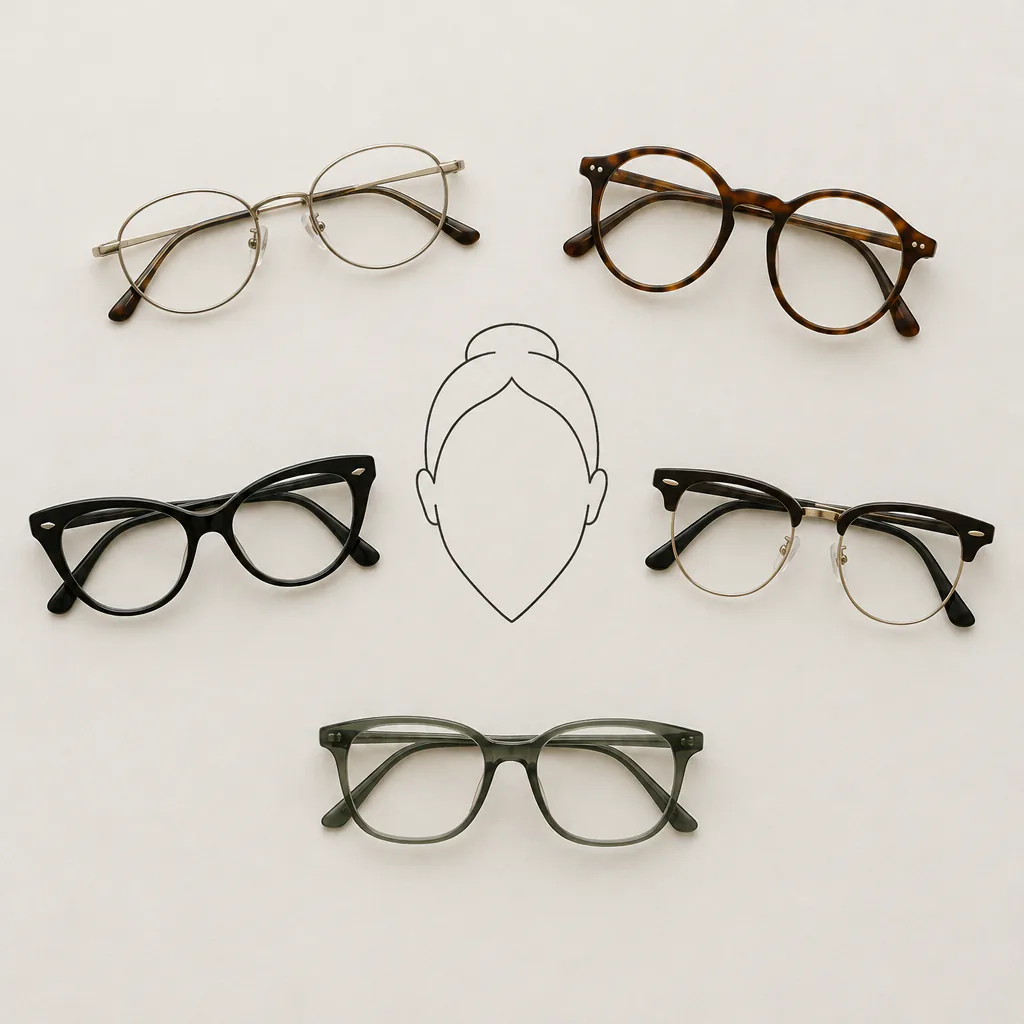
Diamond faces are built around the cheekbones. They are the widest point, and the face narrows both above and below them. That shape gives glasses a specific job, which is why most diamond-face guides land on similar recommendations.
One caveat before the list. Nearly all face-shape frame advice comes from eyewear retailers and stylists. It is styling convention, not measured science, and no study shows that one frame shape suits a diamond face better than another. The convention is a sensible starting point based on visual balance. Fit, comfort and your own taste should decide the rest.
This guide covers four things:
- How to confirm you have a diamond face
- Which frame styles are commonly recommended, and why
- Where the guides disagree
- The fit checks that matter more than any shape chart
First, Confirm You Actually Have a Diamond Face
It is easy to pick frames for the wrong shape. Diamond is often confused with heart, and a few minutes of checking saves you from following advice that does not apply.
The defining proportions
OvalFaceShape.com describes the diamond face like this:
- The cheekbones are the widest part of the face.
- The forehead and jawline are both narrower, and roughly similar in width to each other.
- The face tapers to a pointed chin.
In anthropometric terms (anthropometry is the measurement of human body proportions), your bizygomatic width is larger than both your forehead width and your bigonial width. Bizygomatic width is measured cheekbone to cheekbone. Bigonial width is measured jaw corner to jaw corner.
The diamond is often described as a less common face shape. Perfect Corp calls it one of the rarer ones. However, face-shape categories vary between sources, and there is no solid population data behind any exact ranking.
Diamond vs. heart
This is the most useful distinction to check. According to Oblong Face Shape, diamond faces narrow both upward and downward from the cheekbones, while heart faces narrow only downward. If your forehead is about as wide as your cheekbones, you are probably closer to heart, and heart-shaped advice will suit you better.
A quick mirror check
- Pull your hair fully back off your forehead and temples.
- Face the mirror straight on with a neutral expression. Smiling raises the cheeks and can distort the read, as OvalFaceShape.com points out.
- Compare three widths: forehead, cheekbones and jaw.
- Check the result. If the cheekbones are clearly widest, the forehead and jaw look narrower and similar to each other, and the chin tapers, diamond is a reasonable label.
If you keep going back and forth, a second opinion from a photo can be useful. Aura’s Face Shape Finder gives your likely face shape with its uncertainty. It also explains how your forehead, cheek and jaw proportions compare, and suggests styling options, including accessories such as frames. It does not produce exact physical measurements.
You upload a photo before signing up. The free result is a subjective styling-potential estimate. The full breakdown is part of Aura Pro ($9.99 a month or $49.99 a year).
The Styling Logic: Balance the Widest Point
Most diamond-face recommendations rest on visual balance. Glasses.com describes the goal as adding width near the forehead while softening the cheekbones. Banton Frameworks puts it a similar way: add width to the top half of the face and slightly round out the bottom half. It suggests frames that are wider at the top, such as cat-eye or ’50s oval shapes.
In practice, you have two levers to work with:
- Top-line width. A strong, wide or upswept upper edge draws the eye to the brow, which is the narrow zone above your cheekbones.
- Curves. Rounded lenses contrast with angular cheekbones and a pointed chin instead of repeating them.
Where the guides disagree
Sources do not agree on what frames should do with your cheekbones:
- Soften them. This is how Glasses.com describes the goal.
- Highlight them. Zenni says cat-eye or oval frames highlight the cheekbones while softening angles.
- Accentuate them. Vooglam suggests oversized frames to highlight the widest part of the face.
Neither camp is wrong, because they are answering different questions. Editorial suggestion: decide first whether you want your cheekbones to be the main feature or to blend in, then choose frames to match.
- If you like your sculpted look, you might lean into a bold cat-eye.
- If you want a calmer overall impression, a soft oval with a thinner rim might suit you better.
Frame Styles Commonly Recommended for Diamond Faces
Glasses.com sums up the consensus: the best glasses for diamond-faced men and women are typically rounded, oval or cat-eye frames. Here is how each style works, plus two more worth trying.
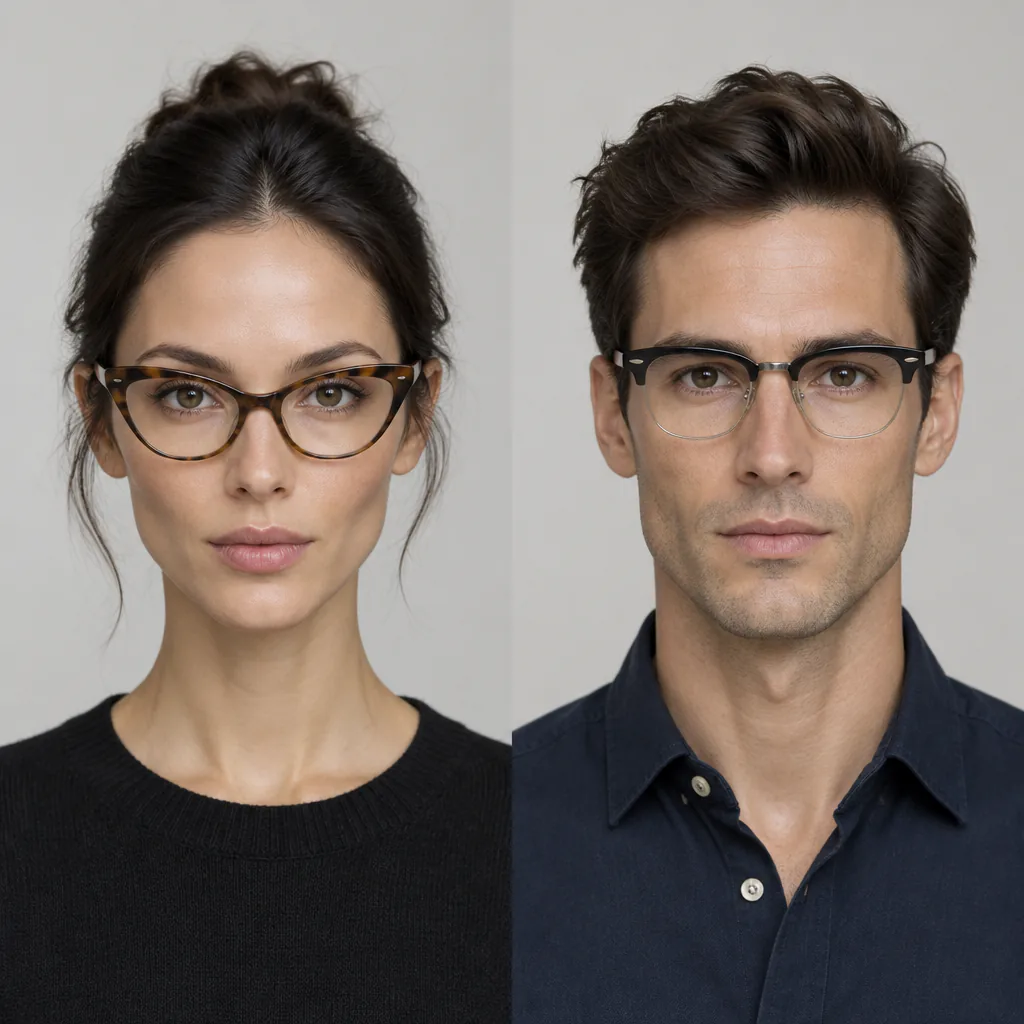
Oval frames
Oval lenses are the most frequently recommended starting point. Moscot lists oval or round frames as a way to soften angles. They come in every material, from thin metal to thick acetate, which makes them an easy first try.
Try this if: you want a balanced, low-risk frame for everyday wear.
Round frames
Round frames give the strongest curved contrast against an angular face. Moscot groups them with ovals for softening angles. Editorial note: very small round lenses can look lost next to wide cheekbones. Try a few lens sizes and see which one holds its own visually.
Try this if: you like a vintage or creative look and want maximum softness.
Cat-eye and upswept frames
Cat-eye frames rise at the outer top corners. That adds width and lift where a diamond face is narrowest.
- Moscot lists cat-eye or upswept styles as a balancing option.
- Banton Frameworks names cat-eye among the frames that are wider at the top.
This style is often associated with feminine styling. Subtler upswept shapes also appear in unisex collections.
Try this if: you enjoy a little drama, or you want your cheekbones to stay a feature.
Browline frames
Browline frames have a heavier top bar and a thinner lower rim, and some have no lower rim at all. The bold top line adds visual weight across the brow. GlassesShop recommends browlines as a frame that shows off high cheekbones.
Browlines are a common pick for men who want structure without a fully angular frame. They also work in feminine styles with slimmer or colored top bars.
Try this if: you want definition and a classic look.
Soft square and rectangular frames
You do not have to avoid corners entirely. Banton Frameworks notes that rectangular and square glasses can work, as long as the overall shape is balanced and gentle rather than overly angular or sharp. Look for slightly rounded corners and a top line that is at least as strong as the bottom.
Try this if: you want a sharper, more professional look without echoing every angle of your face.
Frames to Approach With Caution
These styles are not banned. They simply take more care to get right on a diamond face. The following points are editorial suggestions based on the balance logic above, not measured findings.
- Narrow frames. A frame clearly narrower than your face adds nothing at the brow. It can also make your cheekbones look broader by comparison.
- Sharply angular frames. Hard geometric shapes repeat the angles you already have. If you love them, choose versions with softened corners.
- Bottom-heavy frames. A thick lower rim with a thin top pulls attention down toward a narrow chin. That works against the balance approach.
- Very oversized frames. These are contested. Vooglam recommends them for a bold look, while other guides focus on proportion. If you try them, check that the frame does not rest on your cheekbones, as covered below.
Fit Matters More Than Shape
A well-chosen shape in the wrong size will still look off and feel uncomfortable. Diamond faces also have a specific fit challenge: prominent cheekbones.
Width at the temples
An optician-focused guide from Optogrid says frame width should roughly match the width of your face at the temples. It adds that frames extending well past the face look oversized.
A diamond face narrows above the cheekbones, so check width at your temples, not just at the widest point of your face. A frame sized to your cheekbones can look too wide higher up.
Keep frames off your cheeks
The American Association for Pediatric Ophthalmology and Strabismus states that, in general, frames should not touch the cheeks or eyelashes, and the eyes should sit in the center of the lenses. That guidance is written for children’s glasses. It is still a sensible check for adults, especially if your cheekbones sit high.
To test this, put the frames on and smile broadly. If the lower rim lifts or presses into your cheeks, the frame is too deep or sits too low. Adjusting the nose pads or choosing a different bridge fit can change where it rests.
Read the numbers on your current pair
Most frames print three measurements, in millimeters, on the inside of the temple arm:
- Lens width
- Bridge width
- Temple length
Warby Parker’s fit guide gives common ranges of about 40 to 60 mm for lens width, 14 to 24 mm for bridge width, and 120 to 150 mm for temple length. It also notes that the most suitable size varies by person. If you already own a pair that fits well, use its numbers as a reference when you shop, especially online.

Materials and Budget
Shape gets most of the attention, but material decides how a frame feels at the end of a long day. The American Academy of Ophthalmology notes that most people focus on price and style, but weight, strength, flexibility and corrosion resistance matter too. It describes titanium frames as very strong, lightweight, corrosion-resistant and hypoallergenic. That is important if you are allergic to metals such as nickel.
On price, the AAO is direct: spending more on frames does not mean you will end up with better-quality eyeglasses. A well-fitted affordable frame is a better buy than an expensive one that slides down your nose.
Editorial suggestion: if you try a bold acetate browline or cat-eye, pay attention to its weight. A heavy frame that slips will end up resting on your cheekbones, which undoes the fit work above.
A Practical Try-On Routine
Use this checklist in a store or with home try-on frames.
- Confirm your shape. Do the mirror check with your hair back and a neutral expression.
- Pick your goal. Decide whether your cheekbones should be a feature or blend into a softer overall look.
- Start with three contrasting styles. Try one oval or round, one cat-eye or browline, and one soft square. This quickly shows which direction suits you.
- Check the top line. Does the upper edge add presence at the brow, or does it disappear?
- Check width at the temples. The frame should not stick far out past the sides of your head.
- Do the smile test. The lower rim should not touch your cheeks or lift off them.
- Check eye position. Your eyes should sit near the center of each lens.
- Wear the frames for a few minutes. Notice any pressure behind your ears or on your nose.
- Get them adjusted. An optician can adjust nose pads and temple arms, which often fixes problems that look like a shape issue but are really a fit issue.
The Bottom Line
By common styling convention, the best glasses for a diamond face shape add presence at the brow and bring curves to an angular outline. The usual recommendations are oval, round, cat-eye, browline and soft square frames.
Treat that convention as a starting point, not a rule:
- Confirm your shape first.
- Decide how you want your cheekbones to read.
- Let width at the temples and clearance at the cheeks make the final call.
Sources & further reading
- Glasses Fitting for Children - American Association for Pediatric Ophthalmology and Strabismus
- How to Choose the Glasses Frame Material That's Right for You - American Academy of Ophthalmology
- Eyeglasses: How to Choose Glasses for Vision Correction - American Academy of Ophthalmology
- Glasses for Diamond Shaped Faces: the guide
- Best glasses for a diamond face shape 2025
Frequently asked questions
What glasses suit a diamond face shape? +
Styling guides most often recommend oval, round and cat-eye frames, with browline and soft-square frames as good alternatives. The usual reasoning is to add width at the brow and bring curves to an angular face. This is styling convention rather than science, so try several shapes and let fit decide.
Can men with diamond faces wear the same frames as women? +
Mostly, yes. Oval, round, browline and soft-square frames are widely available in men's and unisex styles, and browlines are a common choice for men who want structure. Cat-eye frames are usually styled as feminine, but subtle upswept shapes exist in unisex collections.
Should diamond faces avoid rectangular glasses? +
Not necessarily. Rectangular and square frames can work if the overall shape is balanced and gentle rather than sharp, so look for slightly rounded corners. Hard, very angular frames tend to repeat the angles of a diamond face rather than balance them.
How do I tell a diamond face from a heart face? +
Pull your hair back and compare the width of your forehead, cheekbones and jaw while keeping a neutral expression. A diamond face narrows both above and below the cheekbones. A heart face keeps a wide forehead and narrows only toward the chin.
Are oversized glasses good for a diamond face? +
Guides disagree. Some recommend oversized frames to highlight the cheekbones, while others focus on keeping frames in proportion. If you try them, check that they do not sit on your cheekbones and do not extend far past the sides of your face at the temples.