 Aura: Looksmaxxing
Best Glasses for a Triangle Face: Frames That Work
Frames that add weight up top to balance a wider jaw, where the standard guides contradict each other, and how to size frames to your own face.

If you have a triangle face, most glasses guides give the same advice: put the visual interest near your brows and keep the bottom of the frame quiet. That advice is mostly sound. But the guides contradict each other on round and square frames, and several confuse a triangle face with its opposite, the inverted triangle. This guide covers what the sources agree on, where they split, and how to judge frames on your own face instead of trusting a chart.
One note up front: matching frames to face shape is a styling convention used by opticians and eyewear brands. No clinical study says a given frame is “best” for a given face. Treat everything below as a starting point for try-ons, not a rule.
What a triangle face shape actually is
A triangle face, often called a pear-shaped face, is wider at the bottom than the top. Poudre Valley Eye Care, an eye-care practice, describes the triangle face shape as having a broader chin. GlassesShop defines it as a face with a forehead narrower than the jawline.
In anatomical terms, the widest part of the face runs across the mandible (the lower jawbone). The frontal region (the forehead) and the temples read narrower by comparison.
Don’t confuse it with the inverted triangle
The inverted triangle is the reverse: a wider forehead tapering to a narrower chin. MOSCOT notes that this shape sometimes overlaps with what stylists call a heart-shaped face.
The difference matters because the advice flips:
- YesGlasses’ triangle guide is written for inverted triangle faces. It recommends frames that tone down forehead width, which is the opposite goal for a pear-shaped face.
- Banton Frameworks describes triangular faces as having wide cheekbones and a pointed chin. That sounds closer to an inverted triangle or heart shape.
Before you trust any frame list, check which version the writer means.
A quick self-check
- Pull your hair back and look straight into a mirror at eye level.
- Compare three widths by eye: the forehead near the hairline, the cheekbones, and the jaw just below the ears.
- If the jaw is clearly the widest and the forehead the narrowest, you’re in triangle territory. If it’s the reverse, you’re closer to inverted triangle or heart.
- If the widths look similar, you might be oval, square or a mix. Plenty of faces sit between categories.
If you’d rather not judge it by eye, Aura’s Face Shape Finder gives your likely face shape with its uncertainty stated. It also explains your forehead, cheek and jaw proportions and suggests styling options.
- You can upload a photo before signing up.
- The free result is a subjective styling estimate.
- The full breakdown is part of Aura Pro ($9.99 a month or $49.99 a year).
It’s a styling aid, not a measuring tool.
The core principle: weight up top, light at the bottom
Most guides for pear-shaped faces land on the same logic. The jaw already carries visual width, so the frame’s job is to add presence near the brows and temples. MOSCOT recommends upswept corners to help widen the forehead. It also advises against thick or heavy bottom rims, which add unwanted weight to the lower face.
In practice, that means looking for three things:
- A strong or wide top line. The brow bar or upper rim should be the most visible part of the frame.
- Outer corners that lift slightly. Even a subtle upswing draws the eye outward and up.
- A thin or absent lower rim. Semi-rimless designs, metal lower edges or clear acetate on the bottom keep weight off the jaw.
This is the editorial filter used for the frame styles below.
Best glasses for triangle face shape: styles to try first
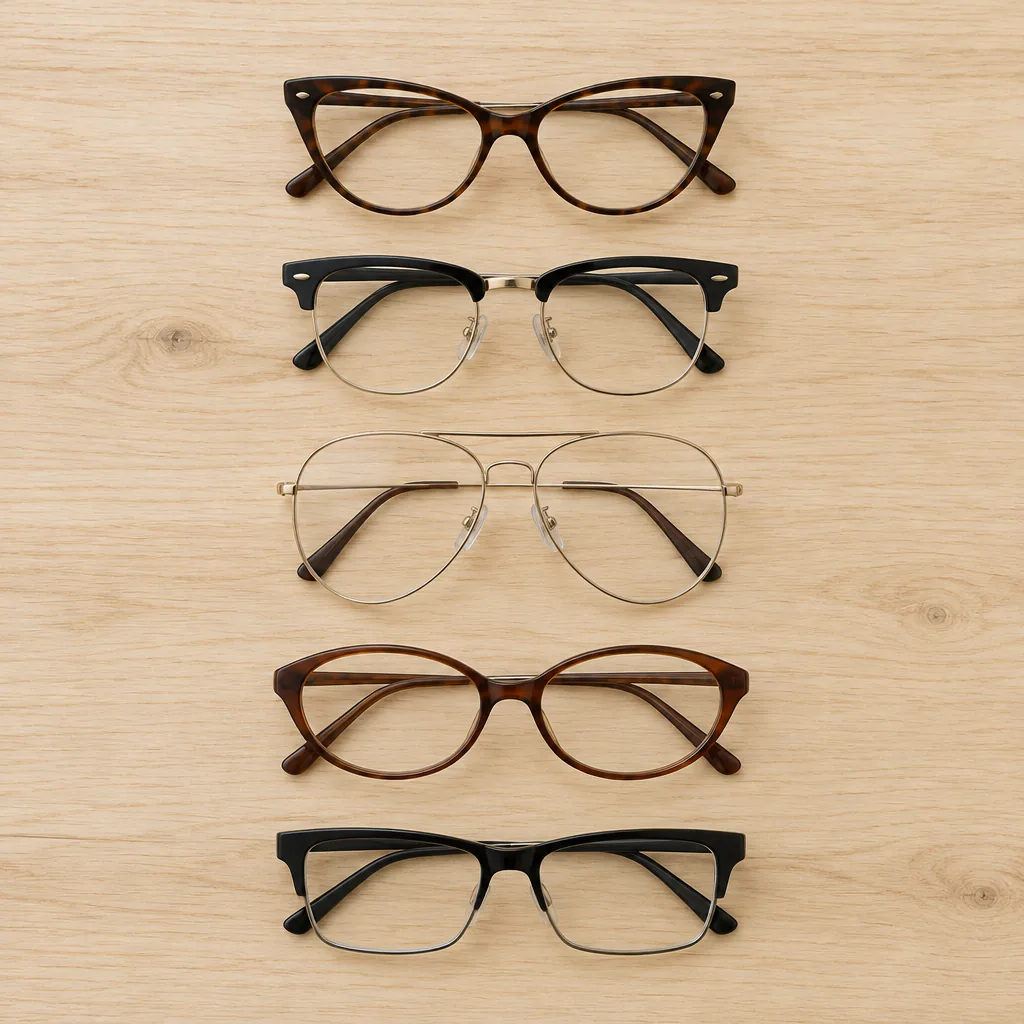
Pearle Vision’s face shape guide lists cat-eye, browline, oval and aviator as its picks for pear and triangle faces. Specsavers suggests cat-eye or rectangular frames to add balance. Here’s how each style works and what to watch for.
Cat-eye
Upswept outer corners are the clearest example of the lift principle, and cat-eye sits at or near the top of most lists.
- Start with a moderate wing rather than a sharp point, especially for everyday wear.
- Look for a thinner bottom edge.
- If a full cat-eye feels like too much, a softly lifted rectangle or oval gives a similar effect.
Browline
Browline frames have a thick upper rim, usually acetate, and a thin metal or rimless lower half. That build is almost a literal version of weight up top, light at the bottom, which is why it suits triangle faces so well. Browlines look classic and work with most wardrobes.
Aviator
Aviators are wider at the top and taper toward the bottom, with a bar across the brow. Pearle Vision includes them in its picks for pear and triangle faces.
- Thin metal versions keep the lower edge light.
- Skip very narrow aviators that sit well inside your face width.
Oval
Oval frames are a softer option if you prefer understated glasses. MOSCOT notes that round or oval shapes help soften angular lines. Choose one with enough width and height that it doesn’t look small against a wider jaw.
Top-heavy rectangles
Specsavers names rectangular frames, and Foster Grant argues that angular styles can contrast with a rounded jawline. Our editorial take: a rectangle suits a triangle face best when the top rim is thicker or darker than the bottom. That way it still follows the top-heavy principle.
Where the guides disagree
Round frames
Round frames are the most contested style:
- Avoid: Foster Grant tells pear-shaped faces to skip round frames, arguing they mimic the roundness of the jaw and make it look wider. Pearle Vision also advises against round shapes for pear and triangle faces.
- Recommended: Eyewa takes the opposite view, calling round eyewear one of the best glasses for triangle faces.
- In between: MOSCOT says round or oval shapes help soften angular lines.
A plausible way to reconcile this (editorial, not proven) is that it depends on your jaw. A round frame adds contrast to an angular jaw but echoes one that is already soft and rounded. Size matters too. A small round frame looks very different from one that matches your temple width.
Square frames
Foster Grant recommends rectangle or square frames for contrast. Pearle Vision’s guide tells pear and triangle faces to avoid square shapes, yet a second recommendation list on the same page includes rectangle and square. Given that inconsistency, judge square frames by the top-heavy test rather than by the shape’s name.
Do you even need to balance your face?
Berris Optical points out that some people choose to accentuate their angular features rather than soften them. A strong jaw is a feature, not a flaw. If you like a bold, structured look, a heavier frame is a legitimate choice. The balancing rules aim for one visual effect. They aren’t the only right answer.
Frames that often work against a triangle face
If your goal is balance, these are the styles to approach with caution:
- Small or narrow frames. Foster Grant warns that tiny frames can make your forehead look even smaller next to a wide jaw.
- Frames that sit low on the nose. Foster Grant also notes these pull attention down toward the jawline.
- Heavy bottom rims. MOSCOT advises against thick lower rims that add weight.
- Bold color or pattern concentrated low. Banton suggests thick frames or bold patterns to add width to the lower half of the face. That advice targets the face it describes, with wide cheekbones and a pointed chin. On a pear-shaped face, extra weight at the bottom works against the top-heavy principle.
Fit matters more than frame shape
A frame can be the right shape on paper and still look wrong in the wrong size. This part of the advice rests on more practical ground than face-shape matching does.
Width
An optician-focused guide from Optogrid says frame width should roughly match the width of your face at the temples. It adds that frames extending well past the face look oversized.
Our editorial read for triangle faces: use your temples as the reference, not your jaw. A frame sized to the widest part of your lower face is likely to overshoot your temples and look too big up top.
Eye position
Warby Parker recommends that frame size match your face size and pupil position, so your eyes sit in an appropriate area of the lens. If your eyes crowd the inner edge or sit very high in the lens, the size is off, whatever the style.
Material
The American Academy of Ophthalmology notes that beyond price and style, you should weigh how lightweight, strong, flexible and corrosion-resistant a frame is. It describes titanium as very strong, lightweight, corrosion-resistant and hypoallergenic, which matters if you react to metals like nickel. Thin metal also fits the light-bottom approach, for example on the lower half of a browline or semi-rimless frame.
Price
The AAO also points out that spending more on frames doesn’t mean you get better-quality eyeglasses. A well-fitted mid-priced frame beats an expensive one in the wrong size.
A practical try-on routine
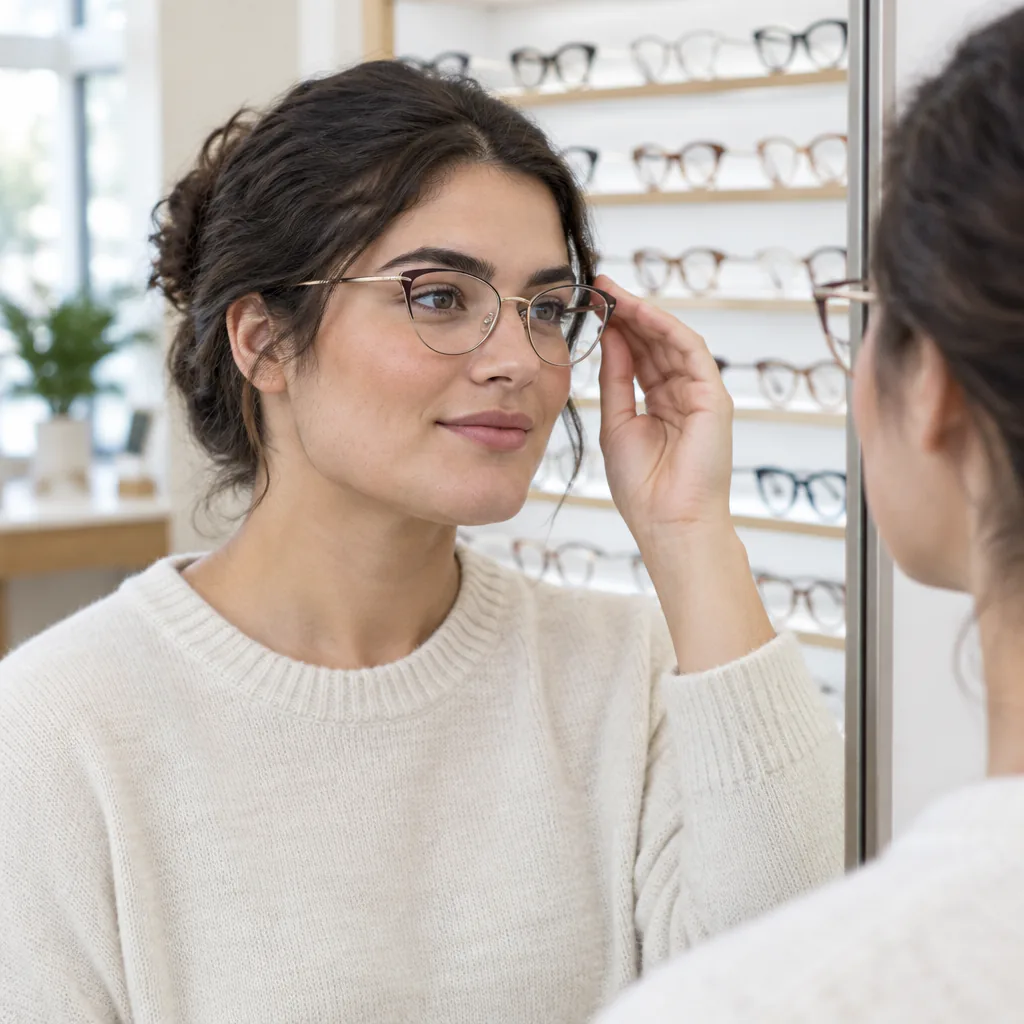
These steps are editorial suggestions for testing frames in a store or with a home try-on kit.
- Confirm your shape. Use the mirror check above, and make sure you’re shopping for a triangle face, not an inverted triangle.
- Shortlist by structure. Pick frames with a stronger top line and a lighter bottom edge: browline, cat-eye, aviator, top-heavy rectangle or a wide oval.
- Check width at the temples. The outer edges of the frame should line up roughly with your temples, not your jaw.
- Check eye centering. Look straight ahead. Your eyes should sit comfortably within each lens, not crowd an edge.
- Look at the bottom rim. If it’s the heaviest or darkest part of the frame, set it aside.
- Take photos. Shoot a front view and a three-quarter view in natural light, without filters. Compare them side by side rather than relying on a quick glance in the mirror.
- Test the contested styles once. Try one round frame and one bolder frame. The sources disagree here, so your own face is the tiebreaker.
- Wear-test. Keep the frames on for a few minutes and check that they don’t slide or pinch.
The bottom line
For a pear-shaped triangle face, the most consistent advice is simple. Choose frames with presence at the brow line and a light lower edge, sized to your temples.
- Safest starting points: browline, cat-eye, aviator and wide oval frames.
- Contested: round and square frames, so test them rather than ruling them in or out.
- Your call: if you like a strong jaw, you don’t have to soften it.
Sources & further reading
- How to Choose the Glasses Frame Material That's Right for You - American Academy of Ophthalmology
- Eyeglasses: How to Choose Glasses for Vision Correction - American Academy of Ophthalmology
- Find the best glasses for your face shape
- Three Tips on How to Find the Best Glasses for Your Face Shape
- Best Designer Glasses for Triangle Faces
Frequently asked questions
What are the best glasses for a triangle face shape? +
Frames with a stronger top line and a lighter bottom edge are the most consistent recommendation. Pearle Vision lists cat-eye, browline, oval and aviator for pear and triangle faces, and Specsavers suggests cat-eye or rectangular frames.
Should people with triangle faces avoid round glasses? +
The sources disagree. Foster Grant and Pearle Vision say to avoid round frames, while Eyewa calls them one of the best options. In our editorial view, round frames contrast with an angular jaw but echo a soft one, so try a pair before deciding.
Is a triangle face the same as a heart-shaped face? +
No. A triangle or pear face is wider at the jaw and narrower at the forehead. MOSCOT notes that the inverted triangle, which is wider at the forehead, sometimes overlaps with what stylists call a heart shape, and the frame advice for it is roughly the opposite.
How wide should my glasses be if I have a triangle face? +
An optician-focused guide from Optogrid says frame width should roughly match your face width at the temples. For a triangle face, use your temples as the reference rather than your wider jaw, and check that your eyes sit in an appropriate area of each lens.