 Aura: Looksmaxxing
Best Glasses for a Heart Face: What Balances It
Frames that balance a wider forehead against a narrower chin, the shapes that make the imbalance worse, and how to check fit before you buy.
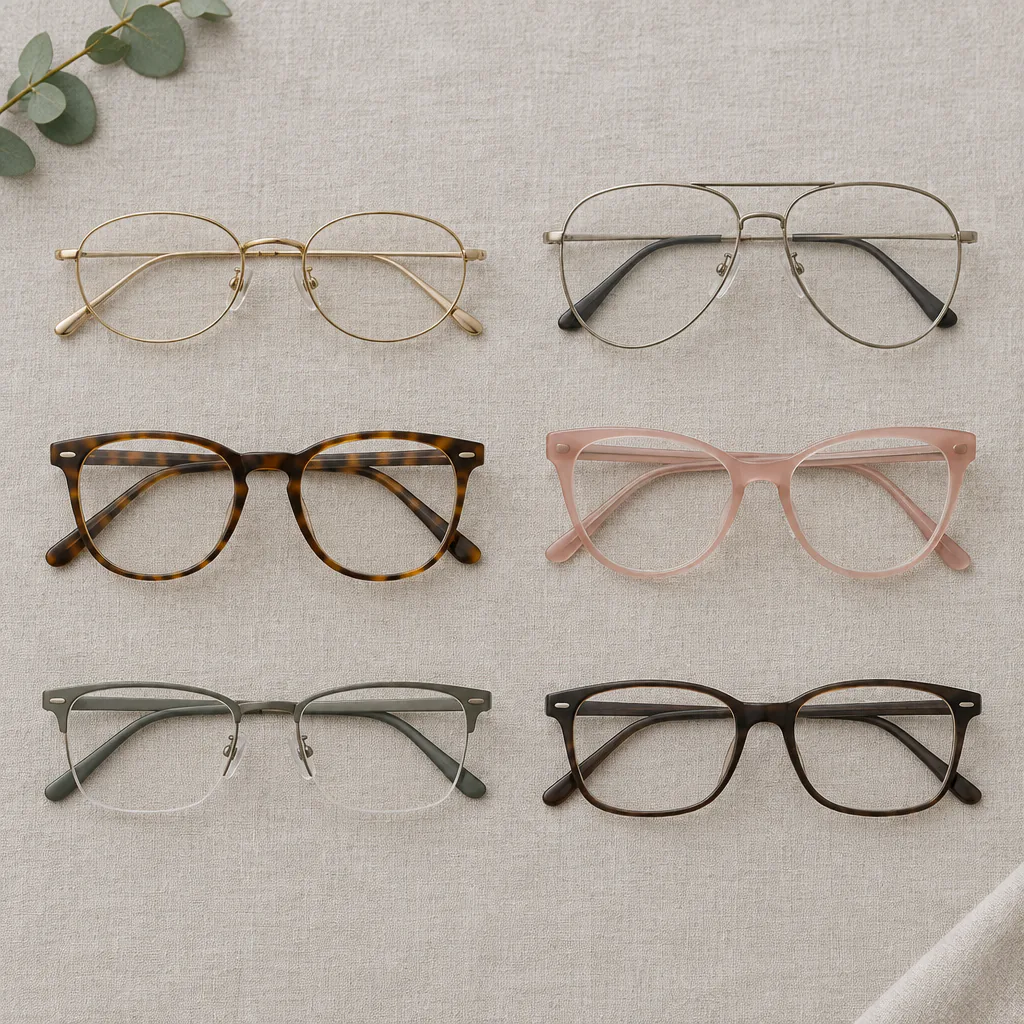
If your forehead and cheekbones are the widest part of your face and your chin tapers to a point, you have probably read a dozen lists of the “best” frames for you. Many of them come from retailers trying to sell a specific model, and some contradict each other.
This guide takes a different approach. It explains the balance principle that optometry and eye-care sources actually agree on, walks through the frame styles that follow it, flags where advice conflicts, and ends with a fit checklist. One caveat up front: face-shape guidance is a styling convention, not a measured science. Use it to narrow your options, then let fit, comfort, and your own taste decide.
What Counts as a Heart-Shaped Face
All About Vision describes a heart-shaped face as having a wide top third and a narrow bottom third. An eye hospital guide puts it in slightly more detail: a wider forehead and cheekbones with a narrow chin.
In practical terms, look for these traits:
- Forehead: relatively broad, often the widest or tied for widest point.
- Cheekbones: prominent and close in width to the forehead.
- Jaw and chin: the face narrows noticeably toward a smaller or pointed chin.
- Hairline: some people have a widow’s peak, but it is not required.
Real faces rarely match a textbook outline. Optometrists.org says this directly: your face is not a “perfect” heart or square, and the category is useful mainly because it helps you narrow your frame choices. If you sit between two shapes, borrow ideas from both.
Heart vs. Triangle vs. Diamond
The labels are not used consistently, which causes real confusion when you shop.
- Rosen Optometry describes a “triangle” face as having narrow chins and wide foreheads. That is close to how most sources define a heart shape.
- Vuarnet uses “triangular” for the opposite: a narrower forehead and a wider chin.
- A diamond face is usually described as narrow at both the forehead and the chin, with the cheekbones as the widest point.
Before you follow any guide, check how it defines the shape. If a “triangle” guide describes a wide forehead and narrow chin, its advice applies to you. If it describes a wide jaw, it does not.
The Core Principle: Balance the Top and the Bottom
The most consistent idea across eye-care sources is visual balance. Your face carries more width up top, so frames that add a little presence lower down, or that avoid piling more weight at the brow, even things out.
Here is how three eye-care sources phrase it:
- VSP says the ideal frames balance the width of the forehead with the narrowness of the chin. It also points to eyeglasses with low-set temples.
- Optometrists.org recommends a bottom-heavy frame to add width at a narrow chin, low-set temples to draw attention away from the forehead, and an oval frame to bring attention to the eyes.
- All About Vision suggests frame shapes that are wider at the bottom, plus thin, light-colored, or rimless frames with an airy look.
Two terms come up repeatedly:
- Temples are the arms of the glasses that run back over your ears. Low-set temples attach lower on the frame front, closer to the middle of the lens than the top edge. This moves the visual line down your face rather than reinforcing the brow.
- Bottom-heavy means the lower rim is more visible than the top. This can come from thicker material, a deeper lens shape at the bottom, or color concentrated along the lower edge.
You do not need to apply every guideline at once. A light frame with a gently rounded bottom already follows the principle.
Frame Styles That Work for Heart-Shaped Faces
All About Vision summarizes the options as rectangular, oval or square frames. Other eye-care sources add aviators, D-frames, cat-eyes, and semi-rimless styles. Here is how each one relates to the balance principle.
Oval Frames
Oval frames are the most frequently recommended option. All About Vision says they soften and balance angles, and that they usually do not overemphasize the cheekbones the way fully round glasses can. Optometrists.org also lists oval frames as a way to bring attention to the eyes.
Editorial suggestion: look for an oval that is slightly wider than it is tall. A very tall, fully round lens adds volume right at the cheekbones, which are already wide.
Aviators and D-Frames
WebMD names aviator frames and D-frames as the best choices for heart-shaped faces. Aviators have a teardrop shape that is deeper at the bottom, which matches the bottom-heavy idea. A D-frame has a flat top and a rounded lower curve, so it reads as structured without adding heaviness at the brow.
Editorial suggestion: in optical (non-sun) aviators, a thin metal frame keeps the look light. Very thick double bridges add weight across the top of the frame.
Cat-Eye Frames
An optometry practice newsletter lists cat eye, aviator, oval or semi-rimless styles as options that balance a narrow chin and wider forehead. Cat-eyes are a natural fit if you like a classic or feminine look.
Be aware that the upswept corners add width at the top outer edge. Editorial suggestion: choose a softer, moderate lift rather than a dramatic wing, and favor lighter colors or a thinner rim, so the frame does not compete with your forehead.
Rectangular and Softened Square Frames
All About Vision includes rectangular and square shapes in its list for heart-shaped faces. A rectangle adds horizontal structure, which can offset a tapering chin.
Editorial suggestion: slightly rounded corners keep the frame from looking harsh, and a thin or light-colored rim avoids a top-heavy effect. Glasses.com makes a similar point, recommending light-colored spectacles with thin metal frames to avoid appearing excessively top-heavy.

Rimless and Semi-Rimless Frames
All About Vision describes rimless and semi-rimless frames as minimalist frames that help draw attention away from your stronger facial features. Semi-rimless frames usually have a rim only along the top, so you get some definition without a heavy outline.
Editorial suggestion: if a semi-rimless top bar feels too dominant, choose one in a muted or light tone, or try a fully rimless pair.
Where the Advice Conflicts: Top-Heavy Frames
Not every source agrees, and it helps to know where the disagreement is.
- Banton Frameworks argues that full-rim acetate glasses with a pronounced ‘browline’ are the best style for heart-shaped faces. A browline frame has a thick upper rim and a thin or absent lower rim.
- Eye-care sources point the other way. Optometrists.org and All About Vision recommend bottom-heavy or wider-at-the-bottom frames, VSP favors frames that balance the forehead with the chin and have low-set temples, and Glasses.com warns against looking top-heavy.
- Lensmart’s page contradicts itself. It first recommends frames wider at the top and narrower at the bottom, then later says frames wider at the bottom are a good option.
Our editorial read: the bottom-heavy, light-frame approach has more agreement among eye-care sources, so it is the safer starting point. That does not mean a browline frame looks wrong on you. If you like bold acetate and it feels like you, try it on and judge in a mirror and in photos. Style rules describe tendencies, not requirements.
Fit Matters More Than Face Shape
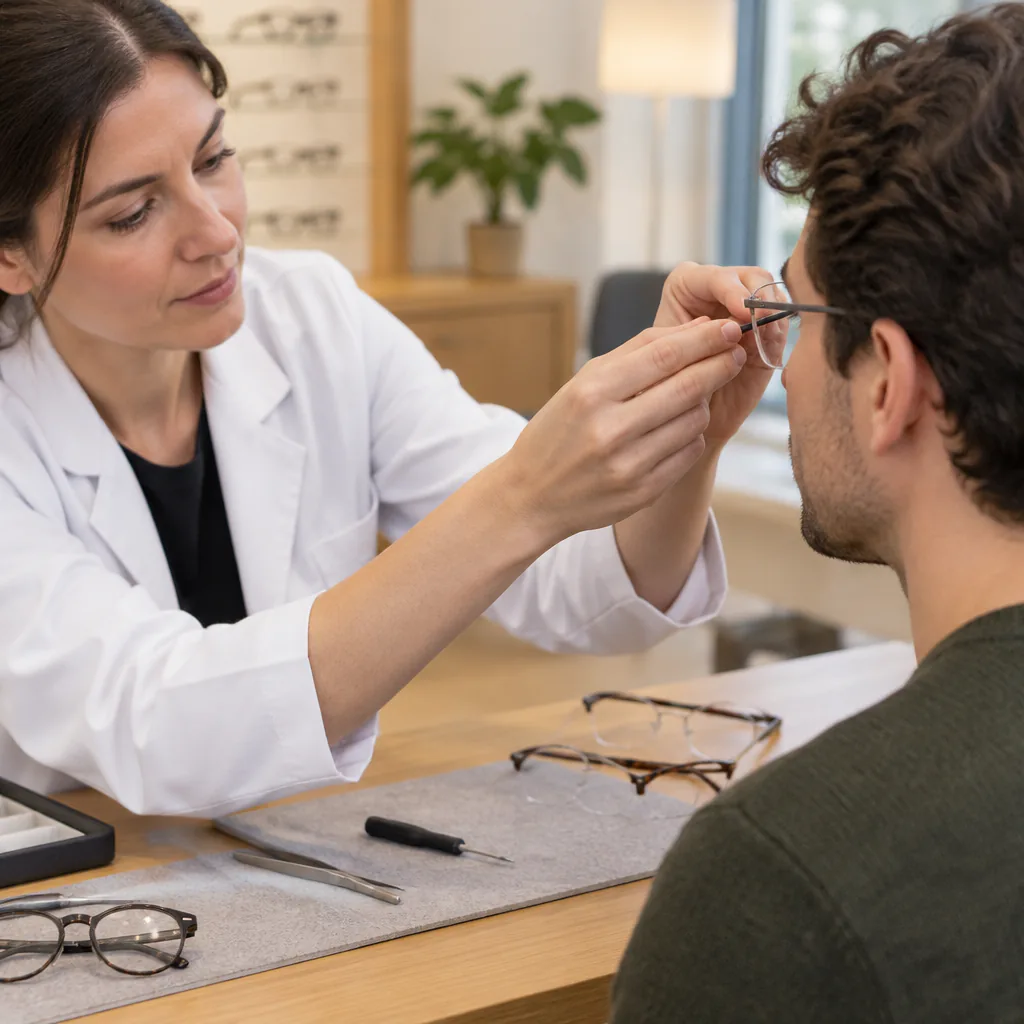
A flattering shape that slides down your nose or presses on your temples will not stay on your face. Rosen Optometry puts fit first: the priority is to make sure glasses fit your face properly and work with your prescription. Its opticians make adjustments before patients leave.
Use this checklist when trying frames:
- Width: the frame front should roughly align with the sides of your face. Heart-shaped faces are often wider at the cheekbones, so check width there, not at the chin.
- Eye position: your eyes should sit near the center of each lens, not near the outer edges.
- Bridge: the frame should rest on your nose without pinching or leaving a gap.
- Temples: the arms should reach your ears without pressing into the sides of your head.
- Cheeks: smile broadly. The bottom of the frame should not lift off or rest on your cheeks. This matters more if you have prominent cheekbones.
- Lens height for your prescription: if you wear progressive lenses, the frame must be long enough from top to bottom to accommodate multiple focal points. Very short rectangular frames can be a poor match. Ask your optician what minimum depth your lenses need.
How to Shop for Glasses for a Heart-Shaped Face
Here is a practical sequence. Treat it as an editorial routine, not a formula.
- Confirm your shape loosely. Pull your hair back, look straight into a mirror or camera, and compare the width of your forehead, cheekbones, and jaw. If the top two are clearly wider than the jaw, the heart-shape guidance applies.
- Shortlist two or three shapes. Start with oval, aviator or D-frame, and one wildcard you already like, such as a soft cat-eye or semi-rimless.
- Filter by weight and color. Prefer thinner rims or lighter colors along the top. Save bold color for the lower rim or temples if you want a statement.
- Try frames on in person, or use a virtual try-on only to narrow choices. Check the fit checklist above before judging style.
- Photograph yourself. Take straight-on and three-quarter photos in daylight. Mirrors flip your image, and photos show what other people see.
- Get the final pair adjusted. An optician can bend temples and nose pads to improve comfort and position.
Using a Face Shape Tool as a Starting Point
Apps that guess your face shape can save time, but they are not precise. Academic work on automated frame matching has been narrow. One study grouped faces into only two categories, oval and non-oval, to recommend frames. Another paper reviewed an earlier system built mainly around oval and square faces and tested with 11 users. Neither validates heart-shape frame rules.
If you are unsure whether you are heart, diamond, or oval, Aura’s Face Shape Finder gives a likely face shape with stated uncertainty. It also explains your forehead, cheek, and jaw proportions in plain terms and suggests haircut and accessory options. It does not provide exact physical measurements. The free result is a subjective styling-potential estimate. The full findings require an account and a one-time purchase. Use it as one input alongside trying frames on.
Practical Tips Beyond Shape
- Color: light, translucent, or soft metallic finishes keep the top of the frame from dominating. Tortoiseshell is a middle ground with more presence than clear acetate but less than solid black.
- Material: thin metal and rimless frames read as light. Acetate gives more color options and visual weight, so place that weight thoughtfully.
- Hair: styles with volume at the jaw, such as chin-length cuts or soft layers around the lower face, work in the same direction as bottom-heavy frames. This is an editorial styling pairing, not a rule.
- Proportion: a frame that is too small can make a broad forehead look larger by comparison. A frame that is far too large hides the face. Aim for a frame that sits comfortably within your face width.
- Sunglasses: the same logic applies, and aviators are a common choice. Check that the lens covers your eyes well for actual sun protection.
The Bottom Line
The best glasses for a heart-shaped face usually add a bit of presence near the bottom of the frame and keep the top light. Oval, aviator, D-frame, softened rectangular, moderate cat-eye, and rimless or semi-rimless styles all follow that idea. Advice conflicts on bold browline frames, so treat them as a personal-taste choice rather than a default.
Most important, a frame that fits your width, bridge, ears, and prescription will serve you better than a “perfect” shape that does not. Use face-shape guidance to narrow the field, then let fit and your own style make the final call. For eyewear decisions tied to your vision or prescription, an optician or optometrist is the right person to check your final choice.
Sources & further reading
Frequently asked questions
What are the best glasses for a heart-shaped face? +
Eye-care sources most often recommend oval, aviator, D-frame, rectangular or softened square, cat-eye, and rimless or semi-rimless frames. The common thread is balancing a wider forehead with a narrower chin, usually through frames that are lighter at the top or slightly fuller at the bottom.
Should I avoid browline or top-heavy frames with a heart-shaped face? +
Sources disagree. Optometrists.org and All About Vision favor bottom-heavy, wider-at-the-bottom, or light frames, and VSP recommends frames that balance the forehead with the chin, such as those with low-set temples. At least one eyewear brand recommends bold browline frames. Start with lighter or bottom-heavy styles, but try a browline pair if you like the look and judge it in person.
Do round glasses work on a heart-shaped face? +
They can, but All About Vision notes that oval frames usually avoid overemphasizing the cheekbones the way fully round glasses can. If you like round frames, a slightly wider, less tall lens is a reasonable middle ground.
How do I know if my face is heart-shaped or diamond-shaped? +
A heart-shaped face is wide at the forehead and cheekbones and narrows toward the chin. A diamond face is usually narrow at both the forehead and chin, with the cheekbones as the widest point. Many faces fall between categories, so use the shape as a guide rather than a strict label.
Do I need special frames if I wear progressive lenses? +
Your frame needs enough height from top to bottom to fit the different focal zones of progressive lenses. Very short frames can be a poor match, so ask your optician what lens depth your prescription needs before you choose a style.