 Aura: Looksmaxxing
Best Glasses for a Square Face: Soften the Jaw
Round and oval frames soften a strong jaw, but the rule has limits. Which shapes to try, where stylists disagree, and the fit checks that decide it.
If you have a square face, you’ve probably seen the same advice everywhere: wear round glasses. That advice isn’t wrong, but it’s incomplete. Frame shape is one variable. Width, bridge position, rim thickness and plain personal taste matter just as much. The guides that agree on round frames disagree on almost everything else.
This guide covers what eye care and optical sources say, where they contradict each other, and a practical way to choose frames you’ll want to wear every day.
Face-shape rules are styling conventions, not science. We found no study showing that a particular frame shape makes a face measurably more attractive. Treat everything below as a strong starting point, not a verdict.
The Quick Answer
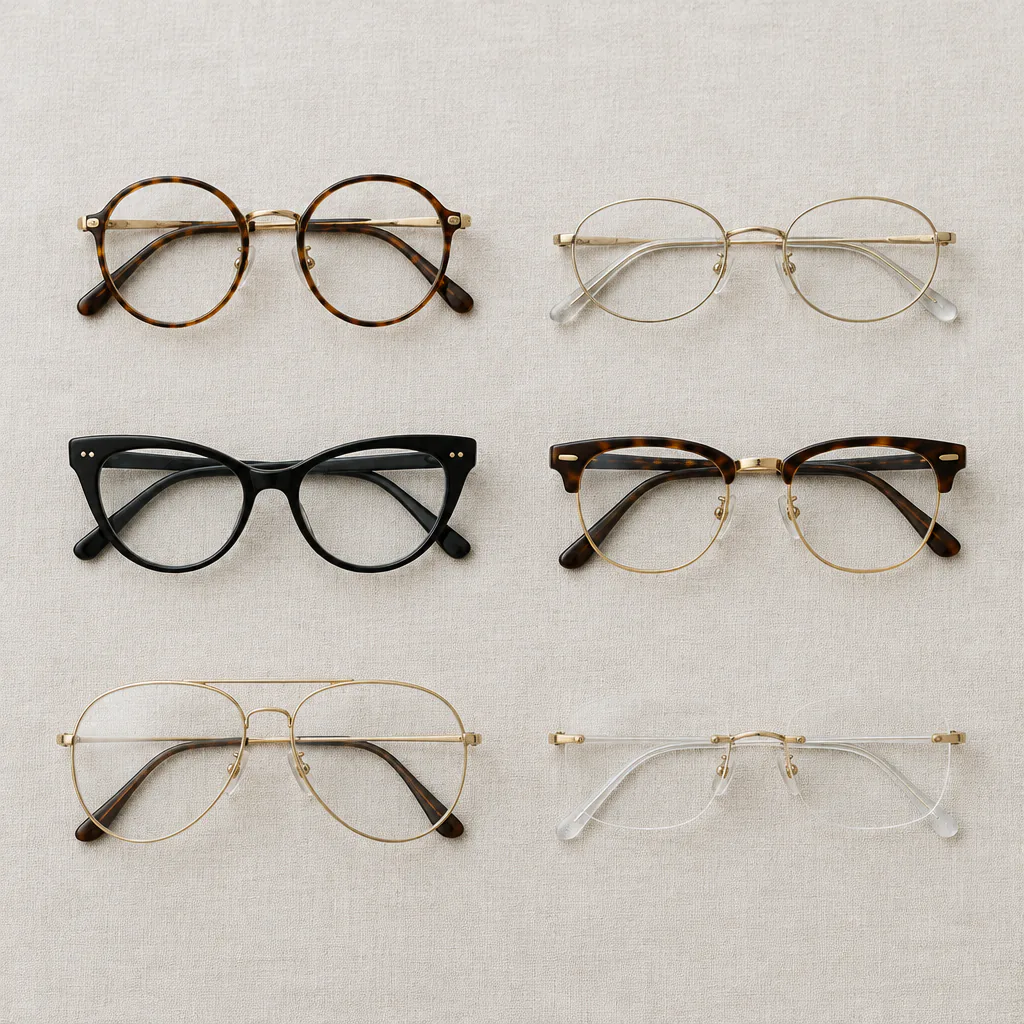
For a square face, these frames come up most often:
- round
- oval
- cat-eye
- browline
- aviator
- rimless or semi-rimless
The shared idea is contrast. Curved lines sit against an angular outline. Most sources say to be careful with thick, boxy square or rectangular frames.
The part most guides skip is fit. A well-fitted soft rectangle can look better than a badly fitted round frame. Shape gets you a shortlist. Fit and comfort decide the winner.
How to Tell If You Have a Square Face
According to Colorado Eye Clinic, a square face has three traits:
- a strong jawline
- a broad forehead
- a forehead, cheeks and jaw of similar width
Warby Parker’s guide adds that square faces are typically about as wide as they are long.
Common signs include:
- Jaw corners (the gonial angle) that look defined. The gonial angle is the point where the back of the jaw turns forward toward the chin.
- Little taper from cheekbones to chin. The lower face stays broad instead of narrowing to a point.
- A forehead that looks wide and fairly straight across.
- Similar width at three levels: temples, cheekbones and jaw.
If your face has those angles but is clearly longer than it is wide, you’re probably closer to rectangular or oblong. That shifts the advice slightly.
The Warby Parker guide also notes that most people are a blend of shapes. If you see some heart or rectangle in your outline, that’s normal. You don’t need a perfect category to use this advice. You only need to know whether your outline reads as mostly angular or mostly curved.
A simple self-check
Here’s a quick check (our editorial suggestion):
- Pull your hair back.
- Stand square to a mirror in even light. Or take a straight-on photo at eye level, since phone selfies held low or close distort the jaw.
- Trace the outline of your face on the mirror with a dry-erase marker, or on a printed photo.
- Look at the jaw corners and the overall width.
If you’re still unsure, Aura’s Face Shape Finder estimates your likely face shape from a photo. It explains how your forehead, cheek and jaw proportions compare and lists styling options, including accessories like glasses.
It doesn’t take calibrated measurements. The result is a likely shape, not a definitive label. The free output is a subjective styling estimate. The full breakdown is part of Aura Pro ($9.99 a month or $49.99 a year).
Why Contrast Is the Core Rule
Almost every frame guide starts from the same principle. A guide from Evans & Piggott Eye Care puts it this way: don’t look for frames that mirror your face shape. Look for frames that bring balance to your curves and angles.
For a square face, that means curves. Glasses.com recommends round, oval and curved frames to soften a strong jaw. It advises against boxy or angular frames that echo the face’s geometry.
The logic is visual, not anatomical. A square face’s outline is made of straight lines and corners. A frame repeats that pattern right at the center of your face, or it breaks it. A curved frame breaks it. A thick square frame repeats it and adds more corners.
The same Evans & Piggott guide makes another point that’s easy to lose. The most important thing is finding frames you can live in comfortably. Contrast is a guideline. Comfort is the requirement.
The Best Glasses for a Square Face Shape
These are the frame shapes the sources recommend most consistently. The “good if you want” notes are our editorial read on each style, not measured effects.
| Frame shape | Why it’s recommended | Good if you want |
|---|---|---|
| Round | Curves contrast with angular lines | A polished, classic look |
| Oval | Soft edges without a strong statement | Something versatile and low-key |
| Cat-eye | Upswept corners pull focus upward | More personality or a vintage feel |
| Browline | Weight at the top, open below | A retro look with structure |
| Aviator | Teardrop curves | A relaxed, casual feel |
| Rimless / semi-rimless | Very little frame material | Glasses that barely register |
Round frames
Round frames are the default recommendation. Warby Parker says round and oval frames are commonly chosen because they create softer-looking lines around the jaw and forehead. All About Vision adds that square faces can suit dark colors and bold styles.
Editorial tip: a perfect circle in thin wire reads academic and light. A thicker acetate round (acetate is the common plastic used for frames) reads bolder and more fashion-forward. Try both before deciding round “isn’t you.”
Oval frames
Colorado Eye Clinic notes that round or oval frames can help balance the strong lines of the jaw and forehead. Ovals are the quieter option. They soften the outline without making the glasses the first thing people notice, which suits work settings and anyone who wants their glasses to blend in.
Cat-eye frames
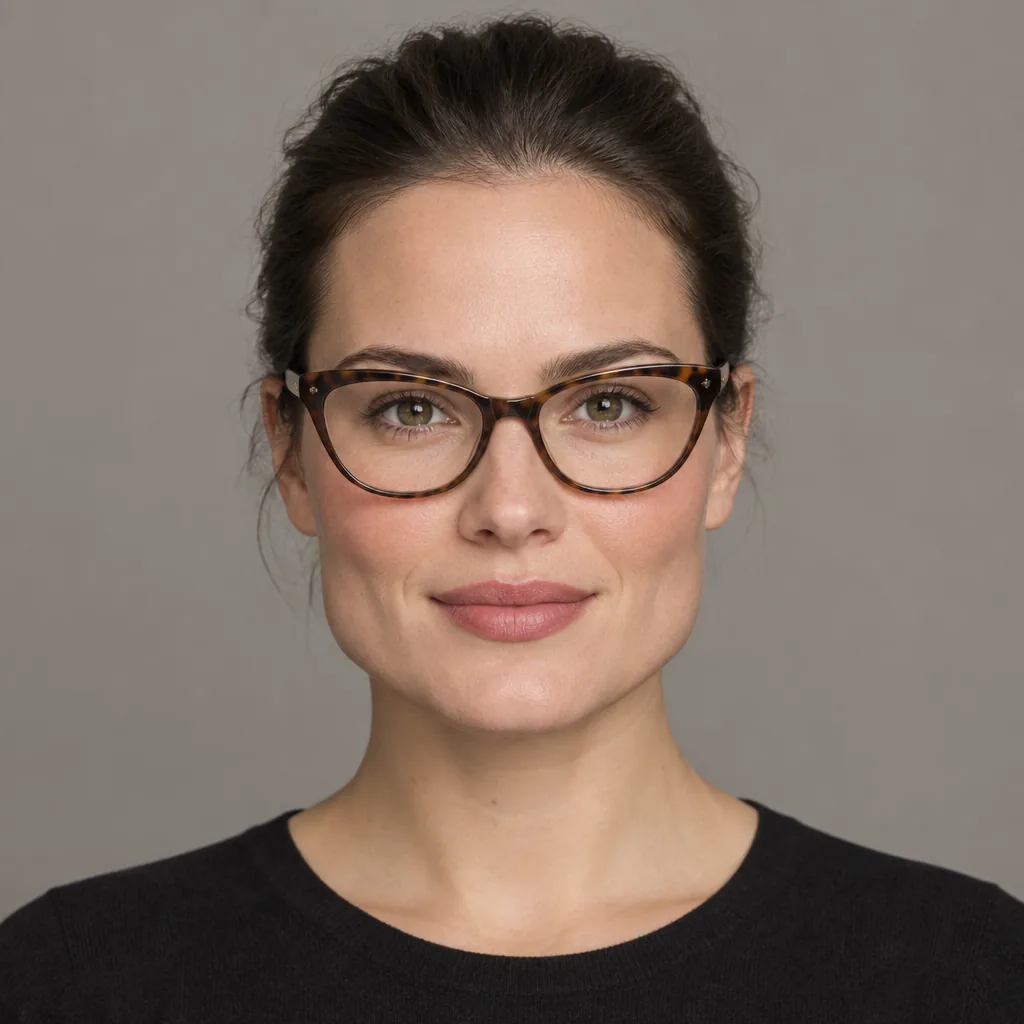
Warby Parker explains that the upswept corners of cat-eye frames draw attention upward and away from the jaw. That makes them one of the more interesting choices for square faces. They contrast with the jaw and also shift the visual emphasis toward the eyes and cheekbones.
Cat-eyes range from barely lifted to dramatic. A subtle upsweep works for almost anyone, regardless of how feminine or neutral you want your style to read.
Browline frames
All About Vision describes browline frames as thicker at the top, mimicking the way eyebrows frame the face. It calls them a strong choice for square faces. The bottom of the lens is usually thin wire or open. That keeps the lower half of the frame light and avoids adding visual weight near the jaw.
Aviator frames
Visionworks lists aviators alongside oval, round and cat-eye frames for square faces. The teardrop shape is curved, especially at the lower outer edge, so it sits near the jaw corners as a contrast rather than a repeat.
Rimless and semi-rimless frames
Glasses.com recommends rimless and semi-rimless styles because they keep the look light. They don’t add more structure to already angular features. These are a good fit if you want vision correction without a style statement.
Frames to Approach With Care
“Avoid” lists for square faces usually name square and rectangular frames. LensDirect goes further and lists square, rectangular, geometric and oversized styles as frames to avoid.
Not everyone agrees. Overnight Glasses argues that square faces can make rectangular frames work if the material and color stay minimal. On oversized frames, Warby Parker says a medium to slightly oversized width can work for many square faces. The conditions are that your pupils sit near the center of the lenses and the frame doesn’t extend far beyond your temples.
Our editorial take is to think in degrees, not bans:
- Highest risk: thick, dark, sharp-cornered square acetate. It repeats every angle of a square face at full volume.
- Middle ground: a rectangle with softened corners in thin metal or a translucent material. You keep the structure without doubling the corners.
- Lowest risk: any curved shape that fits your width.
If you love angular frames, don’t give them up because of a face-shape chart. Try a softened version and judge it in the mirror.
Fit Matters as Much as Shape
A frame that’s the “right” shape but the wrong size will look off. These are the fit points worth checking.
Frame width
Poudre Valley Eye Care suggests measuring your temple width in a mirror and matching it to the frame. The frame’s combined lens and bridge measurements should come within 2 to 4mm of that width.
Visionworks specifically warns against glasses that are too narrow. In our view, an undersized frame on a broad face tends to make the face around it look wider by comparison.
Lens centering
Warby Parker’s rule of thumb is that your pupils should sit near the center of each lens. If your eyes sit close to the inner edge, the frame is probably too wide. If they sit near the outer edge, it’s too narrow.
Bridge height
Empire Optical suggests choosing frames that sit high on the nose to lengthen the face. This is one optical shop’s styling advice rather than a widely documented rule. Still, a higher bridge position does pull the glasses’ visual line upward, so it’s worth testing.
Weight and comfort
Visionworks recommends thinner frames that don’t add weight to the face. That’s both a style point and a practical one. Heavy frames slide down, press on the nose and end up worn less.
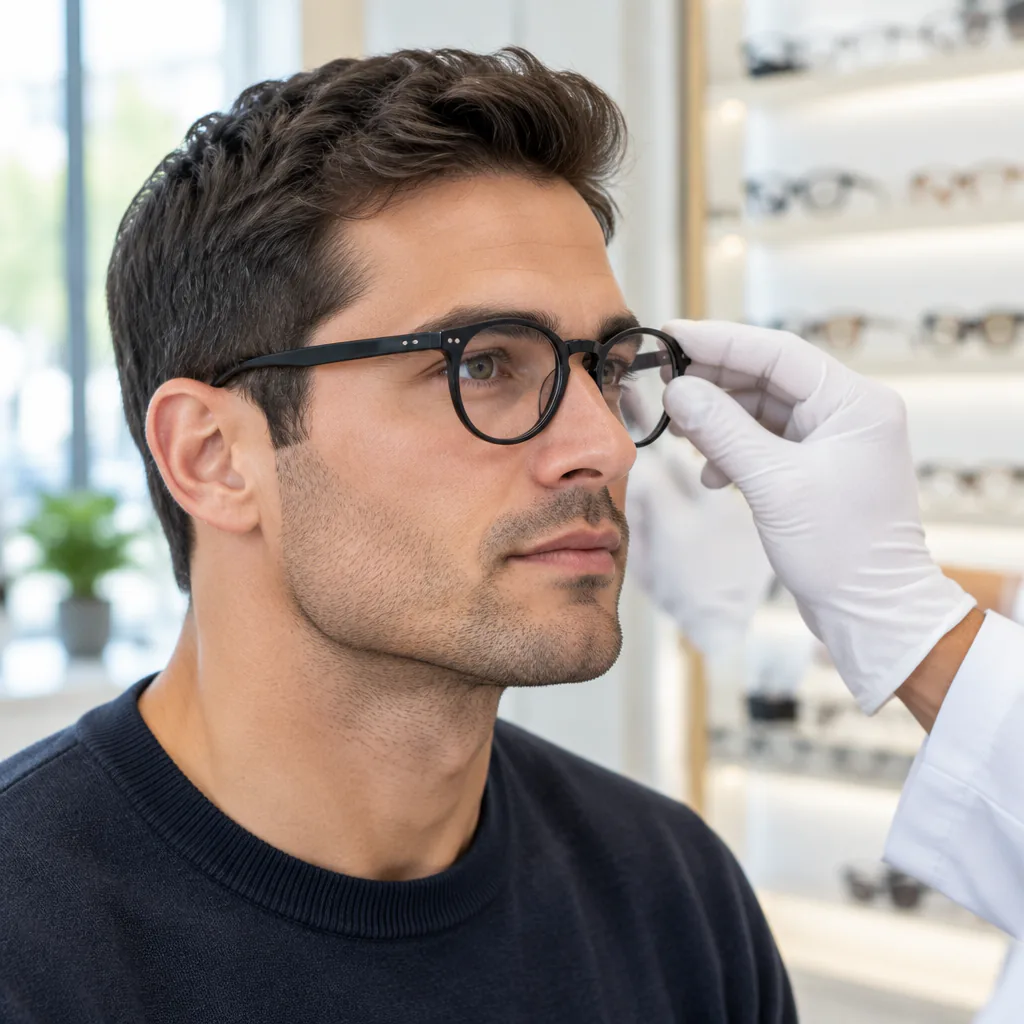
An optician can also check how your prescription affects lens thickness in a given frame. They can adjust nose pads and temple arms so the glasses sit where they should. A style guide can’t do that.
Color and Rim Thickness: Where the Advice Splits
Color is where frame guides contradict each other most:
- EyeBuyDirect recommends sticking to darkly colored frames.
- GlassesShop suggests soft tints and pastels such as pink or rose gold to soften angular features.
- All About Vision says square faces can suit dark colors and bold styles.
- Visionworks leans toward thinner, lighter frames.
These can’t all be universal rules, and none of them is backed by evidence that one color works better on square faces. Our editorial suggestion is to treat color as personal and choose based on three things:
- Your coloring. Some people look best in high-contrast frames, others in tones close to their hair or skin.
- Your wardrobe. Glasses you wear daily should work with what you wear daily.
- How much attention you want on the frames. Black and bold colors stand out. Clear, tortoiseshell and thin metal recede.
Rim thickness is a related choice. Thicker rims make glasses a feature. Thinner rims let your face do the talking. Neither is correct for a square face. It depends on whether you want the glasses noticed.
A Practical Way to Choose Your Frames
Poudre Valley Eye Care describes face shape as a useful tiebreaker when deciding between frames you already like. That’s the right mindset. Here’s a step-by-step process (editorial suggestions):
- Confirm your shape roughly. Use the mirror trace or a straight-on photo. “Mostly square” is enough.
- Get your current measurements. If you own glasses, the inside of the temple arm usually lists lens width, bridge width and temple length. Use these as a baseline, especially when buying online.
- Pick a curved favorite. Choose the round, oval, cat-eye, browline or aviator style that appeals to you most.
- Add a wildcard. Pick one frame outside the usual rules, such as a soft rectangle or a bolder color. Sometimes the rule-breaker wins.
- Run the fit checks. Check that your pupils are near the lens centers, the width lines up with your temples, and the frame doesn’t rest on your cheeks when you smile.
- Photograph each option. Take shots from the front and at a three-quarter angle in normal light. Comparing photos side by side is easier than switching frames in front of a mirror.
- Test for wearability. Wear each pair for a few minutes. Notice weight, slipping and pressure points. A pair you take off by mid-afternoon isn’t the right pair.
If two frames are close, let the contrast principle decide. Choose the one whose lines contrast more with your jaw.
The Bottom Line
The best glasses for a square face shape usually have curves: round, oval, cat-eye, browline, aviator or rimless. That’s because contrast with angular lines is the most consistent recommendation across eye care and optical sources.
The sources disagree on rectangles, oversized frames and color, so treat those as judgment calls. What every good guide agrees on is fit. The right width, centered lenses and a comfortable weight decide whether any shape works on you.
Use face shape to build a shortlist. Use fit and comfort to choose the pair you’ll keep.
Sources & further reading
Frequently asked questions
What is the best glasses shape for a square face? +
Round and oval frames are the most commonly recommended. Their curves contrast with a square face's straight jaw and broad forehead. Cat-eye, browline, aviator and rimless styles are also widely suggested.
Can I wear rectangular glasses with a square face? +
Many guides say to avoid them, but not all agree. Some optical sources say rectangles can work if the material and color are kept minimal. A softened-corner rectangle in thin metal is a reasonable middle ground to try.
Should glasses be wider than a square face? +
Frames should roughly match your face width at the temples. One eye care practice suggests landing within 2 to 4mm of that width. Avoid frames that are clearly too narrow, and make sure your pupils sit near the center of each lens.
Do dark or light frames look better on a square face? +
Sources disagree. Some recommend dark frames, while others suggest soft tints like rose gold. There's no evidence that either works better on square faces, so choose based on your coloring, your wardrobe and how noticeable you want the frames to be.
How do I know if my face is square or rectangular? +
Both have angular jaws and broad foreheads. A square face is roughly as wide as it is long, while a rectangular face is noticeably longer than it is wide. Many people are a blend, so a rough read is enough to choose frames.