 Aura: Looksmaxxing
 Mewing vs Bonesmashing: What You Need to Know
Mewing vs bonesmashing compared side by side. Learn what each technique involves, the risks, and which approach makes sense for your goals.
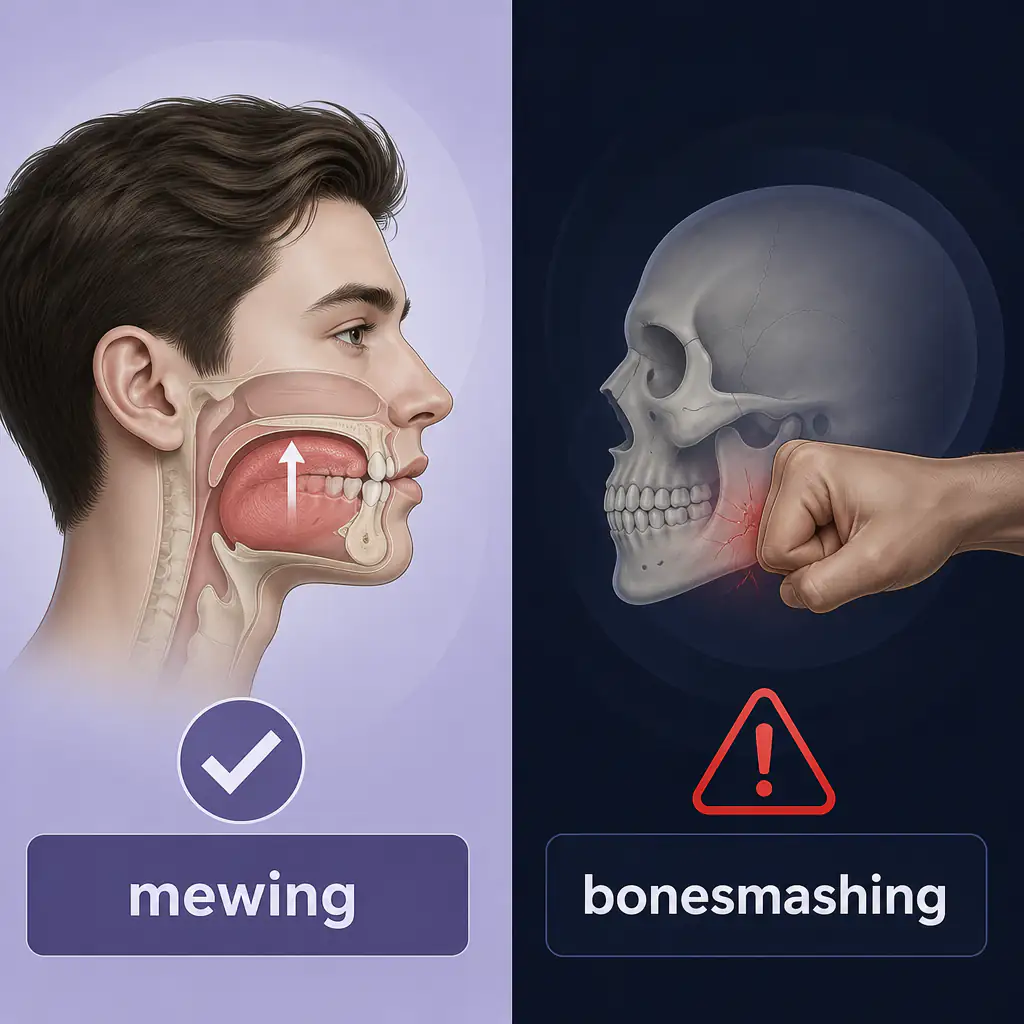
If you’ve spent any time researching facial structure improvement, you’ve almost certainly come across both mewing and bonesmashing. They’re often mentioned together, but they operate on completely different principles and carry very different risk profiles. This post breaks down both techniques honestly so you can decide which, if either, deserves a place in your routine.
What Is Mewing?
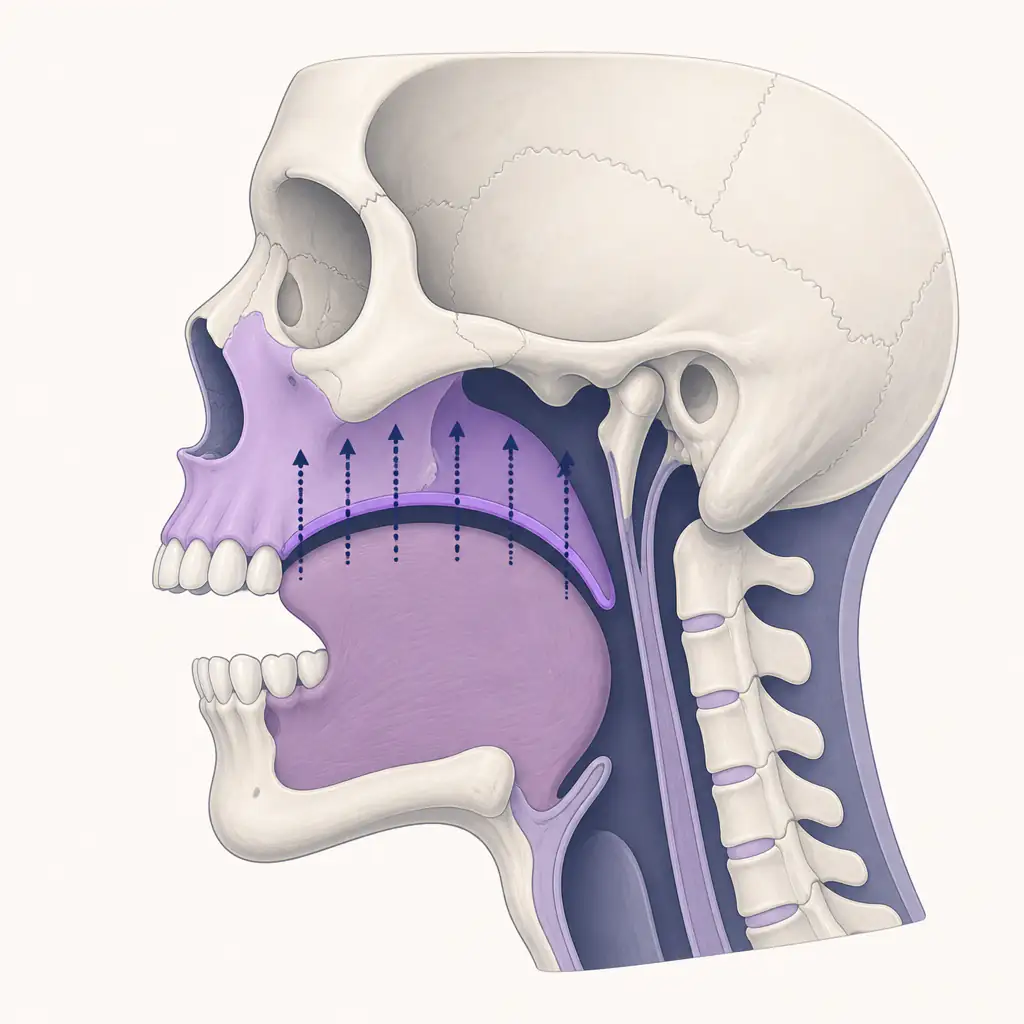
Mewing is a tongue posture practice developed by British orthodontist Dr. John Mew and later popularized by his son Dr. Mike Mew. The core idea is simple: rest your entire tongue flat against the roof of your mouth (the palate), keep your lips together, and breathe through your nose. Maintain this as your default resting posture throughout the day.
The theoretical basis draws from orthotropics, a branch of dentistry focused on how oral posture shapes craniofacial development. Proponents argue that modern humans have drifted toward poor tongue posture, mouth breathing, and soft diets, all of which may contribute to underdeveloped midface bones, recessed chins, and weaker jawlines over time.
The Anatomy Behind Mewing
The relevant structure here is the maxilla, the large bone forming the upper jaw and the floor of the eye sockets. Orthotropic theory holds that consistent upward and forward tongue pressure against the palate may encourage the maxilla to grow or remodel in a more forward direction. In growing children and adolescents, where bone is still actively remodeling, there is some clinical support for this idea. In adults, where sutures are largely fused, the evidence is much thinner.
Research on adult bone remodeling under sustained low-level force (similar to what orthodontic appliances apply) does suggest some degree of change is possible, but the timeline is long, the changes are modest, and results vary significantly between individuals.
Key points about mewing:
- Requires consistent practice, most practitioners recommend thinking of it as a 24/7 habit, not an exercise
- Results, if they occur, develop over months to years
- Carries essentially no physical risk when done correctly
- May also improve breathing, reduce mouth breathing, and support better jaw alignment
- Incorrect technique (pushing with the tip of the tongue only) is a common mistake and unlikely to produce results
What Is Bonesmashing?
Bonesmashing is a far more aggressive and controversial practice. It involves deliberately striking the jaw or other facial bones with a hard object, most commonly the user’s own fist or a tool, with the goal of triggering bone remodeling through mechanical stress.
The theoretical basis borrows from Wolff’s Law, a well-established principle in anatomy stating that bone tissue adapts to the mechanical loads placed on it. Weight-bearing bones that experience regular stress tend to become denser and, in some cases, change shape over time. Bonesmashing attempts to apply this principle to facial bones.
Why the Comparison to Mewing Falls Apart
Wolff’s Law is real, but the application here is deeply problematic. Wolff’s Law describes gradual, repetitive, controlled loading, the kind a femur experiences during years of running. It does not describe blunt impact trauma. Striking a bone hard enough to cause visible bruising or swelling is not controlled loading. It is acute tissue damage.
The claimed mechanism, that micro-fractures in facial bone heal back thicker and more prominent, lacks credible clinical evidence. Bone repair after trauma does not reliably produce the aesthetic outcomes bonesmashing proponents describe. More importantly, the facial region contains dense networks of nerves (including branches of the trigeminal nerve) and blood vessels that are not protected by significant muscle mass the way, say, the tibia is.
Potential risks include:
- Nerve damage, which may be permanent
- Bruising, swelling, and hematoma formation
- Asymmetry from uneven impact or uneven healing
- Damage to teeth and the temporomandibular joint (TMJ)
- In severe cases, actual fracture requiring medical treatment
Important disclaimer: Bonesmashing carries real injury risk. Talk to a qualified medical professional before considering any practice that involves applying deliberate physical trauma to your face or head.
Side-by-Side Comparison: Mewing vs Bonesmashing
| Factor | Mewing | Bonesmashing |
|---|---|---|
| Mechanism | Sustained tongue posture pressure on palate | Blunt impact trauma to facial bones |
| Scientific basis | Orthotropic theory, some orthodontic evidence | Misapplication of Wolff’s Law |
| Risk level | Very low (when done correctly) | High, includes nerve and joint damage |
| Timeline | Months to years | Unknown, results not clinically verified |
| Target area | Maxilla, midface, palate width | Primarily mandible (jaw) |
| Age relevance | More effective in younger individuals | Not supported at any age |
| Reversibility | Posture habit, easily stopped | Tissue damage may be irreversible |
| Evidence quality | Limited but growing | Essentially anecdotal |
The table above makes the contrast fairly clear. Mewing is a low-risk postural habit with plausible mechanisms, even if the evidence in adults is limited. Bonesmashing is a high-risk practice with a scientific rationale that does not hold up under scrutiny.
What Actually Moves the Needle on Facial Structure
Beyond the mewing vs bonesmashing debate, it’s worth zooming out and asking what actually influences how your face looks and how your bones are structured.
Factors You Can Influence
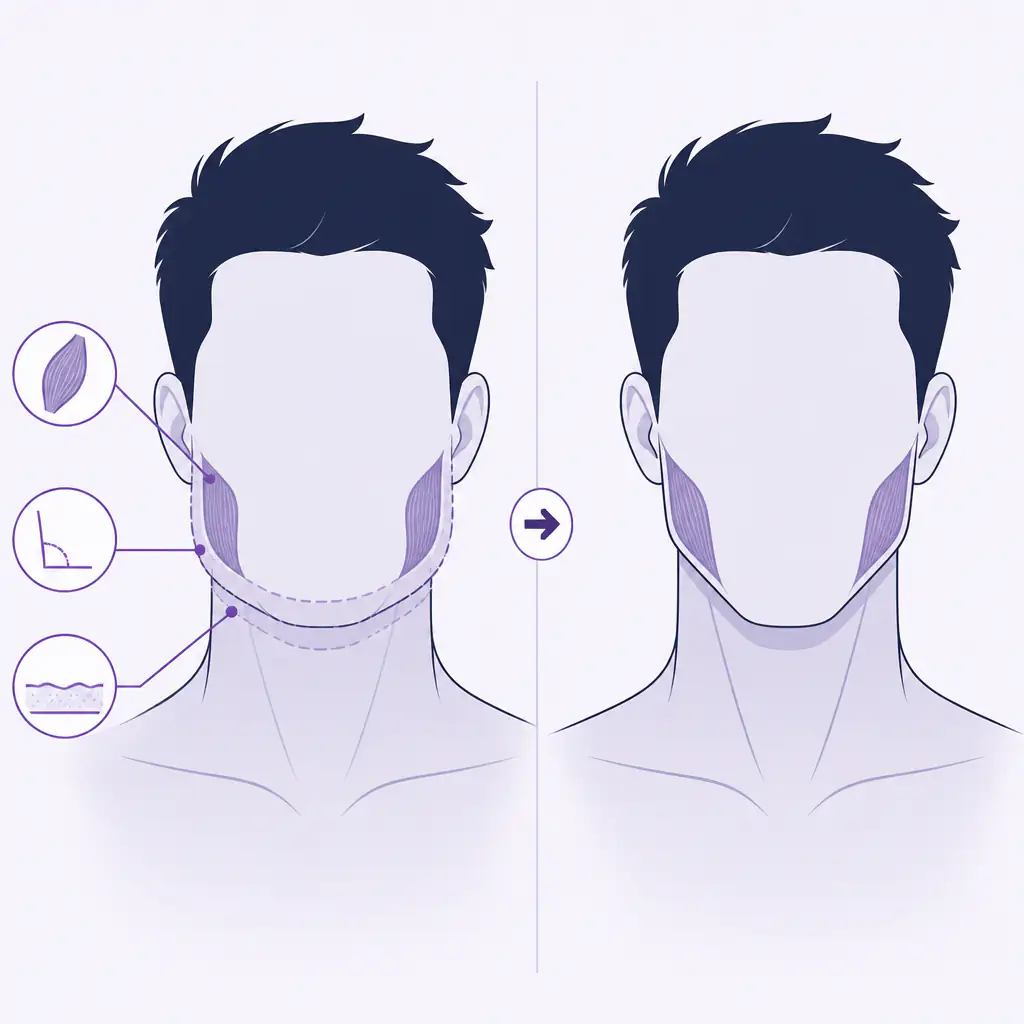
Body fat percentage has one of the most immediate and visible effects on perceived jawline definition. The mandible does not change, but the soft tissue overlying it does. Reducing body fat, particularly in the lower face and neck, can make a significant difference in how angular and defined the jaw appears.
Muscle development in the masseter (the primary chewing muscle, located at the rear of the jaw) can add visible width and definition to the lower face. Chewing tougher foods, using jaw exercisers, and simply increasing chewing volume over time may develop this muscle. Some users report noticeable changes within a few months.
Nasal breathing and sleep position may support better facial development in younger individuals by keeping the tongue in the correct resting position naturally.
Posture affects how the jaw and neck appear from the front. Forward head posture, where the head protrudes in front of the shoulders, can flatten the jaw angle and reduce the visual prominence of the chin and neck line.
Factors You Cannot Change Without Medical Intervention
Bone structure, particularly in adults with fused sutures, does not change meaningfully through surface-level practices. If your goals involve significant skeletal change, the only evidence-based options are orthodontic appliances, orthognathic surgery, or jaw implants. These are legitimate medical procedures with real outcomes, but they come with their own risks, costs, and recovery periods. Any of these should be discussed thoroughly with a qualified specialist.
If you want an honest baseline before deciding what to pursue, Aura can give you an objective AI-based analysis of your facial structure, including jawline scoring and symmetry assessment, which helps you identify what is actually worth addressing versus what looks fine from an outside perspective.
Practical Starting Points If You Want to Try Mewing
If mewing interests you, the technique is straightforward but easy to do incorrectly. Here are the steps most practitioners agree on:
- Place the entire tongue body on the roof of the mouth. Not just the tip. The back third of the tongue is especially important and often neglected.
- Apply gentle upward pressure. You should feel light contact across the whole palate, not a strained push.
- Keep lips together, teeth lightly touching or slightly apart. Do not clench.
- Breathe exclusively through the nose. Mouth breathing defeats the purpose entirely.
- Make it a resting posture, not a scheduled exercise. The habit only accumulates results through consistent, all-day practice.
- Be patient. Do not expect visible changes in weeks. If changes occur, they develop over months to years.
If you have nasal obstruction that forces you to breathe through your mouth, address that first with an ENT physician. Mewing is impossible to sustain with a chronically blocked airway.
The Bottom Line
Mewing and bonesmashing are not comparable practices. Mewing is a low-risk postural habit with a plausible theoretical basis and a long timeline. Bonesmashing is a high-risk behavior with a flawed scientific premise and real potential for lasting harm. They do not belong in the same category.
If you are interested in improving your facial appearance through non-surgical means, the highest-leverage options remain body composition, masseter development, posture correction, and consistent skincare. Mewing may be worth adding as a low-cost, low-risk habit, particularly for younger individuals. Bonesmashing is not worth the risk at any age.
For anyone who wants a clearer picture of where they currently stand before committing to any routine, Aura provides AI-driven facial analysis including jawline scoring and a personalized improvement breakdown, giving you something concrete to work from rather than guessing.
Frequently asked questions
Does mewing actually work for adults? +
The evidence for mewing in adults is limited. Bone sutures are largely fused by early adulthood, which reduces the potential for skeletal change. However, some adults report improvements in jawline definition that may be related to masseter development, posture changes, or reduced mouth breathing rather than direct bone remodeling. Results, if any, take a long time to appear.
Is bonesmashing dangerous? +
Yes, bonesmashing carries meaningful risk. Striking the face with enough force to cause bruising or swelling can damage facial nerves, the temporomandibular joint, and surrounding tissue. The proposed mechanism, blunt trauma triggering beneficial bone remodeling, is not supported by clinical evidence. Talk to a qualified medical professional before considering any practice involving deliberate physical trauma to the face.
How long does mewing take to show results? +
Most practitioners who report visible changes describe timelines of one to three years of consistent practice. Results appear to be more significant in adolescents and young adults whose bones are still actively developing. Anyone expecting changes within weeks is likely to be disappointed.
What is the safest way to improve jawline definition without surgery? +
Reducing body fat percentage, developing the masseter muscle through consistent chewing or jaw exercises, and correcting forward head posture are the most practical and evidence-supported non-surgical approaches. Mewing may complement these efforts, particularly for nasal breathing habit formation, but should be viewed as a long-term addition rather than a quick fix.