 Aura: Looksmaxxing
 Masculine Face Shape: What It Is & How to Improve It
Learn what defines a masculine face shape, which features matter most, and practical steps you can take to improve your facial structure.
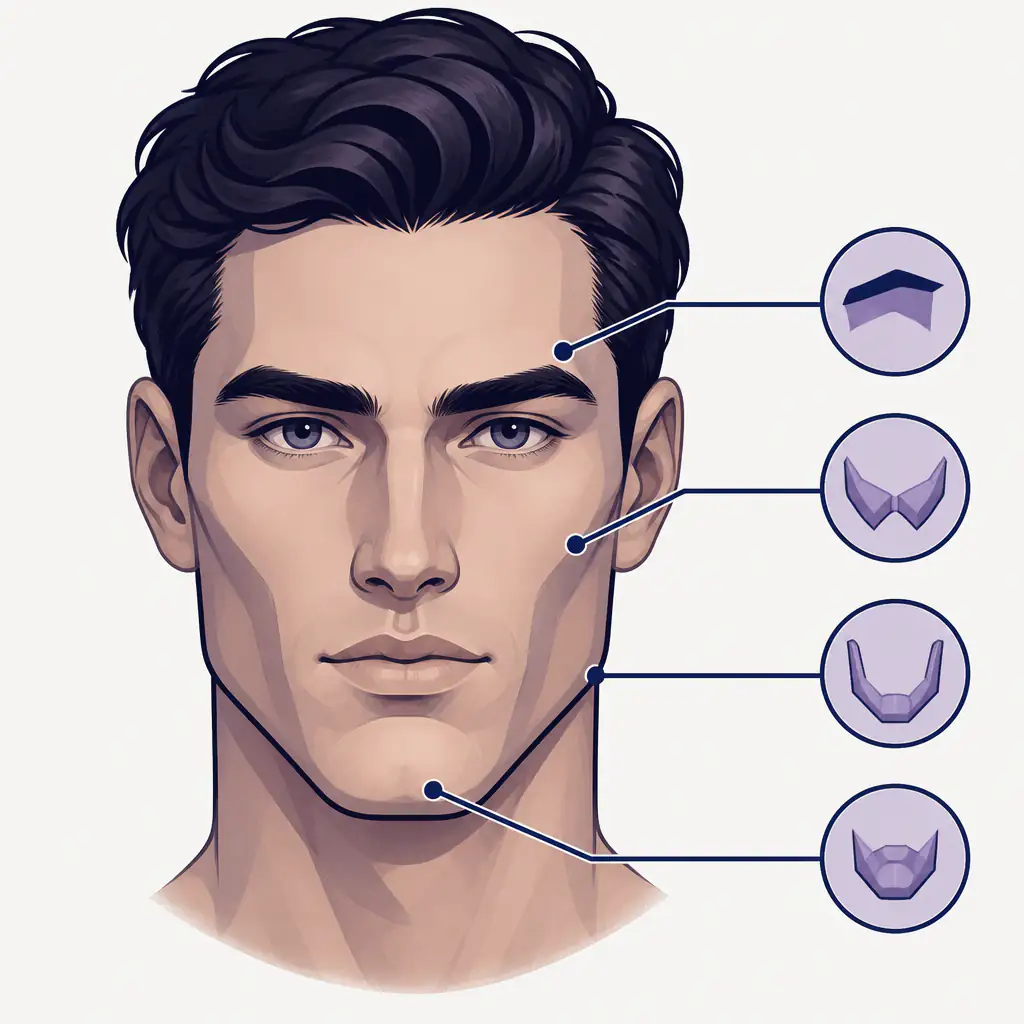
What makes a face read as masculine? It is not one single feature. It is a combination of bone structure, soft tissue distribution, and proportions that signal high androgen exposure during development. Understanding exactly which traits contribute, and which ones you can realistically influence, is more useful than chasing a vague ideal.
This guide breaks down the anatomy behind a masculine face shape, explains the scoring frameworks researchers and aesthetics communities use, and gives you concrete, practical steps to move in the right direction.
What Defines a Masculine Face Shape
Masculinity in the face is largely driven by testosterone. During puberty, androgens influence bone growth in specific ways: the jaw widens and deepens, the brow ridge thickens, the chin projects forward, and the cheekbones tend to sit higher and broader. These changes produce what researchers call sexual dimorphism, the structural difference between male and female faces.
The result is a face that tends to be:
- Wider relative to its height (higher facial width-to-height ratio, or fWHR)
- More angular at the jaw rather than tapered
- Heavier at the lower third of the face
- Flatter and less rounded in overall contour
Feminine faces, by contrast, tend to have a higher, narrower forehead, a smaller jaw, a shorter chin, and more prominent cheekbones relative to jaw width. None of this is a value judgment, just documented sexual dimorphism.
The Key Anatomical Features
Jawline and Mandible
The mandible (lower jaw) is the single most important structure for a masculine face shape. Specifically, what matters is:
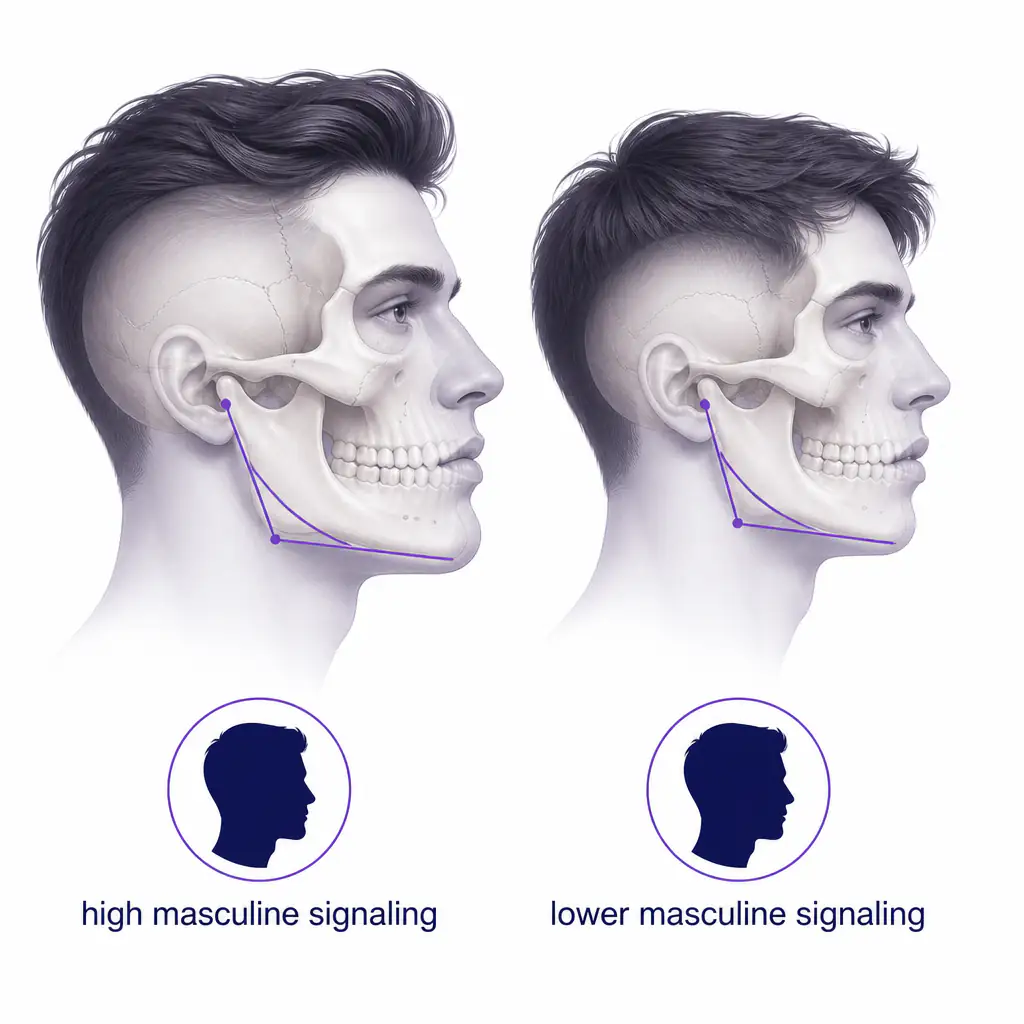
- Gonial angle: the angle at the back corner of the jaw where the ramus meets the body. A lower gonial angle (roughly 120 degrees or less) creates a sharper, more defined jaw corner. A higher angle produces a softer, rounder jaw.
- Bigonial width: the horizontal distance between the two jaw corners. Greater bigonial width creates that squared-off look associated with masculine faces.
- Chin projection: the chin (mentum) projects forward and is wider from side to side in masculine faces. A recessed or narrow chin undermines the entire lower third regardless of jaw width.
Brow Ridge and Supraorbital Bossing
The brow ridge, technically the supraorbital torus, is the bony shelf above the eye sockets. A more pronounced ridge casts a slight shadow over the eyes, contributing to what is often called a “heavy brow” look. This is a strongly androgenic trait. It also affects how the eyes are perceived. Eyes that sit slightly deeper under a prominent brow tend to read as more intense, which is part of the “hunter eyes” concept.
Cheekbones and Zygomatic Arch
The zygomatic arch (cheekbone) contributes to midface width. In masculine faces, the cheekbones are broad but do not necessarily protrude dramatically forward. The ratio matters: if the cheekbones are wide but the jaw is narrow, the face can still read as feminine. The cheekbone-to-jaw ratio in masculine faces is closer to 1:1 than in feminine faces, where the cheekbone-to-jaw ratio is higher.
Forehead Shape
A masculine forehead tends to be slightly lower in height, broader, and flatter. The hairline in many masculine faces is higher or more squared off. The forehead also tends to slope back slightly rather than being perfectly vertical, a trait called supraorbital inclination.
Facial Thirds and Proportions
Classical facial analysis divides the face into three horizontal thirds:
- Hairline to brow
- Brow to base of nose
- Base of nose to chin
In masculine faces, the lower third (jaw and chin) tends to be equal to or slightly longer than the middle third. A short lower third with a long middle third tends to read as less masculine.
Face Shapes and Masculinity
Not all face shapes carry equal masculine signaling. Here is how common face shapes rank in terms of typical masculine perception:
Square face shape: Considered the most masculine. Equal or near-equal width at the forehead, cheekbones, and jaw, with a flat bottom edge. Strong gonial angles and good bigonial width.
Rectangular face shape: Similar to square but longer. Still reads as masculine due to jaw width and definition, though the added length can sometimes soften the overall impression depending on other features.
Oval face shape: Balanced and considered attractive in both sexes, but the narrower jaw and rounded chin tend to read as less overtly masculine than square or rectangular.
Round face shape: Wide but soft, with minimal jaw definition. Associated with lower facial width-to-height ratio and higher body fat, which tends to obscure structure.
Diamond face shape: Narrow forehead and jaw with wide cheekbones. Can look striking but the narrow jaw typically reduces masculine signaling.
Triangle (pear) face shape: Wide jaw but narrow forehead. Ironically, while jaw width is present, the narrow upper face can reduce overall masculine perception.
The takeaway: jaw definition and width matter more than the label of your face shape. A nominally “oval” face with a sharp, defined jaw will read as more masculine than a “square” face with a weak, undefined jaw.
How Body Fat Affects Facial Masculinity
This is where most people have immediate, tangible control. Subcutaneous fat sits on top of your bone structure. Even excellent underlying bone architecture gets obscured by excess facial fat.
Research suggests that losing body fat, particularly in the range of 10 to 15 percent body fat for men, significantly increases the perceived sharpness and definition of the jaw and cheekbones. The effect is proportionally large: going from 20 percent to 12 percent body fat may reveal more jawline than many cosmetic procedures.
Practically, you cannot spot-reduce facial fat. Overall caloric deficit combined with resistance training is the mechanism. Some people carry fat in the face preferentially due to genetics, meaning they may need to reach a lower overall body fat percentage before significant facial definition appears.
Soft Tissue and Muscle Contributions
Bone is the foundation, but soft tissue shapes the surface. Two structures are particularly relevant:
Masseter Muscle
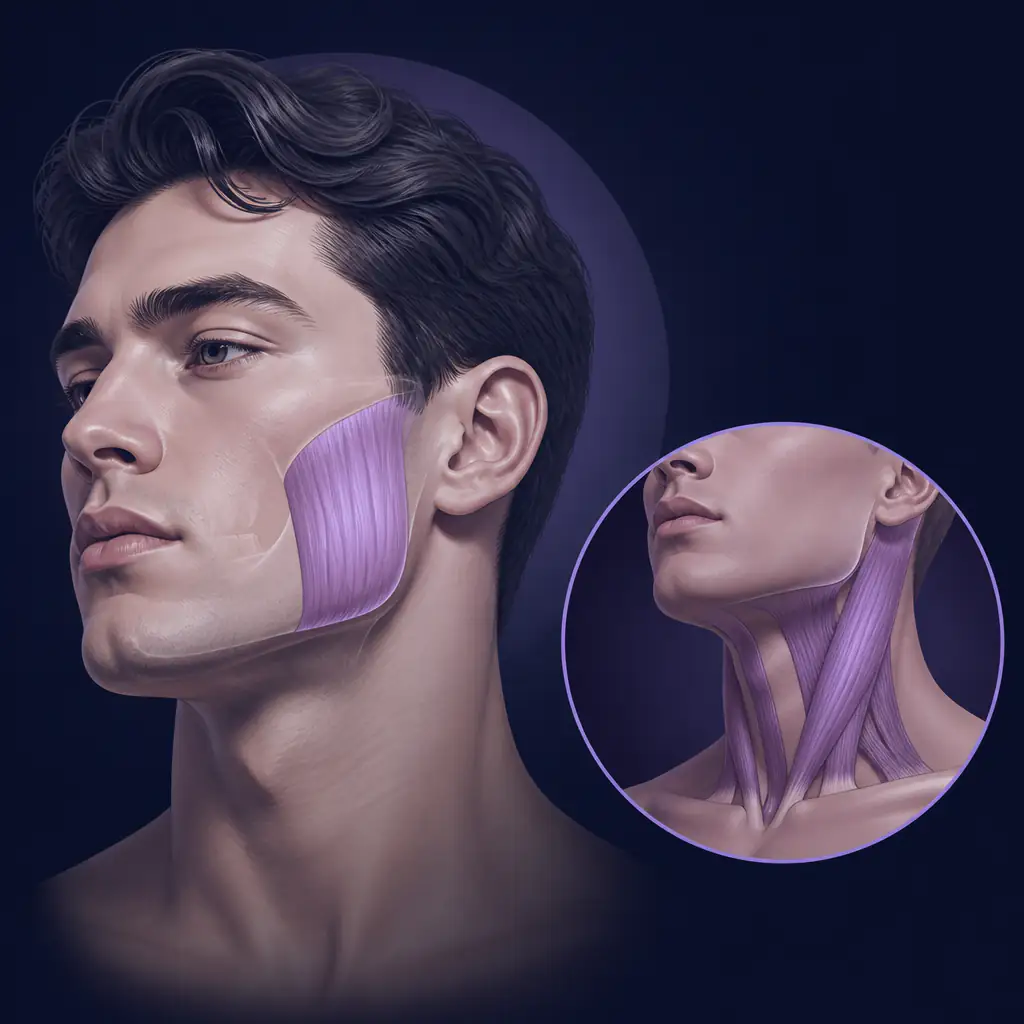
The masseter is the chewing muscle that sits at the angle of the jaw. A well-developed masseter adds visible width and definition to the lower jaw, even without exceptional bone structure. It is one of the few facial muscles that responds meaningfully to deliberate training.
Hard chewing (mastic gum, tough foods) and jaw exercises may hypertrophy the masseter over time. Some users report visible changes over several months of consistent effort. The effect is relatively modest in adults whose bone structure is set, but for people with naturally thin masseters, it can make a noticeable difference in jaw definition.
Neck and Sternocleidomastoid
The neck frames the face. A thicker, more muscular neck makes the jaw look sharper by contrast and contributes to overall masculine proportions. Neck training (neck curls, extensions, and lateral flexion with resistance) is underused but genuinely effective.
Grooming and Styling for Facial Masculinity
Structure is the foundation, but presentation matters. Several grooming choices can emphasize or de-emphasize masculine features:
Facial hair: A beard or stubble adds visual weight to the lower third of the face. For men with recessed chins or weak jaw angles, a beard can substantially compensate by filling in that area. Research on perceived attractiveness consistently finds that heavy stubble to full beards increase perceived masculinity ratings.
Hairstyle: Styles that add volume at the top (quiff, pompadour, textured crop) elongate the face slightly and can balance a rounder face shape. Styles that add width at the sides tend to widen the midface, which may not serve someone with an already-wide face.
Haircut taper: A tight fade on the sides creates visual contrast that makes the jaw appear wider and more defined.
Eyebrow grooming: Masculine brows tend to be thicker, straighter, and lower-set. Over-thinning or arching the brows can soften a masculine face significantly.
Posture and Mewing
Mewing refers to the practice of resting the entire tongue flat against the palate, promoted by orthodontist John Mew and his son Mike Mew. The theory is that consistent proper tongue posture over time may influence the development of the midface, palate, and jawline, particularly in younger people whose sutures have not fully fused.
Evidence for mewing in adults is largely anecdotal. In adolescents and children, there is more credible orthopedic rationale. For adults, the main benefit appears to be posture-related: proper tongue posture encourages the head to sit correctly over the spine, which improves the neck angle and can affect how the jaw reads in photos and in person.
Posture more broadly is relevant. Forward head posture compresses the neck, reduces jaw definition visibility, and makes even a good jaw look recessed in photos.
Getting an Objective Baseline
One challenge with self-assessment is that people are notoriously bad at objectively evaluating their own faces. Angles, lighting, and familiarity bias all distort perception. Before spending time or money on any improvement strategy, it is worth getting an honest, structured analysis.
Aura uses AI to analyze facial features including jawline definition, facial width-to-height ratio, and hunter-eye characteristics, then gives you a PSL score and a personalized improvement plan. Running an analysis before starting any protocol gives you a clear starting point and helps you focus on the features that will actually move the needle for your specific face rather than chasing generic advice.
When to Consider Professional Options
For people who want structural changes beyond what lifestyle and grooming can provide, there are clinical options. These range from non-surgical to surgical:
- Dermal fillers (jaw and chin): Hyaluronic acid fillers can add projection to the chin or definition to the jaw angle temporarily (typically 12 to 18 months). Results vary considerably with the injector’s skill.
- Masseter Botox: Paradoxically, Botox in the masseter reduces its size. This is used to slim an overly wide lower face, the opposite of what most men seeking masculinity want. Worth knowing so you do not accidentally request the wrong procedure.
- Jaw implants: Surgical implants at the jaw angle (gonial angle implants) or chin (genioplasty) can create permanent structural changes. These are significant procedures with real recovery times and risks.
- Orthognathic surgery: For severe skeletal issues affecting bite and facial structure, jaw surgery can address underlying bone position.
Talk to a qualified maxillofacial surgeon or board-certified plastic surgeon before considering any of these procedures. Understand the risks, recovery, and realistic outcomes before committing.
Practical Steps to Improve Your Masculine Face Shape
- Reduce body fat to a range where your underlying structure becomes visible. For most men, this means getting below 15 percent body fat, with 10 to 12 percent revealing the most definition.
- Train your masseter through consistent hard chewing or jaw exercises. Give it several months before expecting visible results.
- Train your neck with direct resistance work to build the frame around your jaw.
- Fix your posture, particularly forward head posture, to improve how your jaw sits and how it reads in photos.
- Grow facial hair strategically to add weight to the lower third if your bone structure is less prominent.
- Get an objective analysis using a tool like Aura to identify which specific features are your weakest points before investing effort.
- Optimize grooming: haircut, brow shape, and styling to complement and emphasize your existing structure.
- Consult a professional if you are considering any clinical interventions. Research is not a substitute for an in-person evaluation by a qualified provider.
Frequently asked questions
What is the most important feature for a masculine face shape? +
The jawline, specifically the width between the jaw angles (bigonial width) and the sharpness of the gonial angle, is the most influential single feature. A wide, defined jaw is the primary visual signal of facial masculinity and is more impactful than any other single feature.
Can you change your face shape without surgery? +
You can improve the appearance of your facial structure through body fat reduction, masseter muscle development, neck training, and posture correction. These changes work within your existing bone structure rather than altering it. For permanent structural changes, surgical options exist but require a qualified professional consultation.
Does mewing actually work for adults? +
The evidence for mewing producing structural changes in adults is largely anecdotal since adult cranial sutures are fused. For younger people still in development, there is more plausible rationale. For adults, the main practical benefit is posture correction, which can improve how the jaw looks in person and in photos.
How does body fat percentage affect facial masculinity? +
Body fat sits on top of bone structure and can obscure definition. Research suggests that reducing body fat to roughly 10 to 15 percent for men significantly increases perceived jaw and cheekbone definition. Many men find that fat loss reveals more structural masculinity than they realized they had.