 Aura: Looksmaxxing
Low Maintenance Hairstyles: What 'Easy' Means
Low maintenance means three different things: daily styling, salon frequency and wash routine. Cuts sorted by which kind of easy you need.

Most lists of low maintenance hairstyles for women show the same photos: a pixie, a messy bob, some curtain bangs. They rarely explain that “low maintenance” can mean very different things. A cropped pixie needs almost no styling in the morning but sends you back to the salon often. Long, layered hair can often go longer between cuts but takes longer to wash and dry.
The useful question is not “what is the easiest haircut?” It is “which kind of effort do I want to cut?” This guide sorts cuts by the upkeep they actually need, matches them to hair texture, and ends with a simple way to brief your stylist.
What “Low Maintenance” Really Means
Hair upkeep comes in three separate parts, and one cut rarely keeps all three low.
- Daily styling time. How long it takes to look done after you wake up or wash. This depends on how well the cut works with your natural texture and whether it needs a blow-dry.
- Salon frequency. How quickly the shape grows out of place. Shorter, more precise cuts lose their shape sooner.
- Wash and care routine. How often you shampoo, condition and detangle. This depends more on your scalp and hair type than on the cut itself.
Before choosing a style, decide which one you most want to minimize. If mornings are your bottleneck, prioritize daily styling time. If booking appointments is the problem, prioritize salon frequency. The rest of this guide is organized around that tradeoff.
Low Maintenance Hairstyles by Length
Short cuts: fast mornings, frequent trims
Pixies, crops, bixies (a hybrid of a bob and a pixie) and buzz cuts are the classic low-effort picks for daily styling. Many need only a comb-through or a small amount of product.
The catch is salon time. L’Oréal Paris notes that bangs, pixie cuts, blunt bobs and other short haircuts need more frequent trims to keep their look. Healthline says that whether you have a pixie cut, bowl cut or contemporary crop, you’ll probably need to maintain it every month or so.
Even roundups that call a buzz cut close to zero daily effort acknowledge it still needs occasional trims. No haircut is maintenance-free. Short hair simply moves the effort from your bathroom mirror to the salon chair.
Best for: people who want the shortest possible morning routine and don’t mind regular appointments.
Medium cuts: the flexible middle
Chin- to collarbone-length cuts are where most people find a workable balance. Salons currently promote several of them as easy-care options. Mavo Hairlounge names the Italian bob, butterfly layers, the soft shag and textured collarbone-length cuts. Numi Hair lists the French bob, textured bob, layered bob and short layered cuts. Treat these as stylist opinion about trends, not proof that any one cut is easier.
In our editorial view, the easiest medium cuts share two traits:
- Texture over precision. A shag or textured bob is designed to look slightly undone, so imperfect drying still looks intentional. A blunt, sharp-edged bob shows every bend and cowlick.
- A length that clears the shoulders or sits well past them. Hair that lands right on the shoulders tends to flip unpredictably as it grows. Asking for a length just above or below that point avoids this.
Best for: people who want styling options (down, tucked, half-up) without long drying times.
Long cuts: fewer appointments, longer wash days
In our editorial view, long hair with long layers is often the lowest-maintenance option for salon frequency. There is no tight shape to protect, so a few extra weeks of growth barely shows.
Published guidance on trim timing varies and is not specific to long hair. L’Oréal says the most common answer stylists give is every six to eight weeks, while salon owner Michael Fuzailov, quoted in Healthline, puts the average time between cuts at every 3 to 4 months. Treat these as general reference points. Your stylist can tell you how long your particular cut will hold its shape.
The cost of long hair is time on wash days: more detangling, more conditioner and longer drying. If you air-dry, that tradeoff may not matter much.
Best for: people who rarely want to book a cut and are fine spending more time on wash day.
Quick comparison
This table is an editorial summary of the tradeoffs above, not a measured ranking.
| Length | Daily styling | Salon visits | Wash-day effort |
|---|---|---|---|
| Pixie / crop / buzz | Very low | Frequent | Very low |
| Bixie / short layered | Low | Fairly frequent | Low |
| Textured bob / shag | Low to moderate | Moderate | Moderate |
| Blunt or precise bob | Moderate | Fairly frequent | Moderate |
| Long with long layers | Low if air-dried | Infrequent | Higher |
Match the Cut to Your Texture
The biggest factor in daily styling time is not the cut. It is whether the cut fights your natural texture. Knowing your hair type also shapes your care routine. The American Academy of Dermatology’s healthy hair tips give different washing advice for oily, straight hair than for dry, textured, curly or thick hair.
The pairings below are editorial suggestions based on how each texture usually behaves. They are not rules.
Fine, straight hair
Fine hair has a small strand diameter, so it shows layering clearly and can look thin if cut too choppy. A cut with a solid perimeter, like a classic bob or a lob with minimal layers, usually air-dries neatly. Heavy layering often means more styling to add volume back.
Thick, straight hair
Thick hair can look bulky as it grows. Ask for internal weight removal, meaning layers cut inside the shape rather than at the surface, so the outline stays smooth while the bulk drops. This also tends to shorten drying time.
Wavy hair
Waves are well suited to low-effort cuts. Shags, layered lobs and soft curtain bangs work with the natural bend instead of against it. A blunt cut on wavy hair can create a triangle shape that needs straightening to look even.
Curly and coily hair
Curls look best when a stylist cuts with your curl pattern in mind, often by shaping curl clusters individually. A cut designed around how your curls dry will look finished with little effort. One designed for straight hair will need ongoing fixing.
Curly and coily textures also need less frequent washing, which lowers upkeep further (see below).
The Fringe Question
Bangs (also called a fringe) are where many “low maintenance” cuts turn high maintenance. Healthline notes that if you like your bangs to look just so, you may need them trimmed as often as every two weeks. Most people book every 3 to 4 weeks to keep hair out of their eyes.
If you want face-framing without that schedule, these are lower-commitment options in our editorial view:
- Curtain bangs: parted in the middle and longer at the sides, so they blend into face-framing layers as they grow.
- Long face-framing layers: pieces that start around the cheekbones or jaw, with no fringe that crosses the forehead.
- Side-swept fringe: easy to tuck away on days you don’t want to style it.
Blunt, eyebrow-skimming bangs are the highest-upkeep version. They look sharp but grow into your eyes quickly.
Your Wash Routine Is Part of the Haircut
Wash frequency is a large part of hair upkeep. Dermatology guidance says it should follow your hair type and scalp, not a fixed schedule.
- The AAD says that if you have straight hair and an oily scalp, you may want to shampoo every day. If your hair is dry, textured, curly or thick, shampoo when needed.
- For curls specifically, AAD dermatologists note that washing curly hair too often can leave it dry, frizzy and hard to manage. Thick, curly hair doesn’t need washing daily or even weekly.
- Cleveland Clinic says those with coarse, coiled, tightly curled locks should wash their hair at least every two weeks, and that finer hair generally needs washing more often.
- A dermatology roundup notes that recommendations range from every day to once every few weeks depending on hair type.
The practical takeaway: if you have fine hair and an oily scalp, choose a cut that dries quickly, because you’ll be washing it often. If your hair is curly or coily, a longer cut is less of a burden because wash days come around less often.
Habits That Lower Upkeep for Any Cut
The cut sets your baseline. These habits keep it from getting harder to manage over time.
- Turn the heat down. The AAD recommends low or medium heat settings plus a heat-protecting product when you use hot tools.
- Do less overall. A dermatologist’s hair care tips shared via PR Newswire put it simply: “The less you do to your hair, the better.” The tips also advise avoiding over-styling or processing hair.
- Skip tight styles. L’Oréal, citing the AAD, notes that some habits, like pulling your hair back tightly in a ponytail, can cause damage. Soft ties or clips are a gentler choice.
- Trim for shape, not speed. A board-certified dermatologist quoted by the AAD calls it a popular but false myth that frequent cutting makes hair grow faster. Healthline, citing the AAD, notes hair grows about half an inch a month. Book trims when the shape stops working or the ends feel rough, not on a fixed calendar.
How to Ask Your Stylist for a Low Maintenance Cut
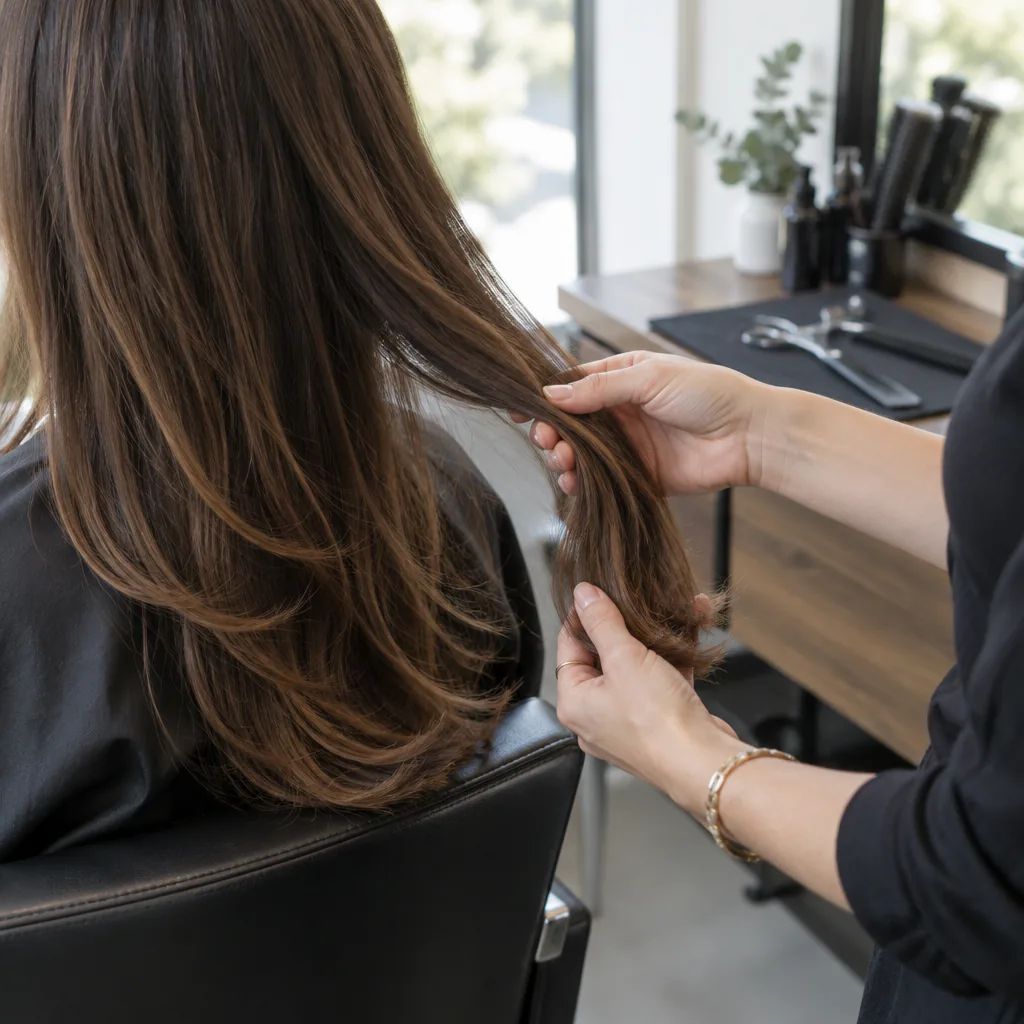
A good stylist can design almost any cut to be easier, but only if you explain what “easy” means to you. Use these steps at your next appointment:
- Name your priority. Say whether you want less daily styling, fewer appointments or easier wash days.
- Describe your real routine. “I air-dry and never use a round brush” is more useful than a photo of a blowout.
- Show how your hair dries naturally. Arrive with it in its usual state, not freshly styled, if your stylist agrees.
- Ask how it will grow out. Ask what the cut will look like six weeks later, not just on day one.
- Agree on a trim interval. Ask directly how often this shape needs maintenance so there are no surprises.
- Bring two or three references, including one of someone with a texture similar to yours.
If you’re unsure which cut to bring, Aura’s Hairstyle Finder for Women can help you prepare. It considers your visible hair texture and length, face shape and stated preferences. It then suggests three named haircut or fringe and parting options, with upkeep notes and a written salon brief you can show your stylist. The free result is a subjective styling-potential estimate. The full shortlist and brief require an account and a one-time purchase. The tool gives recommendations, not a try-on image. Extensions, big length changes and colour stay optional.
The Bottom Line
The best low maintenance hairstyle is the one whose upkeep you don’t mind. Short cuts cut down on morning time but add salon visits. Long layers tend to do the reverse. Textured medium cuts sit in between. Choose the cut that works with your natural texture, set your wash routine by your scalp rather than a trend, and tell your stylist exactly which kind of easy you want.
Sources & further reading
Frequently asked questions
What is the most low maintenance haircut for women? +
It depends on which kind of upkeep you want to cut. Pixies and crops need the least daily styling but usually need maintenance about monthly. Long hair with long layers can often go longer between salon visits. Textured medium cuts like shags and soft bobs sit in between.
Do short haircuts really save time? +
They save time in the morning, but not necessarily overall. Healthline says pixies and crops usually need maintenance every month or so, so you trade styling time for salon time.
Are bangs low maintenance? +
Blunt bangs usually are not, since some people trim them every two to four weeks. Curtain bangs and long face-framing layers are lower-commitment options because they blend in as they grow.
How often should I wash my hair with a low maintenance cut? +
Base it on your scalp and hair type, not your haircut. The AAD says straight hair with an oily scalp may need daily washing, while dry, curly, textured or thick hair can be shampooed when needed.
Will trimming my hair more often make it grow faster? +
No. Dermatologists call this a myth, and hair grows about half an inch a month regardless. Trim when the shape stops working or the ends feel rough.