 Aura: Looksmaxxing
 Bimax Before and After: What Results Look Like
Explore bimax before and after results, plus lefort 2, orbital osteotomy, accutane, and other transformations. See what real change looks like.
What Is a Bimax and Why Do Before-and-After Photos Matter?
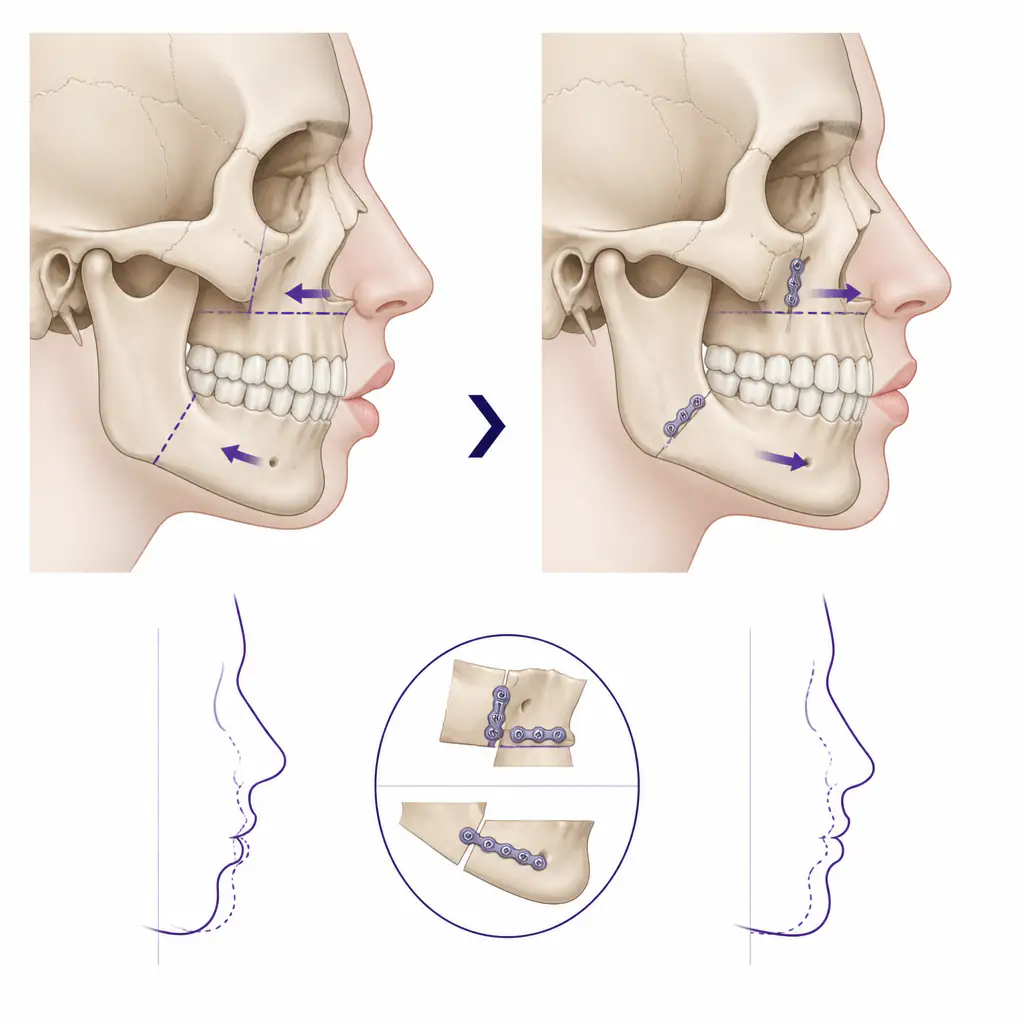
Bimaxillary osteotomy, commonly called bimax, is a surgical procedure that repositions both the upper jaw (maxilla) and lower jaw (mandible) simultaneously. Surgeons perform it to correct skeletal discrepancies: underbites, overbites, open bites, and midface deficiencies that braces alone cannot fix.
Before-and-after documentation matters for a specific reason. Because the changes affect bone position rather than soft tissue alone, the visual results are permanent and structurally significant. The profile shift, chin projection, lip posture, and airway volume all change together. Understanding what those changes actually look like, before committing to a multi-year orthodontic and surgical process, is practical due diligence, not vanity.
This guide walks through bimax results alongside several related transformations so you can build a clear, grounded picture of what each intervention actually produces.
Important: All surgical procedures discussed here carry real risks. Talk to a qualified maxillofacial surgeon or specialist before considering any of them.
Bimax Before and After: What the Transformation Actually Involves
A standard bimax involves cutting the maxilla along the Le Fort I line (a horizontal osteotomy just above the tooth roots) and performing a bilateral sagittal split osteotomy (BSSO) on the mandible. The surgeon then moves both segments to a pre-planned position and fixes them with titanium plates.
Typical Visual Changes
- Profile: Midface projection increases or decreases depending on the direction of maxillary movement. Chin position changes because the mandible rotates or advances.
- Lip posture: Upper lip support changes directly with maxillary advancement. Many patients report that lips appear fuller at rest without any filler.
- Airway: Counterclockwise rotation of the jaw complex, a common component of bimax surgery, may improve airway volume. Research suggests this is one reason some sleep apnea patients pursue the procedure.
- Facial thirds: The ratio between upper, middle, and lower facial thirds often becomes more balanced.
- Nasolabial angle: The angle between the nose and upper lip shifts, which changes how the nose appears even though the nose itself is untouched.
Recovery typically spans six weeks of liquid or soft diet, with full bony healing at three to six months. Final soft tissue results settle at around twelve months.
Le Fort I vs Le Fort II: How the Scope of Surgery Changes Results
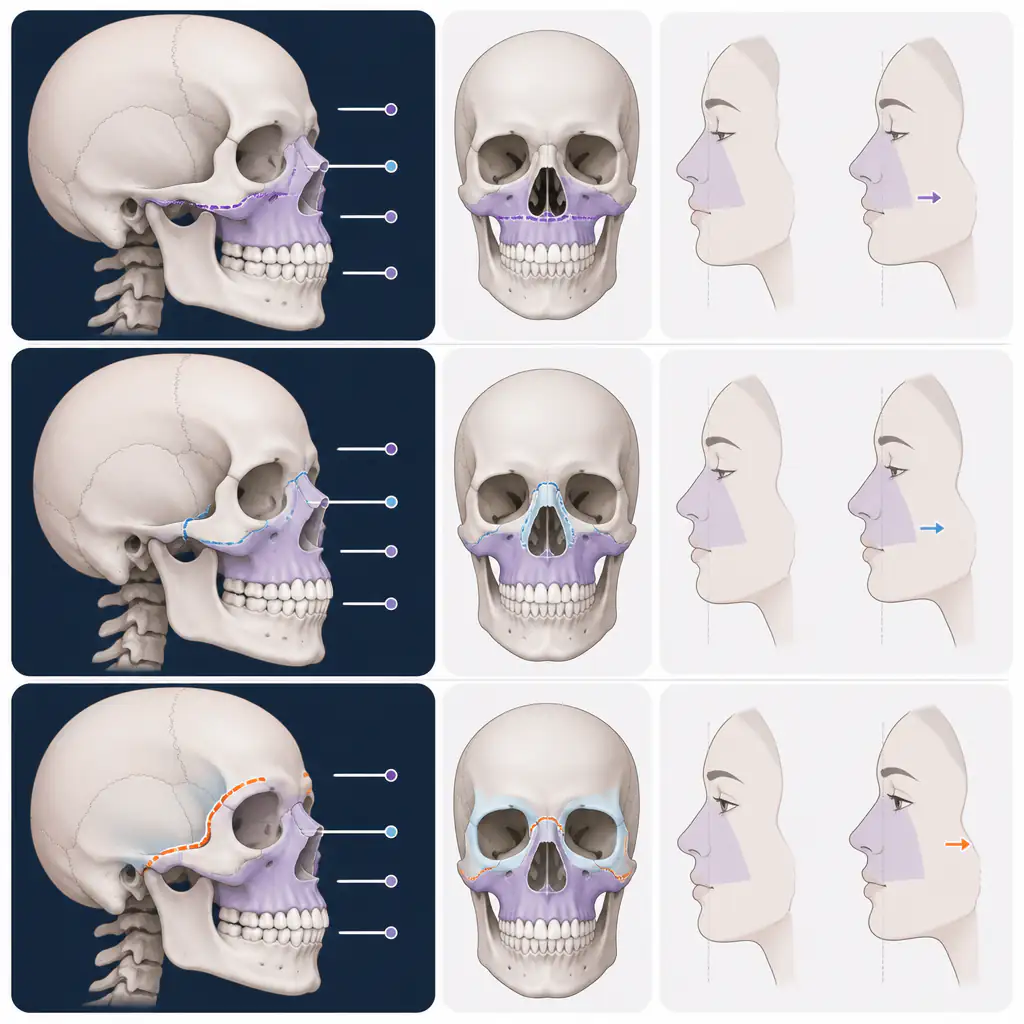
The Le Fort I osteotomy is the lower-level cut used in most standard bimax procedures. It moves only the tooth-bearing portion of the maxilla.
Le Fort II before and after photos show a more dramatic midface change because the Le Fort II cut travels higher, through the nasal bones and orbital rim, moving the entire nose-and-maxilla complex as one unit. This is used for patients with significant midface hypoplasia, such as those with cleft conditions or Treacher Collins syndrome, but also pursued by some adults seeking midface advancement.
The visual difference between Le Fort I and Le Fort II results:
| Feature | Le Fort I | Le Fort II |
|---|---|---|
| Maxillary movement | Tooth-bearing segment only | Midface including nose |
| Nasal change | Indirect (nasolabial angle) | Direct (nose moves forward) |
| Orbital rim | Unchanged | Included in movement |
| Typical indication | Dental malocclusion | Midface retrusion |
Orbital Box Osteotomy Before and After: Targeting the Periorbital Area
Orbital box osteotomy before and after results are among the more striking in facial surgery because they directly affect eye appearance. The procedure repositions the entire bony orbit as a three-dimensional box, changing orbital depth, inter-orbital distance, and the projection of the orbital rims.
From a looksmaxxing perspective, people pursue this to achieve a more projected supraorbital rim, which creates the so-called “hunter eye” appearance (a slight lateral canthal tilt with reduced scleral show). In clinical settings, it is used for orbital hypertelorism (eyes set too wide apart) or shallow orbits.
Before-and-after photos from orbital box cases show:
- Reduced scleral show (less white visible below the iris)
- A more defined brow ridge
- Improved orbital depth
This is among the most complex craniofacial procedures performed, generally only in major academic medical centers.
Non-Surgical Transformations: What the Evidence Shows
Not every meaningful change requires a hospital. Several non-surgical approaches produce documented before-and-after results, though they work through different mechanisms and on different timelines.
Before and After Accutane Pictures
Isotretinoin (Accutane) remains the most effective pharmaceutical option for moderate-to-severe acne. Before and after accutane pictures typically show near-complete clearance of inflammatory acne, reduction of sebaceous gland activity, and, in many cases, significant improvement in post-inflammatory hyperpigmentation over a six-to-nine-month course.
The skin texture change is often as significant as the acne clearance itself. Pore appearance decreases, and oil production remains suppressed for months or years after the course ends in many patients. However, the drug carries serious potential side effects including teratogenicity, mood changes, and dryness. A dermatologist’s supervision is mandatory.
Volufiline Lips Before and After
Volufiline is a botanical extract (sarsasapogenin in a plant-wax carrier) that research suggests may promote lipid accumulation in adipocytes, effectively adding subtle volume to tissue. Volufiline lips before and after comparisons show modest but measurable increases in lip fullness with consistent topical application over four to eight weeks.
The effect is subtle compared to filler but cumulative and reversible. It works best for people with naturally thin lips seeking a minor increase without needles.
Peppermint Oil Hair Growth Before and After
A peer-reviewed study comparing peppermint oil to minoxidil in an animal model found that peppermint oil produced statistically significant increases in follicle depth and dermal thickness. Peppermint oil hair growth before and after documentation in self-reported use typically shows improved density at the temples and hairline after three to six months of consistent scalp application.
It is generally diluted to a 3-5% concentration in a carrier oil. The mechanism is thought to involve increased dermal papilla activity via IGF-1 signaling.
Neck Workouts Before and After
Neck workouts before and after results are underappreciated in the looksmaxxing context. A visibly developed neck changes how the jaw and face appear from the front and side. Key muscles include the sternocleidomastoid, the scalenes, and the deep cervical flexors.
Progressive neck training using isometric exercises and neck harness work, performed two to three times per week, tends to produce visible hypertrophy in eight to sixteen weeks. The practical effect: a thicker neck improves the jaw-to-neck visual ratio, making the lower face appear sharper.
Niche Methods With Growing Documentation
Angion Method Before and After
The angion method is a self-administered facial massage protocol designed to increase local circulation and, theoretically, improve tissue quality and definition. Angion method before and after comparisons shared online suggest improvements in under-eye hollowing and cheekbone definition, though controlled evidence is limited.
The proposed mechanism involves stimulating angiogenesis (new capillary formation) in facial tissue through targeted pressure and movement. Results appear to be gradual and vary considerably between individuals.
K-Shami Before and After
K-shami before and after refers to the results of a systematic mewing and facial posture correction protocol associated with the practitioner K-Shami. The documented results center on improved mandibular definition and midface lift from sustained correct tongue posture and nasal breathing. Like all posture-based interventions, timelines are long (months to years) and individual results depend heavily on age and baseline anatomy.
FME Before and After
FME (Facial Muscle Exercises) before and after results vary by which muscle groups are targeted. Structured programs that focus on the masseter, temporalis, and buccinator muscles can produce visible changes in facial width and definition. Some practitioners combine FME with mewing for compounding effects on lower face appearance.
Bone Smashing Before and After
This is worth addressing directly. Bone smashing refers to the practice of applying blunt force to facial bones, supposedly to stimulate Wolff’s Law-based bone remodeling. Bone smashing before and after claims circulate online, but there is no clinical evidence that this produces cosmetic bone remodeling in adults. The primary documented outcomes are bruising and injury. This is not a recommended practice.

How to Track Your Own Transformation Systematically
Whether you are preparing for surgery, running a skincare protocol, or building a training routine, consistent documentation makes progress legible.
- Establish a baseline. Use standardized lighting, a neutral background, and consistent camera distance. Take frontal, three-quarter, and lateral photos.
- Get an objective assessment. Tools like Aura provide AI-driven facial analysis, including jawline scoring, hunter-eye detection, and PSL scoring, which gives you a quantified starting point rather than a subjective impression.
- Define your priority. Separate structural concerns (jaw position, orbital depth) from surface concerns (skin, hair). They require different interventions on different timelines.
- Photograph on a fixed schedule. Monthly is sufficient for most protocols. Weekly creates noise without useful signal.
- Consult the relevant professional. For anything surgical, a board-certified oral and maxillofacial surgeon or craniofacial surgeon. For skin, a dermatologist. For hair, a trichologist or dermatologist.
- Track subjective metrics too. Sleep quality, breathing ease, and confidence are legitimate outcome measures alongside the visual.
Choosing the Right Intervention for Your Goals
The transformations above span a wide range of invasiveness, cost, risk, and timelines. A rough framework:
- Structural skeletal issues (jaw misalignment, midface retrusion, orbital position): These require surgical evaluation. No topical or exercise-based method addresses bone position in adults.
- Skin quality: Accutane, tretinoin, and consistent sunscreen use produce the most well-documented results.
- Soft tissue volume: Volufiline for subtle lip work, fillers or fat transfer for more significant change.
- Muscular definition: Neck training, FME, and overall body composition are the primary levers.
- Hair: Minoxidil and finasteride have the strongest evidence base. Peppermint oil may support, not replace, them.
If you are unsure where your baseline stands before selecting an approach, running your photos through Aura to get a structured breakdown of your facial proportions and features can clarify which areas have the most room for improvement.
The most common mistake in pursuing any transformation is conflating different categories of intervention. Bone position cannot be addressed with skincare. Skin quality cannot be improved by jaw exercises. Matching the tool to the actual target is the only efficient path.
Frequently asked questions
How long does it take to see final bimax before and after results? +
Swelling resolves significantly within three months, but soft tissue fully settles at around twelve months post-surgery. Skeletal changes are visible much earlier, but final photos are typically taken at the one-year mark for accurate documentation.
Is Le Fort II the same as a bimax? +
No. A bimax typically uses a Le Fort I cut combined with a lower jaw osteotomy. Le Fort II is a higher, more extensive cut that moves the entire midface including the nasal complex. Le Fort II procedures are less common and typically reserved for significant midface deficiencies.
Can non-surgical methods like the angion method or mewing produce results comparable to surgery? +
No. Non-surgical methods may improve skin quality, muscle tone, posture, and soft tissue appearance, but they cannot reposition bones in adults. Surgery addresses structural skeletal discrepancies that no topical or exercise-based method can replicate.
What is the safest starting point before pursuing any transformation? +
Start with a clear baseline assessment of your current facial structure and identify which specific features you want to address. Understanding whether an issue is skeletal, muscular, or related to skin or hair determines the correct category of intervention and prevents wasted effort or unnecessary risk.