 Aura: Looksmaxxing
 High Lat Insertions vs Low: What It Means for Your Physique
High lat insertions vs low explained: how each affects your V-taper, waist appearance, and what you can realistically do about it.
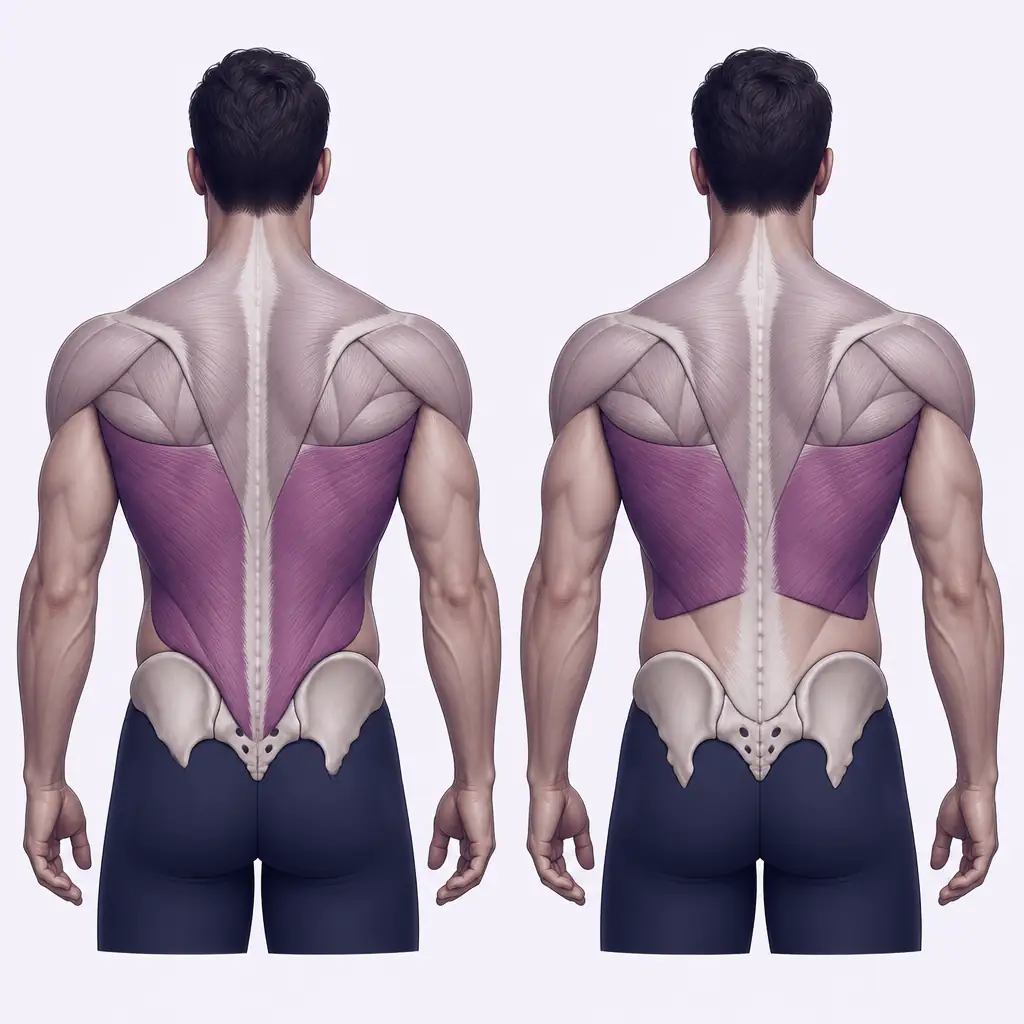
If you have spent any time studying physique development seriously, you have probably come across the debate around lat insertion points. Some guys train for years and end up with a wide, sweeping V-taper. Others put in the same work and find their lats look shorter, thicker, or somehow less dramatic, even at similar body fat and muscle mass levels.
The difference often comes down to one anatomical factor: where your latissimus dorsi muscles insert relative to your pelvis. This is the core of the high lat insertions vs low debate, and understanding it can genuinely change how you train, set expectations, and present your physique.
What Are Lat Insertions, Exactly?
The latissimus dorsi is the large, flat muscle that spans most of your back. It originates from the lower spine, pelvis, and lower ribs, and inserts into the humerus (your upper arm bone). When people talk about lat insertions in the context of aesthetics, though, they are usually referring to how low the muscle belly extends toward the pelvis on the lateral (side) view, and how that affects the visual line of the torso.
A person with low lat insertions has muscle tissue that runs closer to the pelvis, filling in more of the space between the armpit and the hip. A person with high lat insertions has muscle bellies that end higher up, leaving a longer gap between the bottom of the muscle and the top of the pelvis.
This is a genetic structural trait. It is determined by your skeletal anatomy and the actual attachment points of tendons to bone. No amount of training changes where the muscle attaches.
How to Tell If You Have High or Low Insertions
The easiest way to assess this is to stand in front of a mirror with your arms slightly raised and flared, then look at where the muscle tissue appears to end on your sides.
- Low insertions: The muscle appears to travel far down your sides, almost reaching the top of your hips. Your lats seem to fill the entire lateral torso.
- High insertions: There is a visible gap, sometimes called a “shelf” or “notch,” between where your lat muscle ends and the top of your pelvis. The muscle belly looks shorter.
Another indicator is the shape of your lat when you flex or spread it from the front. Low insertions often produce a broader, wider flare that appears to start lower on the torso. High insertions tend to create a higher, more concentrated flare that tapers off sooner.
If you want an objective read on your overall body structure and facial aesthetics together, Aura can give you a detailed analysis of your features and proportions, which is a useful baseline before committing to any physique or appearance goals.
The Visual Impact: V-Taper and Waist Illusion
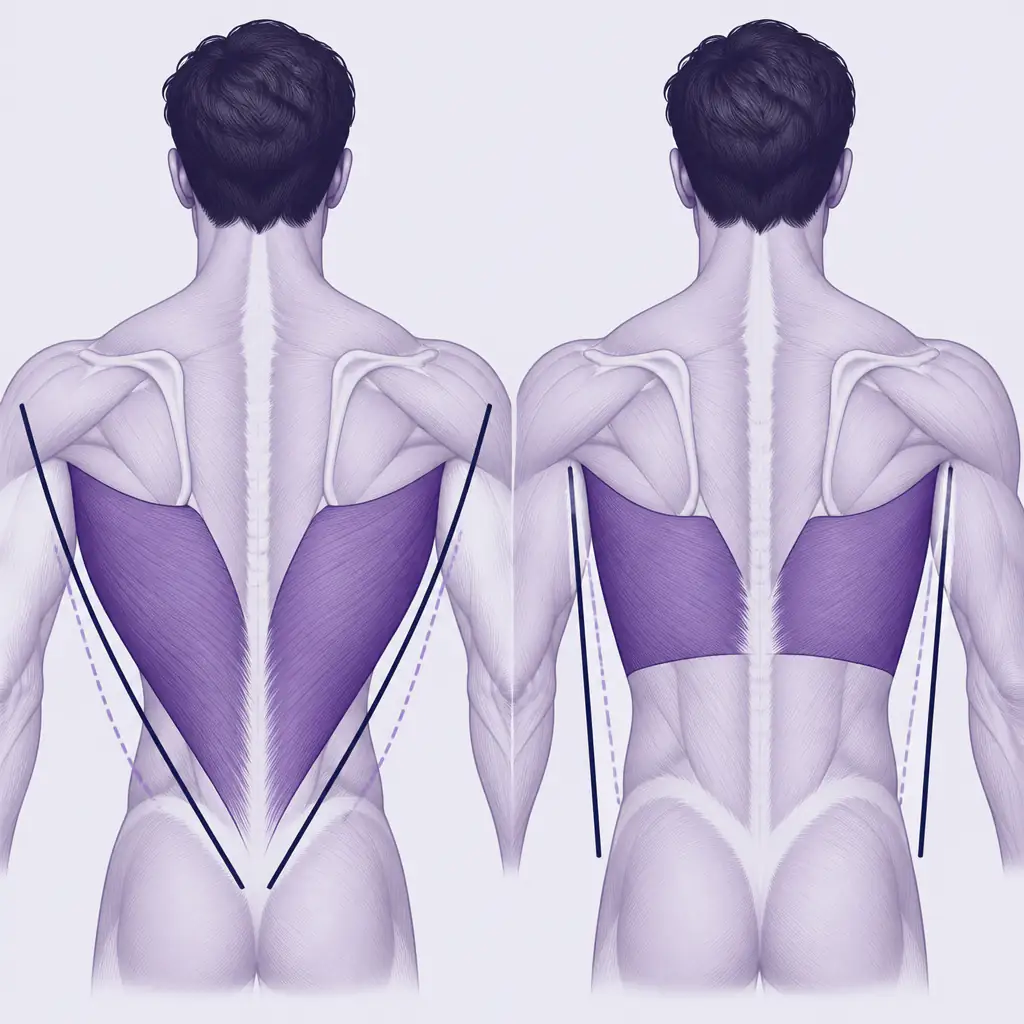
The entire reason this matters aesthetically is the V-taper: the classic silhouette of broad shoulders and back tapering down to a narrow waist. Lat insertions play a significant role in how dramatic this taper looks.
Low Insertions and the V-Taper Advantage
Low lat insertions are generally considered the more aesthetically favorable trait. Here is why:
- The muscle fills more of the lateral torso, creating the illusion of a wider back even at lower muscle mass.
- The transition from lat to waist appears longer and more gradual, which visually narrows the waist by contrast.
- From the front, the “wings” appear to extend further down, amplifying the taper effect.
Many of the most visually striking classic physiques in bodybuilding history had notably low lat insertions. The muscle seemed to grow almost from the hip itself, creating an almost impossibly wide appearance.
High Insertions and Their Limitations
High lat insertions create a shorter muscle belly on the lateral torso. The gap between the lat and the pelvis is more visible, which can:
- Make the waist appear wider than it is, since there is less muscle mass framing and tapering into the hip area.
- Limit the total visual width of the back even with significant development.
- Create a more “blocky” or square torso appearance, particularly when the obliques and serratus are also underdeveloped.
This does not mean a great physique is off the table. It means the ceiling for a certain type of lat-dominant V-taper look is lower, and you may need to prioritize other structural elements to compensate.
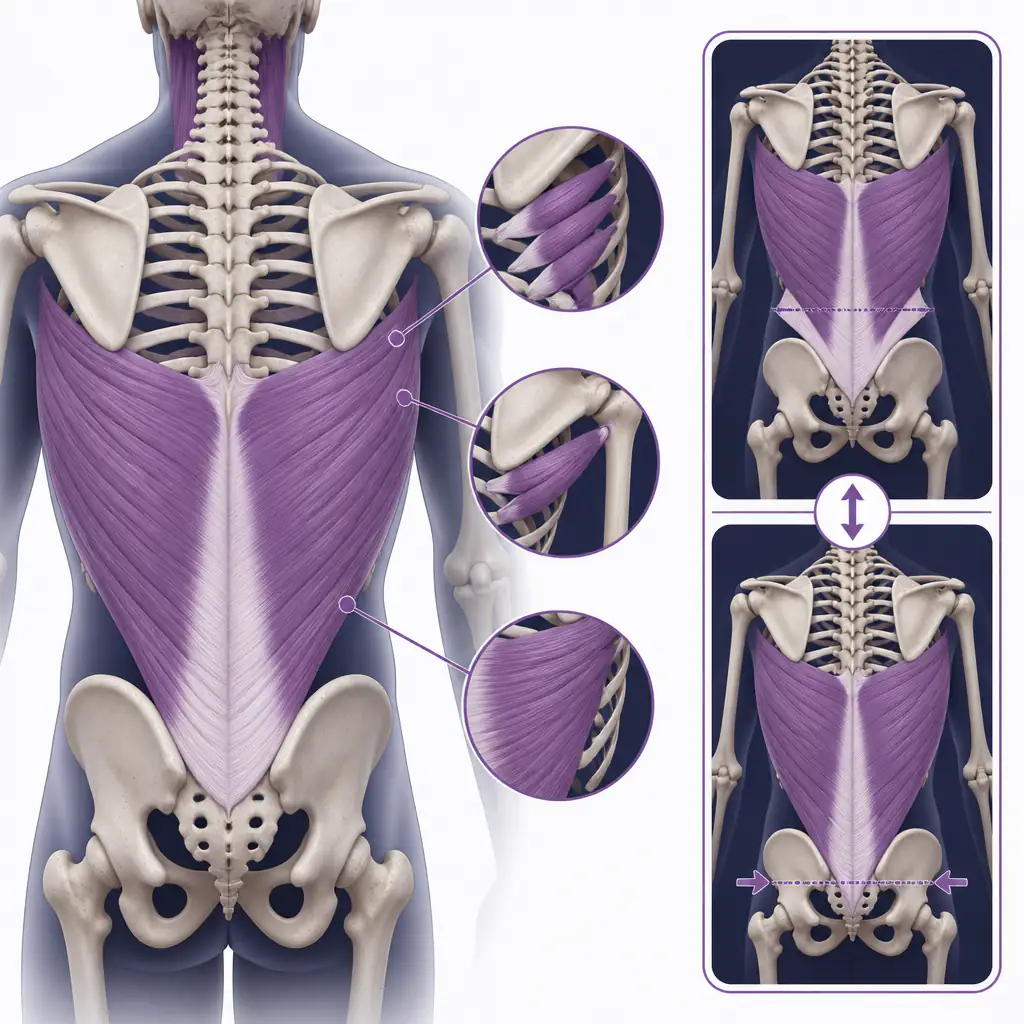
High vs Low Lat Insertions: Side-by-Side Comparison
| Feature | Low Lat Insertions | High Lat Insertions |
|---|---|---|
| Muscle belly length | Longer, closer to pelvis | Shorter, higher on torso |
| V-taper potential | Higher natural ceiling | Lower natural ceiling |
| Waist illusion | Stronger narrowing effect | Weaker narrowing effect |
| Width at lower back | More visual fill | Less visual fill |
| Training impact | Amplified by development | Less dramatic visual return |
| Rarity | Less common in elite physiques | More common in general population |
The key takeaway is that neither insertion point makes or breaks a physique entirely. They shift the starting point and the ceiling, not the entire outcome.
Can Training Change Your Insertion Points?
No. This is worth stating clearly. Tendon attachment points on bone do not change with exercise. What training does change is the size, thickness, and shape of the muscle belly itself, which can influence how your insertions appear in context.
For example, someone with high lat insertions who builds a very thick, wide upper back may still achieve an impressive silhouette because the sheer mass of the upper lats compensates for the shorter lower lat sweep. The visual gap between lat and hip remains, but the overall back width minimizes how much it matters.
What Training Can Actually Do
Even with high insertions, specific training focus can help:
- Maximize upper lat width with wide-grip pull-downs and pull-ups. The upper portion of the lat is less affected by insertion height.
- Build the teres major (the “little lat” just above the lat itself) to add apparent width and lower the visual starting point of back flare.
- Develop the serratus anterior along the side of the ribcage to fill the gap between lat and pelvis with adjacent muscle tissue.
- Build the obliques and spinal erectors to add structure to the lower torso and reduce the notched appearance.
- Reduce body fat to increase muscle definition and make whatever structural advantages you have more visible.
None of these steps move the insertion. They work around it by filling the surrounding area and maximizing what the existing muscle can look like.
Structural Factors That Interact With Lat Insertions
Lat insertion height does not exist in isolation. Several other structural variables interact with it and can amplify or diminish its visual effect.
Clavicle Length
Longer clavicles (collarbones) create broader shoulders, which directly widens the top of the V-taper. A person with high lat insertions and long clavicles may still achieve a strong V-taper because the width at the top is so pronounced that the shorter lat sweep matters less.
Pelvis Width
A narrower pelvis makes the waist appear narrower by default, which can compensate for higher insertions. A wider pelvis combined with high insertions creates the most challenging scenario for achieving a strong V-taper.
Torso Length
A longer torso gives more visual real estate for the lat to develop across. Even with high insertions, a long-torsoed individual may have a more impressive lateral spread than a short-torsoed person with low insertions, simply because scale is different.
Practical Takeaways for Training and Expectation Setting
Understanding your insertion type is useful, but it should inform your training strategy, not become a source of paralysis. Here is a practical framework:
Step 1: Assess your structure honestly. Use the mirror test described earlier. Look at photos from multiple angles. Consider getting an objective baseline on your proportions and facial structure through Aura if you want a data-driven starting point for your overall appearance goals.
Step 2: Accept what is structural. Insertion points, clavicle length, and pelvis width are fixed. Building a training plan around changing them is wasted mental energy.
Step 3: Target compensatory muscle groups. If you have high insertions, prioritize teres major development, serratus work, and upper lat width. These create the best optical illusion available to you.
Step 4: Lean out. Body fat obscures structural details. Lower body fat reveals whatever muscular advantages you have built and makes even modest development look more pronounced.
Step 5: Play to your strengths. If your back V-taper is limited, perhaps your shoulder-to-waist ratio, arm development, or chest structure are more impressive. A well-rounded physique built around your actual genetics will always outperform one built around trying to replicate someone else’s structural profile.
The Bigger Picture on Genetic Variation
Lat insertions are one of dozens of genetic variables that shape how a physique looks. Muscle belly length, muscle fiber density, bone structure, skin thickness, and hormonal profile all play roles. The online discourse around insertions can sometimes tip into fatalism, where people conclude their genetics are bad and improvement is pointless.
That framing is not accurate or useful. High lat insertions narrow one specific aesthetic ceiling. They do not determine overall attractiveness, strength, health, or even overall physique quality. Many impressive physiques are built on structurally average or below-average insertion points, compensated by disciplined training and intelligent program design.
Knowing your anatomy gives you better information. Better information leads to more realistic goals, smarter training decisions, and less frustration when progress does not look exactly like someone else’s progress. That is the only reason this conversation is worth having.
Frequently asked questions
Can I change my lat insertions with training? +
No. Lat insertion points are determined by where your tendons attach to bone, which is a fixed genetic trait. Training can increase the size and thickness of the muscle belly and develop surrounding muscles to improve the overall appearance, but the actual insertion location does not change.
How do I know if I have high or low lat insertions? +
Stand in front of a mirror with your arms slightly raised and flared outward. Look at your sides and observe where the muscle tissue appears to end. If the muscle runs close to your hip with little visible gap, you likely have low insertions. A visible notch or shelf between the lat muscle and your pelvis suggests higher insertions.
Do high lat insertions ruin your chances of a good V-taper? +
Not entirely. High insertions lower the ceiling for a specific lat-sweep-driven V-taper, but other structural factors like clavicle length, shoulder development, waist size, and overall back thickness can compensate. Focused training on the upper lats, teres major, and serratus may also help improve the overall silhouette.
Are low lat insertions rare? +
Notably low lat insertions that produce a strong visual sweep are less common in the general population. They are frequently observed in elite competitive physiques because individuals with that trait tend to stand out visually and pursue bodybuilding. Most people fall somewhere in the middle of the spectrum rather than at either extreme.