 Aura: Looksmaxxing
Female Jawline: What's Genetic and What Isn't
What actually shapes a female jawline, what the attractiveness research shows, why mewing falls short, and the hair and makeup choices that help.

Search female jawline and you will mostly find two kinds of content. One is advice borrowed from men’s looksmaxxing forums that treats a square, chiseled jaw as the goal for everyone. The other is product pages promising to sculpt your face in a few weeks. Neither is a reliable guide.
A woman’s jawline comes mostly from bone structure set during growth, hormones and genetics. The research on how people perceive jawlines is more nuanced, and more forgiving, than the online ideal suggests. This guide covers four things:
- what the jawline is made of
- what facial attractiveness studies do and don’t show
- which popular fixes hold up
- how the jaw changes with age
It then covers the styling choices that change how your jawline looks in person and on camera.
What the Jawline Is Made Of
Your visible jawline is several structures layered together:
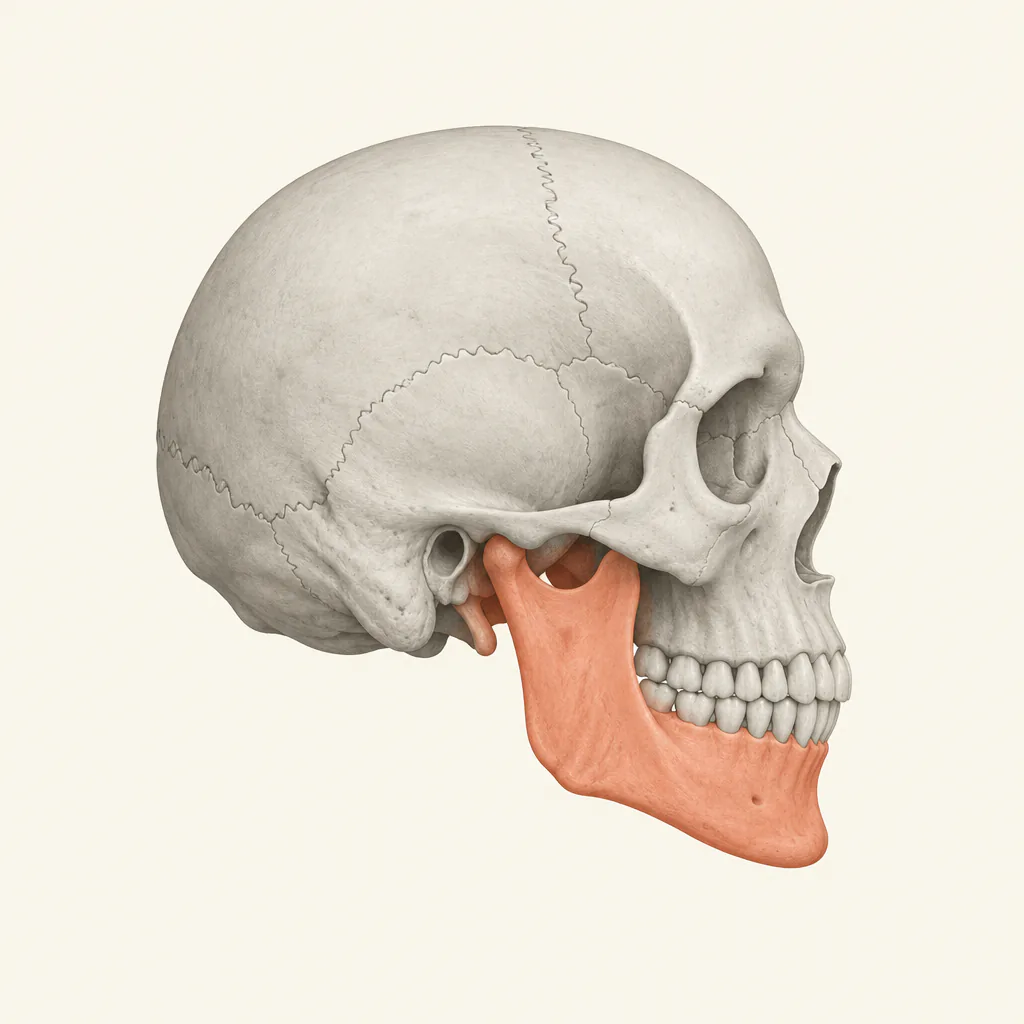
- The mandible. This is your lower jawbone, the only movable bone in the skull. Its horizontal lower edge is called the body, and the vertical section rising toward your ear is the ramus.
- The gonial angle. This is the corner where the body and ramus meet, roughly below your earlobe. How sharp or rounded this corner is drives much of what people call a defined or soft jaw.
- The chin. Anatomists call the bony point of the chin the mental protuberance. Its projection affects how long and defined the jawline looks in profile.
- The masseter. This is your main chewing muscle. It sits over the back of the jaw near the gonial angle and adds width at the lower face.
- Soft tissue. Skin, fat pads and connective tissue sit on top of all of this and soften or sharpen the line the bone creates.
What you see in a mirror or photo is the combined result of all five, plus lighting and camera angle. That is why the same jaw can look sharp in one picture and soft in the next.
How Male and Female Jaws Tend to Differ
Facial differences between the sexes mostly emerge at puberty. During that stage, male jawbones become larger, cheekbones more prominent, and cheeks and lips thinner than in female faces. The same paper notes that feminine facial characteristics are associated with higher estrogen levels.
Keep in mind that these are averages. Plenty of women have naturally strong, angular jaws, and plenty of men have soft ones. A defined jaw on a woman is not a flaw or a sign that something is off. It is one of many normal variations.
What Research Shows About Jawlines and Attractiveness
Facial attractiveness research rarely studies the jaw alone. It usually examines the jaw as part of sexual dimorphism, meaning features that differ on average between male and female faces. One study examined perceptions of features of this kind, such as eyebrow prominence and cheekbone prominence.
A few findings matter for anyone thinking about their own jawline.
Perceived femininity is consistently linked to attractiveness
One study compared faces from five populations. It found that women’s perceived femininity was positively related to their perceived attractiveness in all samples.
The same study measured face shape directly. In that analysis, neither perceived femininity nor attractiveness was associated with morphological sexual dimorphism (how female-typical the face measured). In other words, how feminine a face seems to observers is not the same as how feminine its geometry measures.
The jaw and chin are where ‘attractive’ and ‘hyperfeminine’ split
An analysis of female face shape applied shape statistics to the question. It found that attractive facial shape and sexual dimorphism were similar in the upper face but distinct in the lower face.
Put simply, pushing the lower face toward the most exaggerated feminine shape did not line up with the shapes people rated most attractive. Treat it as one piece of evidence rather than a rule.
Femininity is not the whole story
A separate experiment found that perceived attractiveness and sexual dimorphism are dissociable, suggesting other facial cues contribute to attractiveness beyond masculinity or femininity.
What this means in practice
Our editorial reading of these studies:
- Your jaw is one input, not the verdict. Observers form a whole-face impression.
- Extreme sharpness is not a target. Neither is extreme softness. The evidence does not point to a single jaw shape women should aim for.
- How a face is perceived matters more than one measurement. Hair, brows and presentation all feed into that impression, and you control those far more than your bone structure.
There Is No Single ‘Ideal’ Female Jawline
Stylists often sort jawlines into rough categories to guide haircut and makeup choices. These are editorial styling labels, not medical or anatomical classifications:
- Soft or rounded: a gently curved gonial angle and a jawline that blends smoothly into the chin.
- Tapered or V-shaped: a narrower chin with the jaw angling inward from wider cheekbones.
- Square or angular: a more defined corner at the gonial angle and a jaw roughly as wide as the forehead.
- Long: a jawline that looks elongated, often paired with a longer chin.
None of these is better than the others. A common mistake online is applying masculine jaw standards, like maximum width and hard angles, to women’s faces. Those standards come from a different set of preferences and do not transfer. The goal of styling is to work with the shape you have toward the look you want, whether that is softer, sharper or somewhere in between.
Mewing, Jaw Exercises and Other Quick Fixes
Mewing means holding the tongue pressed to the roof of the mouth for long stretches in hopes of reshaping the jaw. It is the most popular DIY jawline trend, often alongside chewing gadgets and facial exercises. The evidence does not support it.
The American Association of Orthodontists states that many claims about reshaping your jaw or improving your bite through exercises or ‘hacks’ are not supported by scientific evidence.
The reason comes down to age. Orthodontists explain that in children and young teens, whose facial bones are still growing, tongue posture and breathing patterns do influence development. In adults, growth is finished, and no amount of tongue pressure remodels a mature jaw.
Why the before-and-after photos look convincing
The dramatic transformations online have more ordinary explanations. Clinicians point out that age between fifteen and twenty-two, weight change, camera angle and lighting explain most before-and-after transformations attributed to tongue posture. A teenager photographed at fifteen and again at twenty, under different lighting and from a slightly higher angle, will look different regardless of what her tongue was doing.
The forceful version carries risk
The same source notes that clinicians link aggressive ‘hard mewing’ to jaw-joint soreness and to unwanted forward tipping of the front teeth when the tongue pushes on them. If you have been doing it and notice jaw pain or changes in your bite, stop and see a dentist.
How the Female Jawline Changes With Age
Bone is living tissue that constantly breaks down and rebuilds. Women gradually lose bone from around age 35, and around menopause the rate of bone loss escalates.
The face is part of this process. A literature review on facial bone aging describes age-related changes in the jaw as notably accelerated in postmenopausal women due to estrogen deficiency, highlighting the hormonal influence on mandibular structure.
The practical takeaway is that a softening jawline over the decades is a normal part of aging, not a personal failing. Styling choices that suited you at twenty-five may need adjusting at fifty, and that is an opportunity to update your look, not a problem to panic about.
Styling That Works With Your Jawline
You cannot reshape adult bone with posture or exercises, but you have a lot of control over how your jawline reads. Everything below is an editorial styling suggestion, not a measured effect.
- Get a clear look at your starting point. Take a straight-on photo at eye level in soft, even daylight with your hair pulled back. Then take a three-quarter view. This shows your jaw shape without shadows or a flattering angle distorting it.
- Use hair length and layers to frame. The eye tends to land where hair ends or changes direction.
- If you want to soften an angular jaw, layers that start around the chin or just below it work well. So do soft waves near the jaw corners.
- To add length to a rounder jaw, try longer cuts with vertical lines, a deep side part or face-framing pieces past the chin.
- To show off a defined jaw, a sleek bob or a high ponytail puts it on display.
- Balance with your brows. For an angular jaw, a softer, rounded arch is a common pairing. A rounder lower face often pairs with a slightly higher, more lifted arch for contrast.
- Contour with a light hand. For more definition, blend a matte shade one or two tones deeper than your skin just under the jawbone, sweeping from below the ear toward the chin. Blend it down into the neck so there is no visible line. To soften corners, skip the contour there and keep blush higher on the cheeks.
- Choose necklines and accessories deliberately. V-necks and scoop necks create vertical lines that elongate the lower face. Drop or linear earrings do something similar. Large round earrings or chokers draw attention to jaw width, which can be great if that is the look you want.
- Work the camera, not your bones. Light from the front or slightly above defines the jaw. Light from below flattens it. Shooting from slightly above eye level, with your chin gently forward and down, avoids the soft line that low angles create. This is the same effect that inflates mewing before-and-afters, so you might as well use it on purpose.
If you’d like a structured starting point for these choices, Aura’s Face Analysis for Women looks at a photo you upload. It returns notes on your facial profile, hair and brow ideas, and your personal priorities, shaped around the style goals you set. It does not apply masculine jaw ideals.
The free result is a subjective styling-potential estimate. The full findings are part of Aura Pro ($9.99 a month or $49.99 a year). Treat it as a styling guide, not a measurement or a medical assessment.
When to See a Professional
Some jaw concerns are not styling questions. See a dentist or orthodontist if you notice any of these:
- jaw pain, clicking, popping or locking when you open or close your mouth
- a change in how your teeth meet when you bite
- headaches or facial muscle tension you suspect is jaw-related
- noticeable asymmetry that appeared or worsened recently
Cosmetic procedures for the jawline also exist, including injectable fillers, botulinum toxin injections into the masseter, and surgery. We don’t recommend them for appearance. Jaw filler can migrate, form lumps or block a blood vessel; masseter Botox can weaken chewing and cause an uneven smile; and jaw surgery brings risks such as lasting numbness of the lip and chin.
The Bottom Line
Your jawline is set mainly by bone, muscle and genetics, and it changes slowly with age, particularly around menopause. The research does not crown a single ideal female jawline. In one shape analysis, the most attractive lower faces were not the most exaggeratedly feminine ones. Quick fixes like mewing have no evidence behind them for adults.
What you do control is how your jaw is framed: hair, brows, makeup, clothing and the angle of the camera. Start there, style toward the look you want, and leave the bone structure debates to the forums.
Sources & further reading
- Shape analysis of female facial attractiveness - ScienceDirect
- A new data-driven mathematical model dissociates attractiveness from sexual dimorphism of human faces
- The Effect of Target Sex, Sexual Dimorphism, and Facial Attractiveness on Perceptions of Target Attractiveness and Trustworthiness
- Facial bone aging: An update and literature review - PMC
- Aging and menopause reprogram osteoclast precursors for aggressive bone resorption
Frequently asked questions
Can you change a female jawline naturally? +
There is no evidence that mewing or facial exercises reshape adult bone, and the American Association of Orthodontists says claims about reshaping the jaw through exercises or hacks are not supported. What you can change is how your jawline looks, through hair framing, brow shape, contouring, necklines and camera angle.
Is a sharp jawline attractive on women? +
Research links perceived femininity with attractiveness in women across several populations, but it does not identify a single ideal jaw. One shape analysis of female faces found that attractive shapes and the most exaggerated feminine shapes diverged in the lower face, so neither maximum sharpness nor maximum softness is the target.
Is a strong jaw a masculine trait in women? +
On average, male jawbones grow larger at puberty, but these are averages with plenty of overlap. Many women naturally have defined, angular jaws. Hair and makeup can soften or emphasize that structure depending on the look you prefer.
Does the jawline change after menopause? +
Yes. Women's bone loss accelerates around menopause, and a literature review on facial bone aging describes age-related jaw changes as notably accelerated in postmenopausal women due to estrogen deficiency. Gradual softening of the jawline with age is normal.
What haircut suits a strong or square female jaw? +
As an editorial suggestion, layers that begin around or just below the chin, soft waves near the jaw corners, and side-swept pieces tend to soften angular lines. If you want to show off a defined jaw, sleek bobs and high ponytails put it on display.