 Aura: Looksmaxxing
Dimorphism: Why a Face Reads Male or Female
Sexual dimorphism explains why some faces read male or female at a glance. The specific features involved, and what the preference research found.
What Dimorphism Actually Means
The word dimorphism comes from the Greek roots di (two) and morphe (form). In biology, it refers to the existence of two distinct physical forms within a single species. When scientists talk about sexual dimorphism, they mean the observable differences in body or facial structure between males and females of the same species.
In plain terms: males and females of many species look noticeably different from each other, and those differences are not random. They follow predictable patterns shaped by evolution, hormones, and reproductive pressures.
For humans, dimorphism meaning extends well beyond height or muscle mass. It shows up in the face in specific, measurable ways, and understanding those patterns gives you a clearer picture of why certain facial structures are perceived the way they are.
Sexual Dimorphism in the Human Face
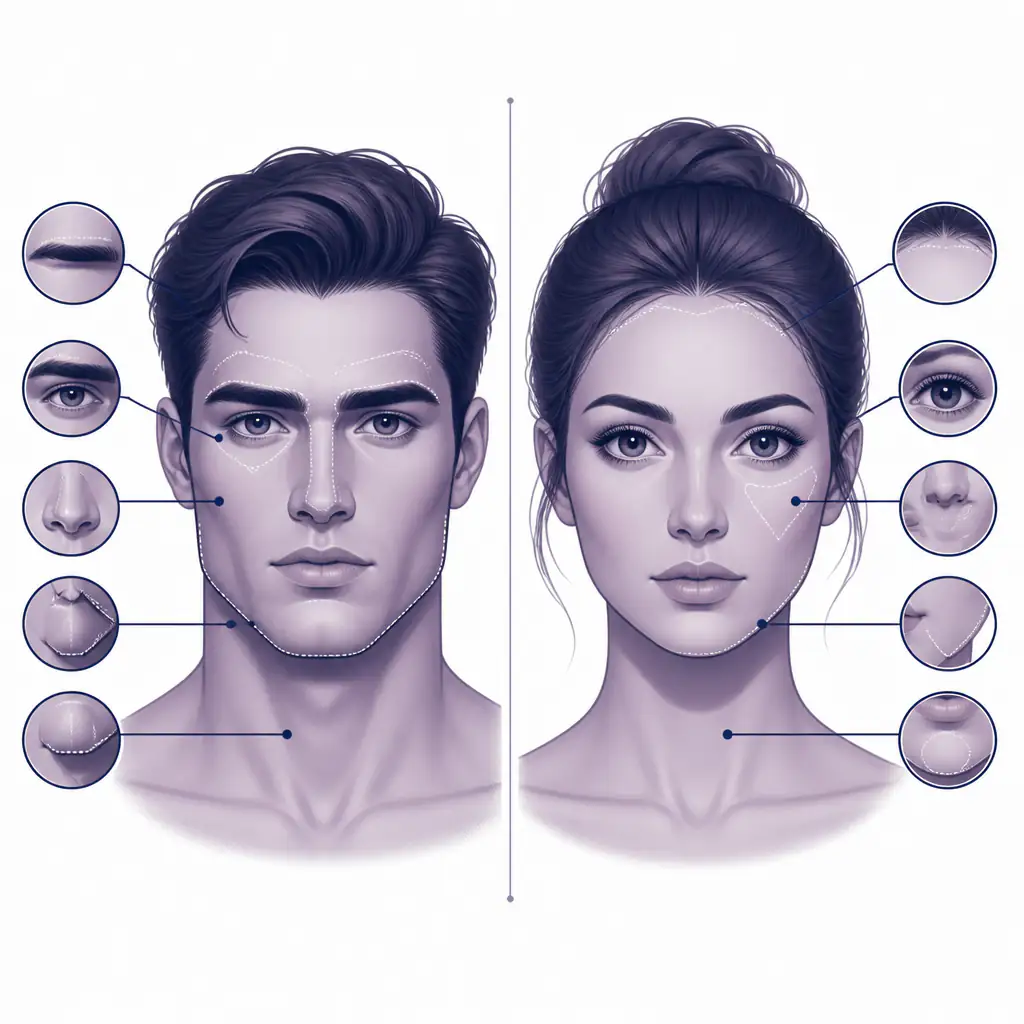
Facial sexual dimorphism describes the set of structural differences between a typically male face and a typically female face. These differences emerge primarily during two developmental windows:
- Prenatal hormone exposure (especially testosterone and estrogen ratios in the womb)
- Puberty, when sex hormones drive the majority of adult facial bone growth
The result is two broad facial archetypes, each with a cluster of associated features.
Masculine Facial Traits
- A more prominent, square or rectangular jawline with greater width at the gonial angle
- A heavier, more projecting brow ridge (supraorbital ridge)
- Deeper-set eyes, often described as hunter eyes, with a more forward orbital rim
- A longer midface and stronger chin projection
- Thicker skin and more pronounced zygomatic (cheekbone) structure with less subcutaneous fat
- A broader, more angular nose
Feminine Facial Traits
- A narrower, more tapered jaw with a softer chin
- Higher, rounder cheekbones with more subcutaneous fat distribution
- Larger eyes relative to face size, with a higher brow arch
- A shorter midface and fuller lips
- Smoother skin texture and less pronounced brow ridge
These are statistical tendencies, not rigid rules. Real faces sit on a spectrum, and individual variation is enormous. Dimorphism is a continuum, not a binary switch.
Why Dimorphism Matters for Perceived Attractiveness
Research in evolutionary psychology suggests that facial sexual dimorphism acts as a biological signal. The underlying logic is that pronounced dimorphic features, in either direction, may indicate a hormonally healthy developmental history.
For male faces, research suggests that stronger jawline definition, brow projection, and overall facial robustness are associated with higher testosterone during puberty. Observers across cultures tend to rate faces with these traits as appearing more dominant and masculine.
For female faces, features like higher cheekbones, fuller lips, and larger eyes relative to face size are associated with estrogen influence and are consistently rated as more feminine in attractiveness studies.
However, the relationship is not linear. Studies on the attractiveness of male dimorphism, in particular, show a nuanced picture: very high masculinity is not always the highest-rated option, especially for long-term partner preference. Context matters. What reads as dominant and attractive in one cultural or situational frame may read differently in another.
The key takeaway is that understanding dimorphism gives you a framework, not a formula.
How Hormones Shape Facial Dimorphism
Testosterone and estrogen are the primary drivers, but the story is more layered than “more testosterone equals more masculine face.”
Testosterone’s Role
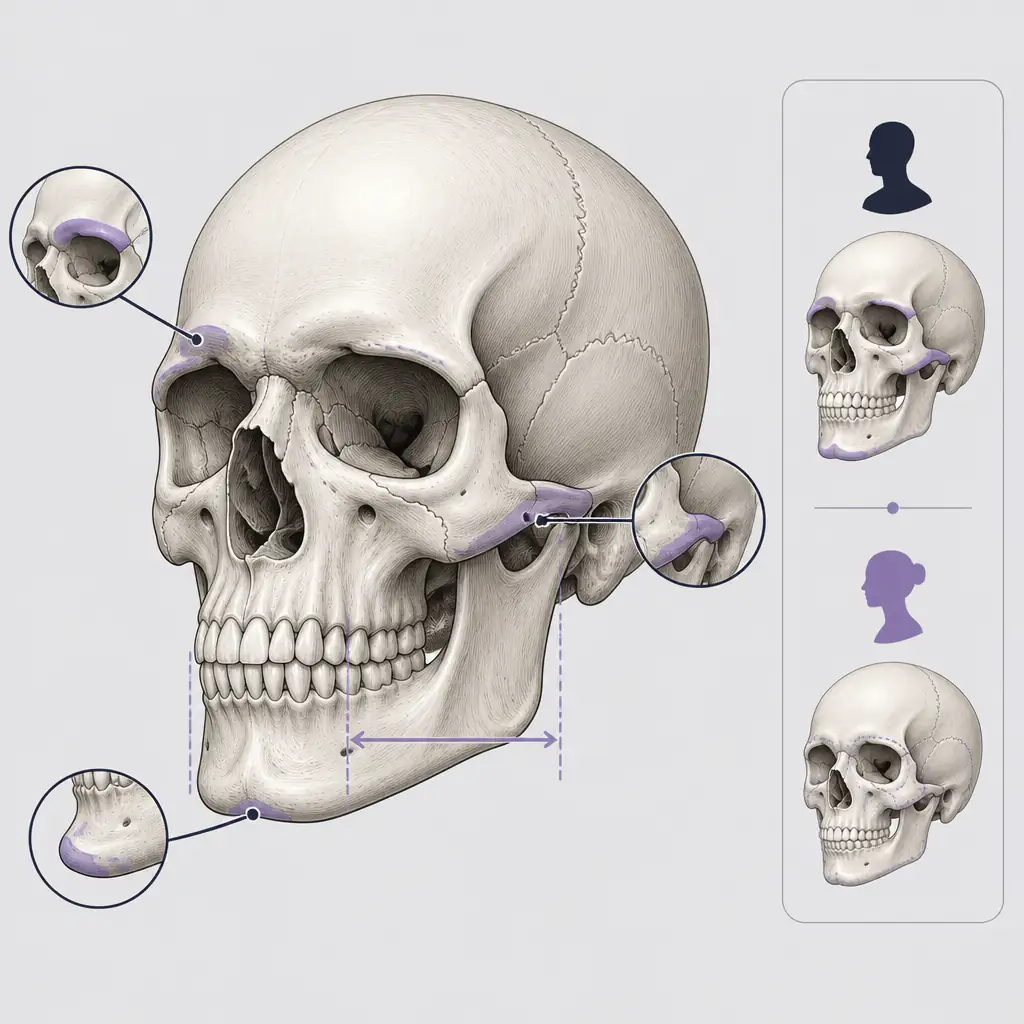
During puberty in males, elevated testosterone drives bone remodeling in specific regions:
- The mandible (jawbone) grows wider and longer
- The supraorbital torus (brow ridge) becomes more prominent
- The chin projects forward and widens
- The zygomatic arches broaden
This is why the male face changes so dramatically between ages 12 and 18, while the female face changes in softer, less angular ways over the same period.
Estrogen’s Role
Estrogen promotes growth of the midface, increases subcutaneous fat in specific areas like the cheeks and lips, and slows the overall bone growth that testosterone accelerates. The result is a face that retains more of the neotenic (youthful) proportions associated with femininity.
Prenatal Androgen Exposure
Researchers sometimes use the digit ratio (2D:4D), the ratio of the index finger to the ring finger, as a proxy for prenatal testosterone exposure. A lower ratio in males is associated with greater prenatal androgen exposure and, in some studies, with more pronounced masculine facial features. This remains an area of active research rather than settled science.
Dimorphism and the Concept of PSL Scoring
In the looksmaxxing community, facial assessment often relies on a scoring framework called PSL (named after three researchers whose work on facial attractiveness became widely cited). PSL scoring attempts to quantify facial attractiveness on a numerical scale by evaluating a range of traits, many of which directly map onto sexual dimorphism markers.
For males, a PSL assessment weights factors like:
- Jawline definition and width
- Brow ridge prominence and orbital depth
- Cheekbone projection
- Chin shape and forward projection
- Facial thirds proportions
For females, the weighting shifts toward facial symmetry, eye size relative to face, lip fullness, and facial fat distribution.
If you want an objective starting point for understanding where your own facial dimorphism sits, Aura provides an AI-driven PSL score along with specific breakdowns of traits like jawline definition and hunter-eye depth. Having a concrete baseline is more useful than guessing, especially before deciding which areas to focus on.
Can You Influence Facial Dimorphism?
This is where the conversation becomes practical. While bone structure is largely set after puberty, there are legitimate levers that can influence how dimorphic your face appears.
Factors Within Your Control
1. Body fat percentage Facial fat distribution is highly responsive to overall body composition. Reducing body fat, particularly in males, can reveal underlying bone structure that dimorphism markers like jawline and cheekbone definition depend on. Some users report significant changes in perceived jaw definition with a 5 to 10 percent reduction in body fat.
2. Mewing and oral posture Mewing refers to maintaining proper tongue posture against the palate. Research on this specific practice in adults is limited, and claims about bone remodeling in fully developed adults remain contested. However, correct oral posture may improve the appearance of the jawline by affecting muscle tone and neck posture. Treat this as a low-cost, low-risk habit rather than a guaranteed structural fix.
3. Facial muscle development Masseter hypertrophy (enlarging the jaw muscles through chewing resistance or exercises) can add visible width to the lower face. This is achievable through consistent mastic gum chewing or targeted jaw exercises over months.
4. Skincare and skin quality Skin texture affects how strongly structural features read. Clear, well-hydrated skin with good elasticity allows underlying bone and muscle structure to show through more clearly.
5. Hairstyle and grooming These do not change bone structure, but they significantly influence how facial proportions are perceived. A hairstyle that adds volume at the top can elongate the face; a well-maintained beard can define an otherwise soft jawline.
Procedures to Consider (With Professional Guidance)
Clinics also sell jaw filler, chin augmentation and brow bone surgery to make a face look more masculine or feminine. We don’t recommend them for appearance. Their risks include blocked blood vessels, nerve damage, infection and results that cannot be undone.
Reading Your Own Facial Dimorphism
Assessing your own face objectively is harder than it sounds. Familiarity bias (you see your face every day) and variation in photographs due to lighting, angle, and lens distortion all make self-assessment unreliable.
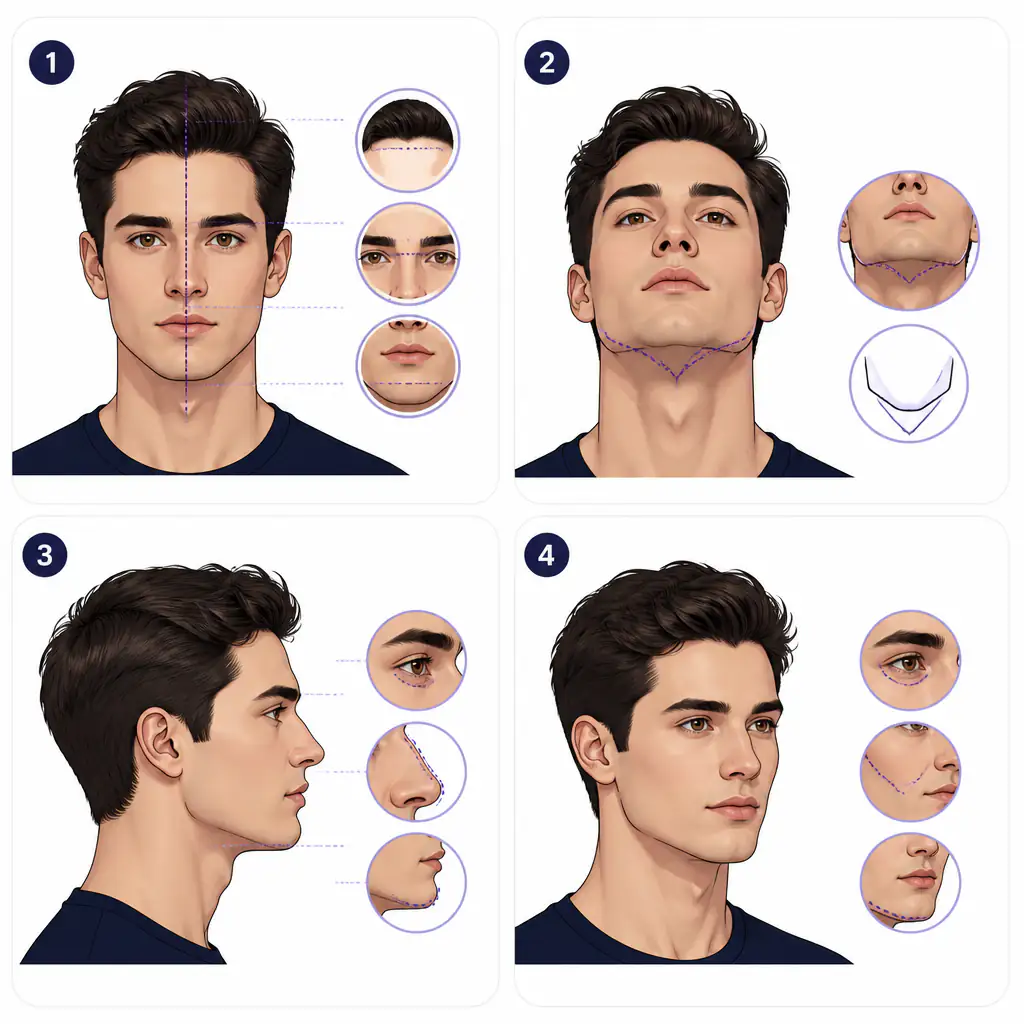
A useful approach:
- Take a standardized photo: neutral expression, even lighting, camera at eye level, no wide-angle lens distortion.
- Map your facial thirds: hairline to brow, brow to nose base, nose base to chin. Equal thirds are generally considered proportional.
- Assess your jawline in a slight downward angle photo to see definition without chin-forward compensation.
- Look at orbital depth: in a side-profile photo, does the brow ridge project beyond the eye, or is the eye more flush with the brow?
For a more structured analysis, Aura runs these assessments automatically, flagging specific traits like hunter-eye depth, jawline symmetry, and midface ratio with a breakdown that is harder to get from subjective self-review.
The Limits of Dimorphism as a Framework
It is worth being clear about what facial dimorphism is and is not.
It is a biological and statistical framework that describes population-level patterns in how faces develop under hormonal influence. It is a useful lens for understanding why certain features are perceived the way they are.
It is not a comprehensive theory of attractiveness. Attractiveness is influenced by symmetry, averageness, skin quality, grooming, social context, individual preference, and factors that have nothing to do with how masculine or feminine a face reads. Cross-cultural attractiveness research consistently shows that while some dimorphism preferences are broadly shared, cultural variation is significant.
It is also not a value judgment. A face that is less dimorphic in the conventional sense is not a worse face. The goal of understanding dimorphism is self-knowledge and informed decision-making, not fitting into a rigid ideal.
Understanding what dimorphism means gives you a more precise vocabulary for thinking about your face. What you do with that understanding is entirely up to you.
Frequently asked questions
What does dimorphism mean in simple terms? +
Dimorphism means the existence of two distinct physical forms within one species. In humans, sexual dimorphism refers to the structural differences between male and female faces and bodies that develop due to differences in hormone exposure during growth.
Is more facial dimorphism always more attractive? +
Not necessarily. Research suggests that moderate dimorphism is often rated as highly attractive, but very extreme masculinity or femininity does not always score highest. Attractiveness depends on symmetry, proportions, skin quality, and cultural context, not dimorphism alone.
Can adults change their facial dimorphism without surgery? +
Bone structure is largely fixed after puberty, but factors like body fat percentage, facial muscle development, oral posture, and grooming can meaningfully influence how dimorphic your face appears. More significant changes would require professional cosmetic intervention.
What is the connection between sexual dimorphism and PSL scoring? +
PSL scoring assesses facial attractiveness using a set of traits that closely map to sexual dimorphism markers, such as jawline definition, brow projection, and cheekbone prominence for males. Dimorphism provides the biological framework that PSL scoring attempts to quantify.