 Aura: Looksmaxxing
 Brow Ridge in Males: Anatomy, Aesthetics & Improvement
Learn how the brow ridge shapes male facial attractiveness, what anatomy is involved, and practical ways to optimize your appearance.

The brow ridge is one of the most immediately noticeable features of the male face. It sits at the intersection of the forehead and the upper orbital area, and its size, shape, and projection influence how masculine, assertive, and even symmetrical a face appears to observers. Yet most men have never thought critically about this structure.
This guide breaks down the anatomy behind the brow ridge, explains why it matters for male facial aesthetics, and gives you practical, grounded options for working with what you have.
What Exactly Is the Brow Ridge?
The brow ridge, known anatomically as the supraorbital ridge or supraorbital torus, is a bony shelf that projects outward from the frontal bone of the skull just above the eye sockets (orbits). It runs horizontally across the lower forehead, forming the upper boundary of the orbital rim.
In males, this structure is typically more pronounced than in females due to the influence of androgens during development. The difference is so consistent that forensic anthropologists use brow ridge projection as one of several markers when estimating the biological sex of skeletal remains.
The Three Segments of the Supraorbital Region
The brow ridge is not a single uniform ledge. It has three distinct anatomical zones:
- Glabella: The central section between the eyebrows, sitting just above the nose. This is often the most prominent part in males.
- Superciliary arch: The curved portion that extends laterally over each eye socket. This creates the arching shape visible beneath the brow hairs.
- Lateral orbital rim: The more subtle outer edge where the brow ridge transitions toward the temple. Less prominent but still contributes to overall orbital depth.
Understanding this three-part structure matters because changes or asymmetries in any one segment produce visibly different aesthetic effects.
Why the Brow Ridge Matters for Male Attractiveness
Research in evolutionary biology and facial perception consistently identifies brow ridge projection as a marker of androgenic facial development. Put simply, a well-defined supraorbital ridge is read by observers, often unconsciously, as a signal of masculinity.
Several mechanisms explain this:
- Orbital shadowing: A projecting brow ridge casts a shadow over the eyes, creating depth and the appearance of what is sometimes called “hunter eyes” (a deep-set, slightly hooded orbital position). This shadowing reduces scleral show and gives the gaze a more focused, intense quality.
- Facial thirds balance: The brow ridge anchors the upper third of the face. Adequate projection here creates a visual counterweight to the jaw and chin in the lower third, contributing to overall facial balance.
- Perceived dominance: Studies on face perception suggest that faces with more prominent brow ridges are rated as appearing more dominant and assertive, independent of emotional expression. This is partly why strong brow structure appears frequently in descriptions of “strong” or “chiseled” male faces.
- Skin texture and aging: A defined brow ridge can make the overlying skin appear tighter and more structured, which tends to read as youthful and vital.
None of this means a subtle brow ridge makes a face unattractive. Facial attractiveness is multifactorial. But the supraorbital region is a legitimate and meaningful component of male facial geometry.
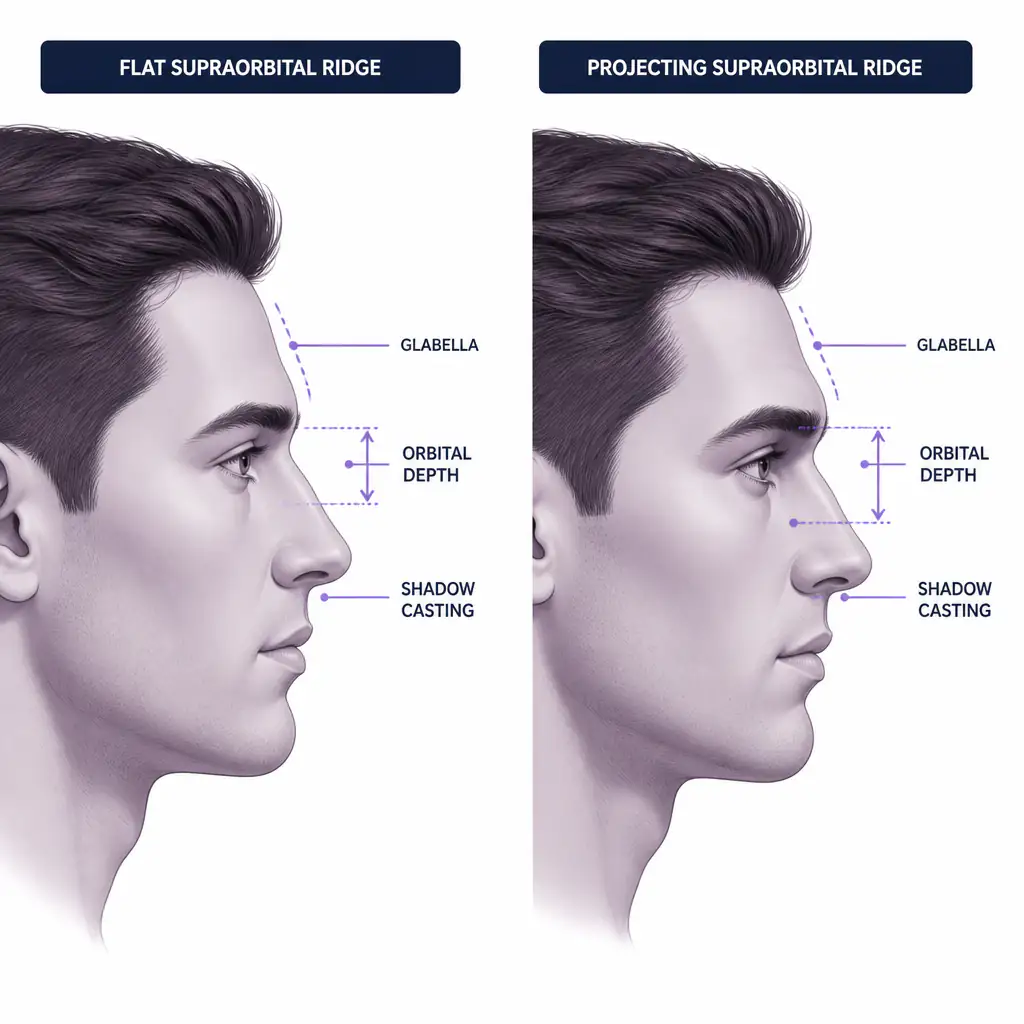
How Brow Ridge Development Is Influenced
The supraorbital ridge develops primarily during puberty under the influence of testosterone and growth hormone. The degree of projection a man ends up with is largely determined by genetics and androgenic exposure during adolescence.
Key factors include:
- Genetics: The size and shape of the frontal bone, and therefore the brow ridge, is heavily heritable. Family patterns are a reliable predictor.
- Testosterone levels during puberty: Higher androgenic activity during the adolescent growth window is associated with more pronounced brow development. This is the same hormonal environment that drives jaw widening, voice deepening, and increased skeletal density.
- Skull pneumatization: The frontal sinus, a hollow air space inside the frontal bone, sits just behind the glabella. Larger frontal sinuses can contribute to a more prominent central brow projection, though the contribution of the sinus versus the outer cortical bone varies between individuals.
- Nutrition and overall health during development: Adequate caloric intake, protein, and micronutrients during adolescence support optimal skeletal development, including cranial bone density and growth.
Once skeletal development is complete, the underlying bone structure is fixed without surgical intervention. However, the visual appearance of the brow ridge is also shaped by soft tissue factors that remain modifiable.
Assessing Your Own Brow Ridge
Before attempting to change anything, it helps to get an honest and objective read on your current facial structure. Many people either overestimate or underestimate their brow ridge prominence depending on how they photograph themselves, lighting conditions, and angle bias.
A few practical assessment approaches:
- Side-profile photography: Shoot a true lateral photo with your head in neutral position (the Frankfort horizontal plane, where the lower orbital rim and the tragus of the ear are level). From this angle, you can measure how far the brow ridge projects relative to the cornea of the eye.
- Three-quarter view: The 45-degree angle reveals how the brow ridge interacts with orbital depth and cheekbone structure together.
- Consistent lighting: Overhead or slightly angled lighting from above will reveal brow ridge projection more accurately than flat frontal lighting, which flattens all midface and upper-face structure.
If you want a structured, scored baseline, Aura provides AI-driven facial analysis that includes hunter-eye detection and overall upper-face geometry scoring. It can give you a quantified starting point rather than relying entirely on your own perception.
Non-Surgical Ways to Maximize Brow Ridge Appearance
For most men, surgical options are not relevant or desirable. The good news is that several accessible strategies can meaningfully affect how prominent and defined the brow ridge appears.
Body Fat Percentage and Facial Adiposity
Excess body fat deposits around the forehead and temples can soften the visual impact of the brow ridge by reducing the contrast between the ridge and the surrounding tissues. Reducing overall body fat percentage through a sustained caloric deficit and resistance training tends to improve facial definition across the board, including in the supraorbital area. This is not a quick fix, but it is one of the highest-leverage non-surgical changes a man can make.
Eyebrow Grooming and Position
The eyebrows sit directly on top of the brow ridge and dramatically influence its perceived prominence. Key grooming principles for males who want to emphasize brow structure:
- Keep brow hairs close to the supraorbital rim rather than letting them grow excessively upward onto the forehead. This keeps visual attention anchored to the bone structure beneath.
- Avoid over-arching. A relatively straight, horizontal brow shape complements and accentuates the underlying ridge better than a highly arched shape, which can draw the eye upward and away from the bone structure.
- Light grooming underneath the brow (cleaning up stray hairs on the upper orbital rim) can sharpen the boundary between the brow ridge and the orbital area, creating more visible definition.
Skincare and Skin Quality
Thin, well-hydrated skin with good collagen density will conform more closely to the underlying bone structure and make brow ridge projection more visible. Chronic dehydration, loss of skin elasticity from poor sleep, and unmanaged skin conditions can all cause puffiness and textural changes that soften bone-level features.
Posture and Head Position
This sounds minor but is worth noting. Forward head posture tilts the face slightly upward and reduces the perception of brow ridge projection in forward-facing photos and interactions. A neutral head position with the chin slightly tucked shows the brow ridge, orbital structure, and jawline more accurately.

Surgical and Medical Options
For men with significant concerns about brow ridge projection or shape, surgical options exist. These are serious procedures and are not appropriate for the vast majority of men. This section is included for completeness and accuracy.
Forehead contouring / brow ridge augmentation: A craniofacial or maxillofacial surgeon can augment a flat or under-projected brow ridge using custom implants (typically made from PEEK or silicone) or bone cement. This is performed under general anesthesia through a coronal (scalp) incision.
Frontal sinus setback: In cases where the brow ridge is excessively prominent (more common in transgender women seeking feminization, but occasionally relevant in other contexts), the frontal sinus anterior wall can be repositioned. This is a specialized procedure.
Filler (off-label): Some practitioners inject hyaluronic acid filler along the supraorbital rim to add soft-tissue volume and the appearance of projection. Results are temporary (typically six to eighteen months) and outcomes depend heavily on injector skill and individual anatomy. Vascular complications in the periorbital area are a real risk with filler.
Important: Talk to a qualified medical professional before considering any of these interventions. A board-certified plastic surgeon, craniofacial surgeon, or oculoplastic surgeon with experience in male facial anatomy is the appropriate starting point. Outcomes vary, risks are real, and no procedure should be approached without thorough consultation.
Putting It Together: A Practical Priority Order
If you want to improve how your brow ridge presents without surgery, here is a sensible sequence:
- Get an accurate assessment first. Use consistent, neutral-angle photography or a tool like Aura to understand what you are actually working with before drawing conclusions.
- Optimize body composition. Reduce facial adiposity through sustained fat loss if relevant. This is foundational and improves multiple facial features simultaneously.
- Refine eyebrow grooming. Small adjustments to brow shape and position can noticeably sharpen the appearance of the supraorbital ridge without any cost or risk.
- Improve skin quality. Consistent skincare, sleep, hydration, and sun protection preserve skin elasticity and facial definition over time.
- Address posture. Neck and posture work pays dividends in how your whole facial structure presents in social and photographic contexts.
- Consider professional consultation last, and only if you have a genuine structural concern after optimizing the above variables.
The brow ridge is a fixed skeletal feature in adults, but its visual impact is shaped by multiple modifiable factors. Most men have more room to improve their brow ridge appearance through lifestyle and grooming than they realize.
Frequently asked questions
Can you increase brow ridge prominence without surgery? +
You cannot change the underlying bone without a surgical procedure. However, reducing body fat percentage, grooming the eyebrows to sit closer to the orbital rim, and improving skin quality can all make an existing brow ridge appear more defined and prominent.
Is a prominent brow ridge always more attractive in males? +
Research suggests that moderate to strong brow ridge projection is generally associated with higher perceived masculinity in males, but attractiveness is multifactorial. A balanced face with harmonious proportions across all features tends to read as more attractive than any single prominent feature in isolation.
Why do males have more prominent brow ridges than females? +
The difference is driven primarily by testosterone during puberty, which stimulates greater development of the frontal bone and supraorbital region in males. This pattern is consistent enough that forensic anthropologists use brow ridge projection as one of several sex-estimation markers in skeletal analysis.
What is the difference between the brow ridge and the glabella? +
The brow ridge (supraorbital ridge) is the full horizontal bony shelf running above both eye sockets. The glabella is specifically the central portion of this ridge, located between the eyebrows just above the nose. The glabella is often the most projecting part of the brow ridge in males.