 Aura: Looksmaxxing
 Does Chin Filler Migrate? What You Need to Know
Does chin filler migrate? Learn why it happens, how to spot it, which factors raise your risk, and what you can do to prevent it.
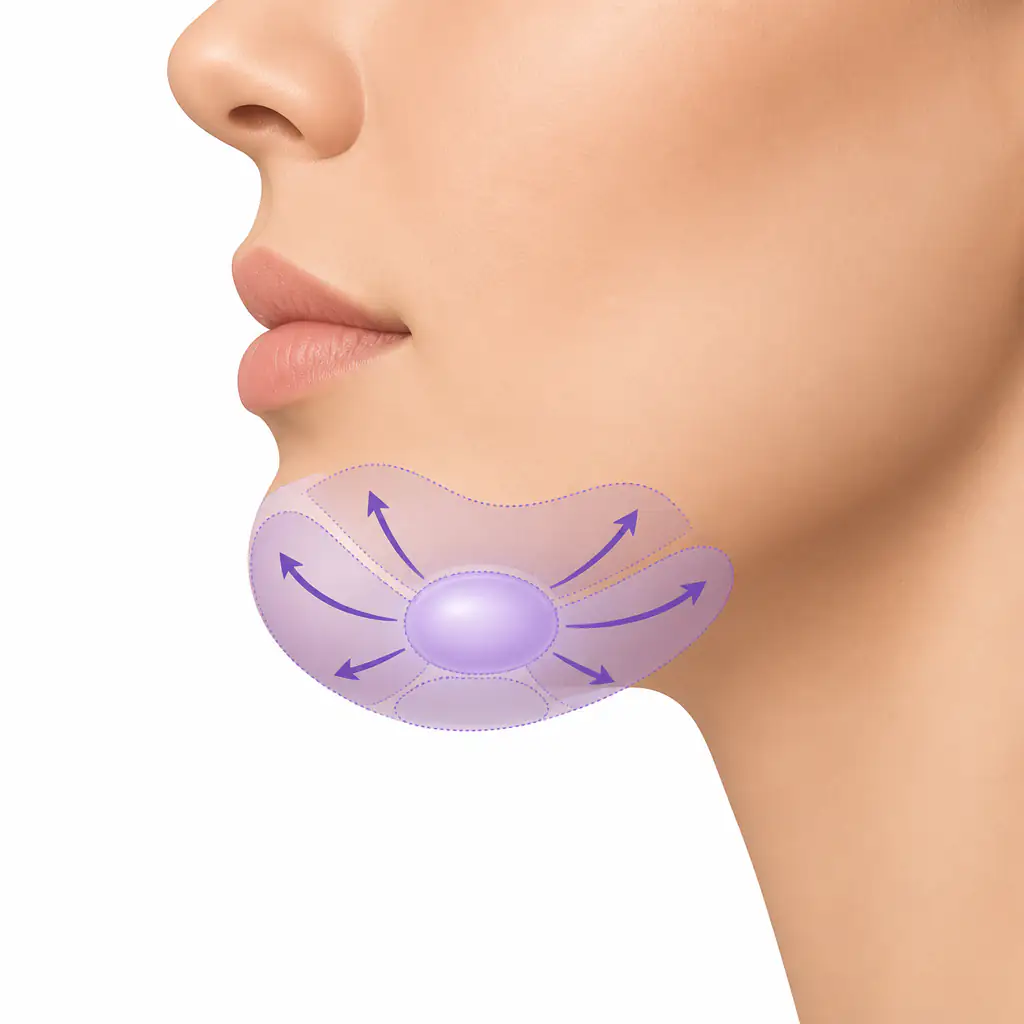
Chin filler has become one of the more popular non-surgical options for improving facial balance, projecting the chin forward, or sharpening the lower third of the face. But one question keeps coming up among people researching the procedure: does chin filler migrate?
The short answer is yes, it can. Migration is a real phenomenon, and it is worth understanding before you commit to the treatment. This article breaks down what migration actually means, why it happens, how to recognize it, and what steps may reduce your risk.
Disclaimer: This article is for informational purposes only. Talk to a qualified medical professional before considering any injectable filler treatment.
What “Migration” Actually Means
Filler migration refers to the movement of hyaluronic acid (or another filler substance) away from the original injection site. The filler does not teleport, it spreads gradually through tissue planes, often in the direction of least resistance.
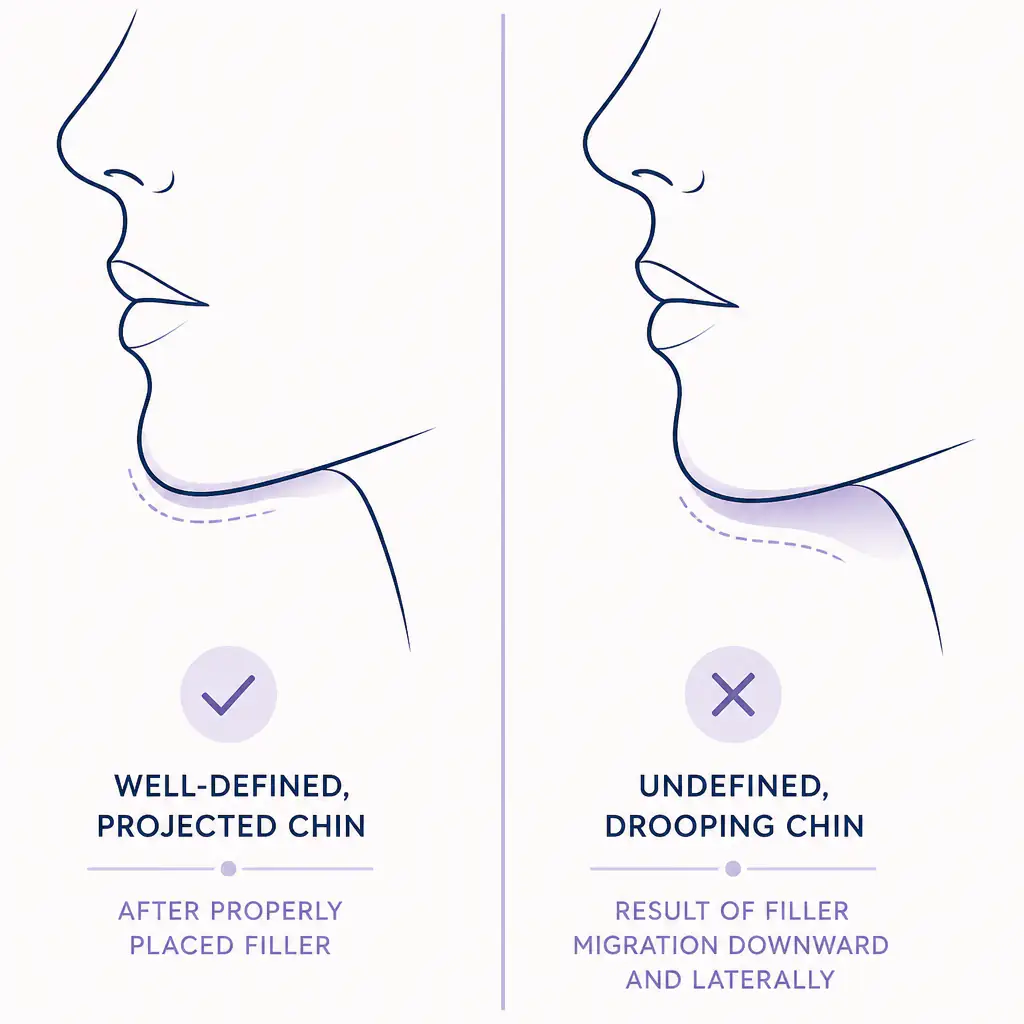
In the chin, this typically means filler drifting upward toward the mentolabial fold (the crease between your lower lip and chin), laterally toward the jowl area, or downward under the chin, sometimes creating a soft, undefined look sometimes called a “witch’s chin” when the tissue droops below the bone.
Migration is distinct from simple swelling or bruising, which are expected after any injection and resolve within days. Migration is a structural shift that can change the shape of the lower face in ways that were not intended.
How Common Is Chin Filler Migration?
There is no single agreed-upon prevalence figure, partly because mild migration is easy to miss and many cases go unreported. That said, research suggests migration is more common with repeated treatments over time than with a single session, and more likely with certain filler products and injection techniques than others.
Anecdotally, practitioners who specialize in facial aesthetics note that the chin is one of the areas where migration is more noticeable precisely because the chin is a prominent, well-defined anatomical landmark. Even a few millimeters of filler displacement can alter the profile noticeably.
Most practitioners agree that migration is not an inevitable outcome, but it is a known risk that deserves honest discussion with your injector before the procedure.
Why Does Chin Filler Migrate?
Several factors contribute to filler movement. Understanding them helps you have a more informed conversation with your provider.
Filler Product Choice
Not all hyaluronic acid fillers behave the same way. Products vary in their G-prime (a measure of stiffness and resistance to deformation), cohesivity, and hydrophilicity (how much water they attract). A filler with a low G-prime is softer and more spreadable, which may be ideal for lips but less appropriate for structural areas like the chin, where you want the product to stay put.
Higher G-prime, more cohesive fillers are generally preferred for chin projection because they resist lateral spread better and integrate differently with the surrounding tissue.
Injection Depth and Technique
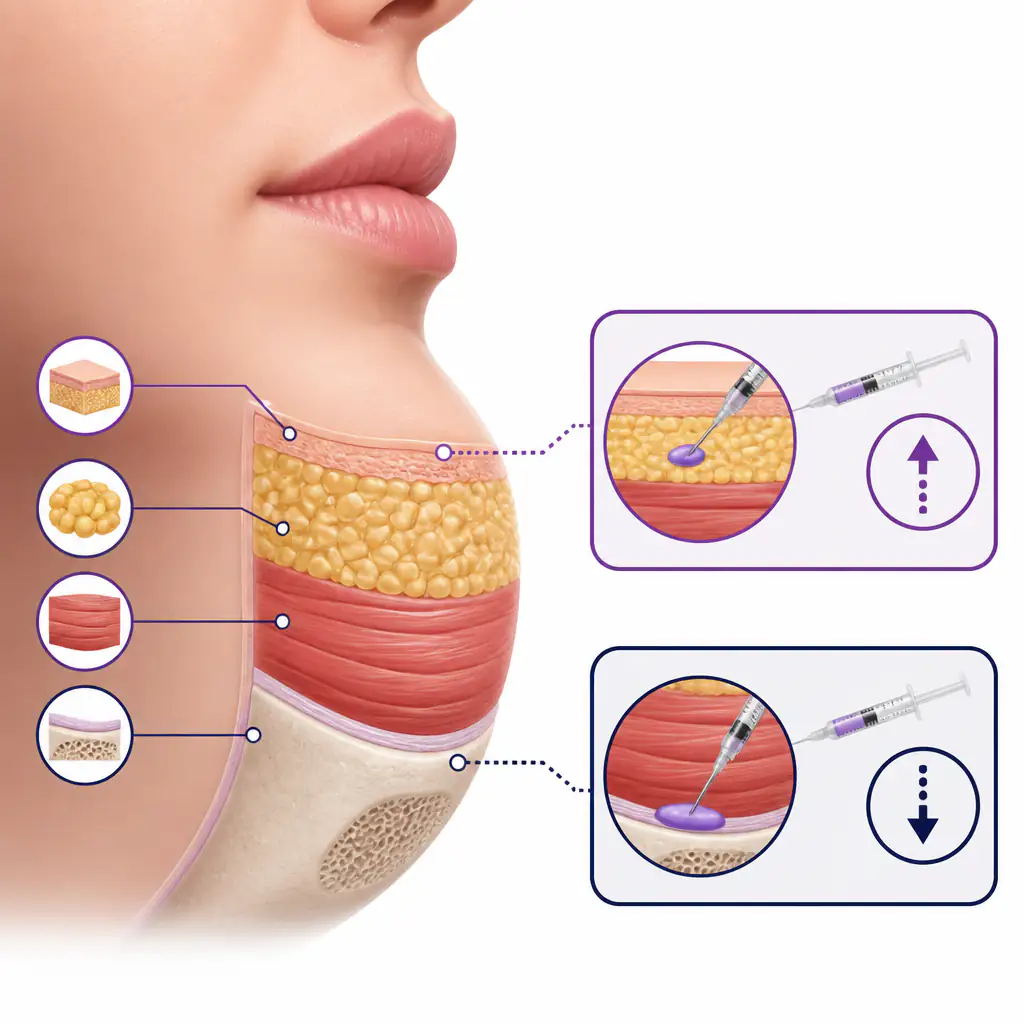
The chin has multiple tissue layers: skin, subcutaneous fat, the mentalis muscle, and the periosteum (the membrane covering the bone). Injecting at the wrong depth dramatically affects both the result and the risk of migration.
Deep injections placed on or near the periosteum tend to stay in place more reliably. Superficial injections sit in more mobile tissue planes where movement is easier. Experienced injectors typically place chin filler deep and in a controlled bolus (a single concentrated deposit) rather than in multiple shallow passes.
Poor technique, too much product per session, or injecting into an area already saturated from a previous treatment all raise the likelihood that filler will shift.
Volume Overload
There is a concept sometimes called “filler fatigue” in the tissue, where repeated treatments stretch the local structures and reduce their ability to contain the product. Placing too much filler in a single session, or accumulating high volumes over multiple sessions without dissolving previous product first, creates conditions where migration becomes more likely.
Some providers recommend a conservative approach, treating in smaller increments and assessing results over several weeks before adding more.
Natural Facial Movement
The mentalis muscle, which sits in the chin pad, is active during facial expressions, chewing, and speaking. This repeated movement can gradually displace filler, particularly if it was placed too superficially or if the product is soft enough to be deformed by muscle contraction.
Signs That Chin Filler May Have Migrated
Recognizing migration early gives you more options for correction. Here are the signs worth watching for:
- Loss of definition: The chin projection you had right after treatment gradually flattens or blurs, even after initial swelling has resolved.
- Unintended fullness elsewhere: A new softness or puffiness appears along the mentolabial fold, under the chin, or along the jawline where filler was not placed.
- Asymmetry: One side of the chin looks fuller or higher than the other in a way that was not present immediately post-treatment.
- A “blobby” or amorphous shape: Instead of the clean, projected contour you started with, the lower face begins to look undefined or heavy.
- Changes appearing weeks or months later: Filler migration rarely happens overnight. If your chin shape shifts gradually over a few months, that is more consistent with migration than with normal healing.
If you notice any of these changes, the appropriate step is to return to your injector for an assessment, not to wait and hope it resolves on its own.
Who Is at Higher Risk?
Certain circumstances raise the probability of experiencing migration:
- Repeat treatments in the same area without dissolving previous filler
- Using a provider with limited experience in chin anatomy
- Choosing a very soft or hydrophilic filler for a structural indication
- High-volume injections in a single session
- Existing tissue laxity or poor skin elasticity in the chin area
- Mechanical pressure on the area, such as consistently sleeping face-down on the chin
Age-related tissue changes also matter. Younger skin with good elasticity may contain filler better, while tissues that have lost some structural integrity may be more permissive of displacement.
How to Reduce Your Risk
These steps are not guarantees, but they represent the practical consensus among experienced practitioners.
-
Choose a specialist with specific experience in lower-face anatomy. Chin injections require a detailed understanding of the facial danger zones, relevant vascular structures, and tissue planes. A generalist with limited facial filler experience is a higher risk than a facial plastic surgeon or dermatologist who performs these treatments regularly.
-
Ask about the specific filler product being used. Request that your injector explain why they chose that particular product for the chin. A knowledgeable provider should be able to discuss G-prime and why the product fits your anatomy.
-
Start conservatively. Resist the temptation to go for maximum volume in one session. A conservative initial treatment that you can build on is safer than an aggressive approach that leaves you with too much product in a region that may not contain it well.
-
Avoid mechanical pressure on the area. In the weeks after treatment, sleeping on your back rather than on your stomach may help the filler settle in place.
-
Know your baseline. Before any treatment, it helps to have a clear, documented picture of your natural chin anatomy, projection, and facial proportions. Aura provides AI-driven jawline and facial structure analysis that can give you a precise, objective baseline before and after any procedure, which makes it easier to track subtle changes over time and have a factual conversation with your provider.
-
Follow up with your injector. Most providers want to see you at two to four weeks post-treatment. Do not skip this appointment. It is the best opportunity to catch early displacement and address it before it becomes a larger issue.
What Happens If Migration Occurs?
The good news about hyaluronic acid fillers is that they are reversible. An enzyme called hyaluronidase can dissolve HA filler relatively quickly, usually within a few days of injection. If migration has occurred, your injector can use hyaluronidase to remove the displaced product, either partially or entirely, and then reassess.
This reversibility is one of the reasons HA fillers are generally preferred over permanent or semi-permanent options for facial contouring. It provides a meaningful safety net.
For non-HA fillers (such as calcium hydroxylapatite or poly-L-lactic acid), reversal is not as straightforward. These products cannot be dissolved with hyaluronidase, and management of migration from these substances may require other approaches that take longer to show results.
If you are considering chin filler for the first time and are concerned about migration, an HA filler with good structural properties is typically the lower-risk starting point.
Setting Realistic Expectations
Chin filler, when performed well by an experienced injector using an appropriate product and technique, can produce clean, measurable improvements in chin projection and lower face balance. Migration is a known risk, not a certainty, and for many patients who choose their provider carefully, it does not occur.
The key is going in with accurate information rather than assumptions. Understanding what the chin anatomy looks like, what a well-placed result should look like, and how to detect problems early puts you in a much stronger position as a patient.
If you want to evaluate your facial structure before pursuing any treatment, Aura offers AI-powered analysis of jawline definition, facial symmetry, and lower-face proportions that may help you clarify what you are actually looking to change and whether filler is the right tool for it.
Remember: any decision about injectable treatments should involve a qualified medical professional who can assess your specific anatomy, medical history, and goals in person.
Frequently asked questions
Does chin filler always migrate? +
No, chin filler does not always migrate. Migration is a known risk, but it is not an inevitable outcome. Choosing an experienced injector, using an appropriate high-G-prime filler, and avoiding volume overload all reduce the likelihood of displacement.
How long after getting chin filler does migration typically occur? +
Migration rarely happens immediately. It tends to develop gradually over weeks to months as the filler shifts through tissue planes. If your chin shape changes noticeably after the initial healing period has passed, that warrants a follow-up assessment with your injector.
Can migrated chin filler be fixed? +
If the filler is hyaluronic acid-based, yes. Hyaluronidase can dissolve displaced HA filler relatively quickly, allowing the area to be reassessed and, if appropriate, re-treated. Non-HA fillers are harder to reverse and may require a different management approach.
What type of chin filler is least likely to migrate? +
High G-prime, cohesive hyaluronic acid fillers designed for structural use are generally considered less prone to migration than softer, more hydrophilic products. Your injector should select the product based on your anatomy and the depth at which they plan to inject. Always discuss product choice with your provider before the procedure.