 Aura: Looksmaxxing
Best Haircut for a Round Face: 9 That Slim It
Nine cuts that add height and slim the cheeks, why volume on the sides works against you, and what to ask for so you leave with the right shape.
A round face is not a flaw. It often reads as younger, friendlier, and more approachable. The tradeoff is that soft curves and roughly equal width and length can make your face look wider, and your jaw less defined, than it actually is.
The right haircut corrects most of that. It needs no procedure, no diet, and no gym time. It is one of the fastest and cheapest changes you can make to how your face reads to other people.
This guide covers four things. First, how to confirm you actually have a round face. Second, the geometry behind why certain cuts work. Third, the specific haircuts that flatter round faces most, and which ones to avoid. Fourth, exactly what to tell your barber so you walk out with the cut you wanted.
How to Tell If You Actually Have a Round Face
Plenty of men misjudge their face shape, usually confusing round with square or oval. Getting this wrong means choosing cuts built for a different face, so it is worth checking properly.
A round face usually has most of these traits:
- Length and width are roughly equal. Your face is about as wide as it is tall.
- The widest point is the cheeks. This is your bizygomatic width, the distance between your cheekbones.
- The jaw is soft. The gonial angle, the corner of your jaw just below the ear, curves gently instead of forming a sharp corner.
- Full cheeks and a rounded hairline that curves rather than sitting straight across.
The Quick Photo Test
- Pull your hair fully back off your forehead.
- Have someone take a photo straight on, at eye level, from at least five feet away. Close-range selfies distort proportions, so avoid them.
- Compare four measurements: forehead width, cheekbone width, jaw width, and face length from hairline to chin.
If length and cheekbone width are close and the jaw has no clear corners, you are likely round. If the proportions are similar but the jaw is angular, you are closer to square. If your face is noticeably longer than it is wide with a tapered chin, you are oval.
If you want a more objective read than a bathroom mirror, Aura analyzes facial proportions and jawline definition from a photo. That can help you confirm your shape before you commit to a cut.
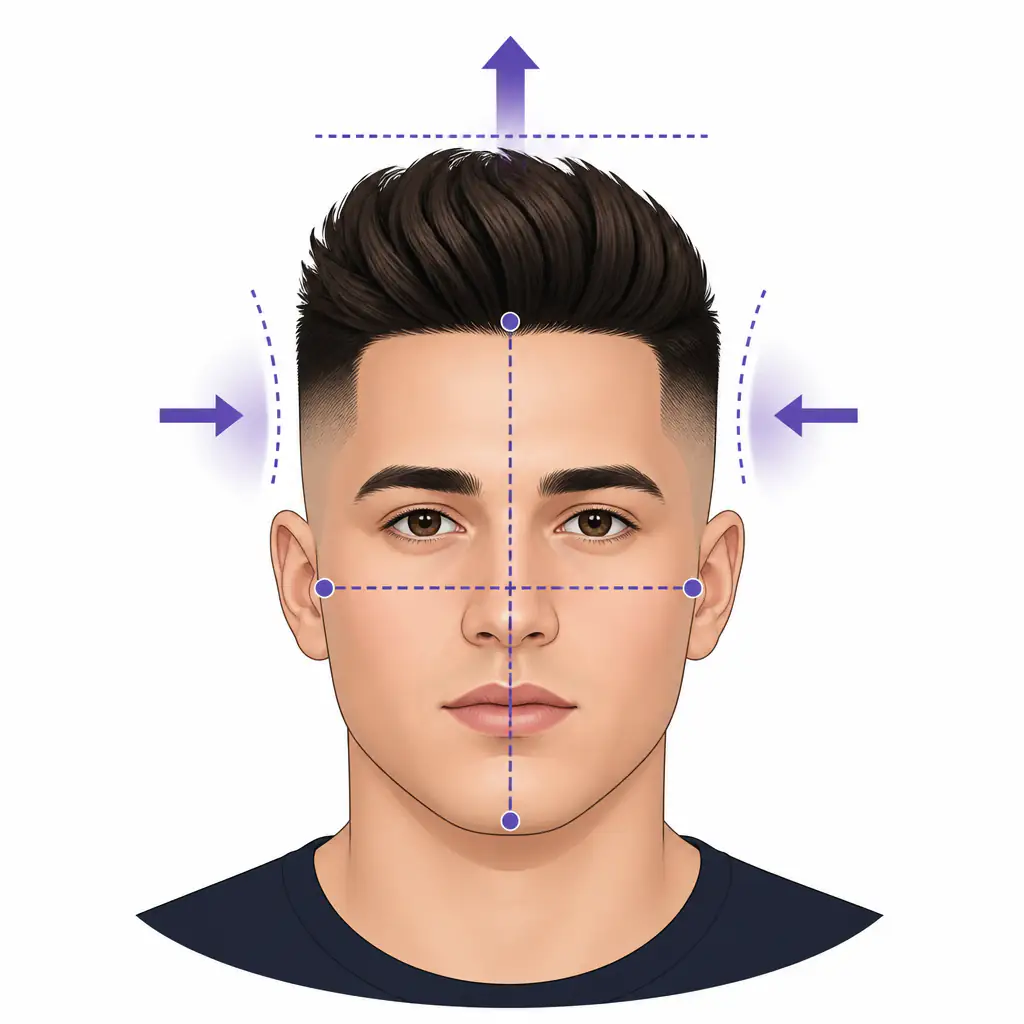
The Core Principle: Build Height, Remove Width
Every good haircut for a round face follows the same logic. You are trying to change the face’s apparent proportions, making it look longer and narrower with more defined edges.
Four rules do most of the work:
- Add vertical volume on top. Height makes the whole head look longer, which makes the face look slimmer by comparison.
- Keep the sides short and tight. Bulk above the ears adds width right where a round face is already widest. Fades, tapers, and undercuts remove it.
- Introduce angles. Round faces lack straight lines. A hard part, textured edges, or an asymmetric fringe adds the structure your bone shape does not.
- Never end the hair at the cheek line. Any cut where the hair stops at cheek or jaw level draws a horizontal line across the widest part of your face.
Perception research on facial width-to-height ratio (fWHR) suggests people read faces largely through these proportions. You cannot change your bone structure with scissors, but you can change the frame around it, and that frame shifts how the proportions read.
The Best Haircuts for Round Face Men
These are ranked roughly by how reliably they work across different round faces and hair types.
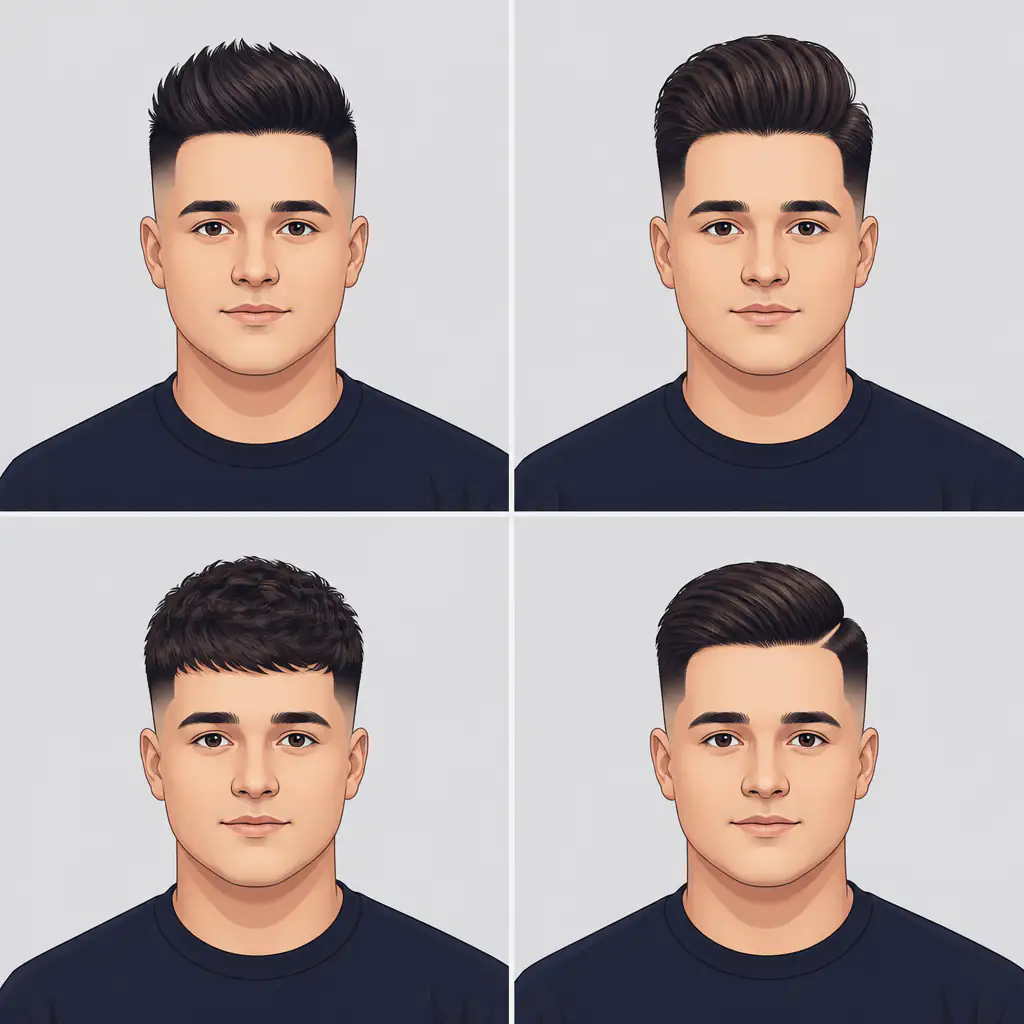
1. High Fade Quiff
This is the most dependable option. The sides are faded high, often to the skin or a short guard, and the top is left 3 to 5 inches long and styled up and slightly back. The fade removes width and the quiff adds height. It works on straight and wavy hair and suits most lifestyles.
2. Pompadour with Tapered Sides
The pompadour is the more structured cousin of the quiff. The hair is swept up and back into a single smooth volume. It adds even more height, which makes it a strong choice if your face is very round or your forehead is short. Keep the sides tapered tight. A pompadour with bulky sides defeats the point.
3. Textured Crop with Lift
A textured crop can work, but only in the right form. Ask for a choppy, point-cut top (the barber cuts into the hair vertically for jagged texture) with a high fade, and style the front up and messy rather than flat and forward. A flat, blunt French crop sitting low on the forehead shortens the face, so avoid that version.
4. Hard Side Part
A shaved or razored part line adds a sharp, straight line to a face that needs one. Pair it with a taper and a slightly lifted top. Placing the part off-center, above the outer edge of one eyebrow, adds asymmetry that further breaks up the roundness.
5. Faux Hawk
The hair is pushed toward the center into a soft ridge, with the sides faded short. It creates a strong vertical line down the middle of the head. Keep it subtle and textured, not spiked into a sharp fin, if you want it to look current.
6. Angular or Asymmetric Fringe
If you prefer some hair on your forehead, sweep it diagonally to one side. A diagonal line cuts across the face and implies angles that are not there. The key is asymmetry. A straight, even fringe does the opposite.
7. Slick Back Undercut
The sides are cut very short, with a disconnected, longer top slicked back. The contrast between tight sides and a longer top elongates the head. Use a medium-hold product with some volume at the roots so it does not sit flat against the scalp.
8. Long Layered Hair Past the Chin
Longer hair can work on a round face, as long as it falls past the jaw, ideally to the shoulders, with layers. The vertical lines of long hair frame and narrow the face. Tucking one side behind the ear adds asymmetry. Chin-length hair is the danger zone here.
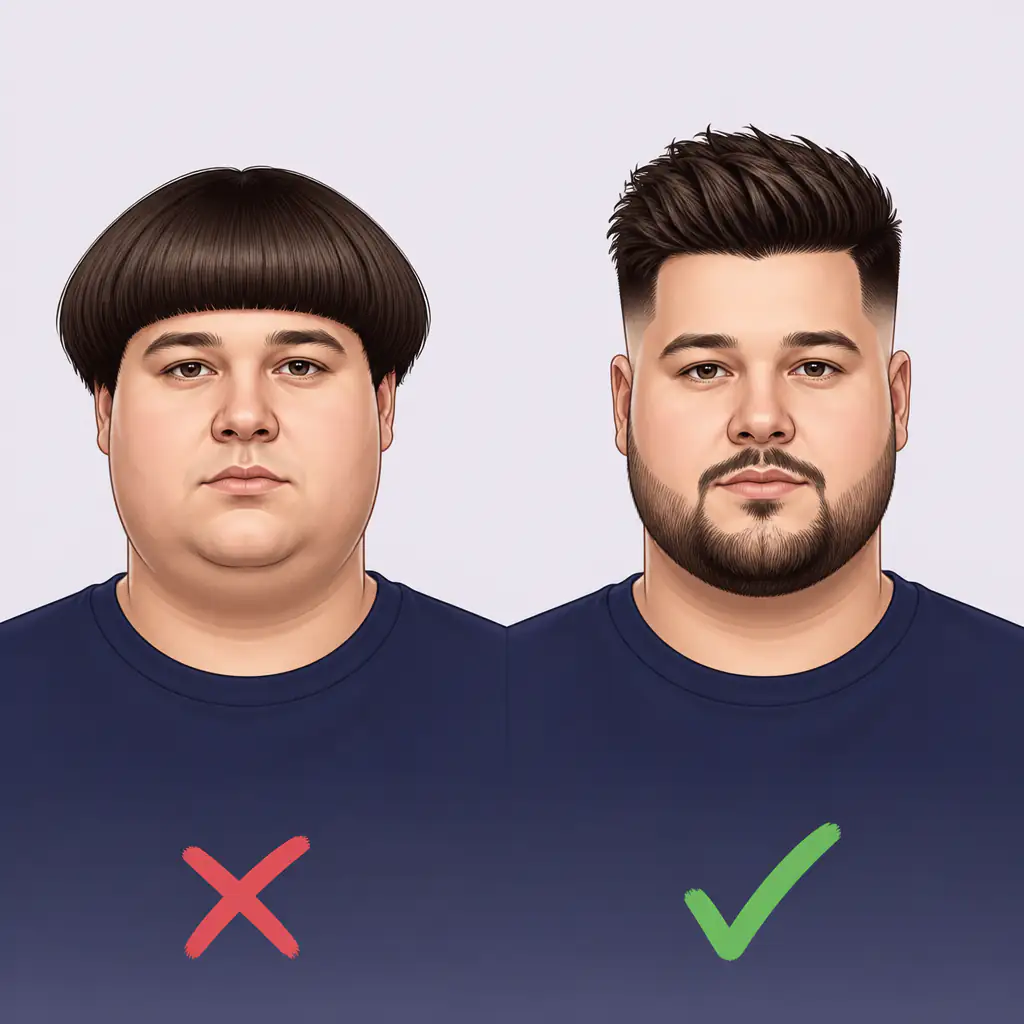
9. Buzz Cut with a Beard
A buzz cut on its own tends to expose the full roundness of the head and face. Paired with a well-shaped beard, it can look strong, because the beard adds length and structure to the lower face. Only choose this if you can grow a reasonably full beard.
Haircuts to Avoid with a Round Face
These cuts tend to emphasize width and softness:
- Bowl cuts and blunt, straight fringes. They create a horizontal line across the forehead and make the face look shorter.
- Chin-length or cheek-length styles. Hair ending at the widest part of your face adds visual weight there.
- Full, puffy sides. Curly or thick hair left long above the ears makes the head look wider.
- Flat, center-parted styles. A perfectly symmetric, low-volume part reinforces roundness.
- Even-length buzz cuts with no beard. Uniform length around the head mirrors the round shape.
Use Your Beard as a Second Haircut
Facial hair is one of the most effective tools a round-faced man has, because it can build the jawline shape your bone structure does not provide.
- Keep the cheeks tight. Trim the cheek line low and sharp. Fuzzy, high cheek growth adds width.
- Add length at the chin. A goatee, a short boxed beard, or a beard that is slightly longer at the chin than the sides extends the face downward.
- Define the neckline. Set it about one to two finger-widths above the Adam’s apple. A clean neckline creates a visible lower border for your jaw.
- Go squarer at the corners. Shaping the beard slightly squarer near the jaw corners gives the illusion of a more defined gonial angle.
Even heavy stubble, kept tidy with a clean neckline, may help the jaw read as sharper.
Match the Cut to Your Hair Type
The best haircut for your face shape still has to work with your hair.
Thick, Straight Hair
You have the most options. Quiffs, pompadours, and slick backs hold height well. The main risk is side bulk, so book regular fade touch-ups.
Curly or Coily Hair
Curls add natural volume, which works in your favor on top and against you on the sides. Ask for a high taper or fade with length and definition on top. A curly top with skin-faded sides is one of the best looks for a round face. Avoid letting curls grow out evenly into a rounded shape.
Fine or Thinning Hair
Height is harder to hold, so lean on texture. A textured crop styled upward, or a short side part, looks fuller than long, heavy styles. A matte product and a blow dryer make a real difference. If your hairline is receding, a shorter overall cut with a high fade usually looks cleaner than trying to hide it.
How to Talk to Your Barber
Most bad haircuts come from vague instructions. Use this process:
- Bring two or three reference photos of the exact cut, ideally on someone with a similar face shape and hair type.
- Say what you want to achieve. For example: “I have a round face and want to add height and keep the sides tight.” A good barber will adjust the cut to that goal.
- Specify the fade height and guard. “High fade, starting at a 1” or “mid taper, 2 on the sides” is far clearer than “short on the sides.”
- Give a top length in inches. Three to five inches is typical for quiffs and pompadours.
- Ask for texture if you want it. Mention point cutting or thinning shears for a choppy, lifted top.
- Ask how to style it. Have the barber show you the product amount and blow-dry direction before you leave.
- Book your next appointment. Sides lose their shape in three to four weeks.
Styling Tips That Make the Cut Work Every Day
The cut sets the shape. Styling is what holds it.
- Blow-dry upward. Dry your top on medium heat while pushing the hair up and back with your fingers or a brush. This builds root lift that product alone cannot.
- Use a pre-styler. A few sprays of sea salt spray or a volumizing tonic on damp hair adds grip and height.
- Choose matte products. Clay and paste give hold and texture with a natural finish. High-shine gel can make hair look flat and heavy.
- Use less product than you think. Start with a fingertip amount, warm it between your palms, and work it from the back to the front.
- Check your angles. Look at your hair from the front and in profile. Height that looks good head-on can look flat from the side if the back is not lifted too.
- Stay on top of maintenance. A grown-out fade adds width fast. A quick clean-up between full cuts keeps the shape sharp.
Once you have settled on a cut, compare photos taken before and after under the same lighting. Some users track this with Aura alongside their broader grooming plan to see which combination of haircut and beard shape reads best on their face.
The bottom line is simple. Go high on top, keep the sides tight, add a few angles, and let your beard do some of the jawline work. For most round faces, a high fade quiff or pompadour is the safest starting point. Adjust from there to suit your hair type and style.
Frequently asked questions
What is the best haircut for a round face for men? +
A high fade quiff is the most reliable choice for most round faces. It adds height on top and removes width from the sides, which makes the face look longer and slimmer. A pompadour with tapered sides is a close second.
Should men with round faces have short or long hair? +
Both can work if the shape is right. Short cuts should keep the sides tight and add height on top. Long hair should fall past the chin, ideally to the shoulders with layers, because hair ending at cheek or jaw level adds width.
Does a beard help a round face? +
Yes, a well-shaped beard may help a round face look longer and more defined. Keep the cheek line tight, add slightly more length at the chin, and maintain a clean neckline to create a visible jaw border.
Can men with round faces wear a fringe? +
They can, but it should be textured and swept diagonally to one side rather than cut straight across. A blunt, even fringe creates a horizontal line that shortens the face, while an angled fringe adds the structure a round face lacks.