 Aura: Looksmaxxing
Best Haircut for a Diamond Face: 7 That Suit It
Seven cuts that widen the forehead and soften prominent cheekbones, which styles make a narrow chin worse, and how to brief your barber.
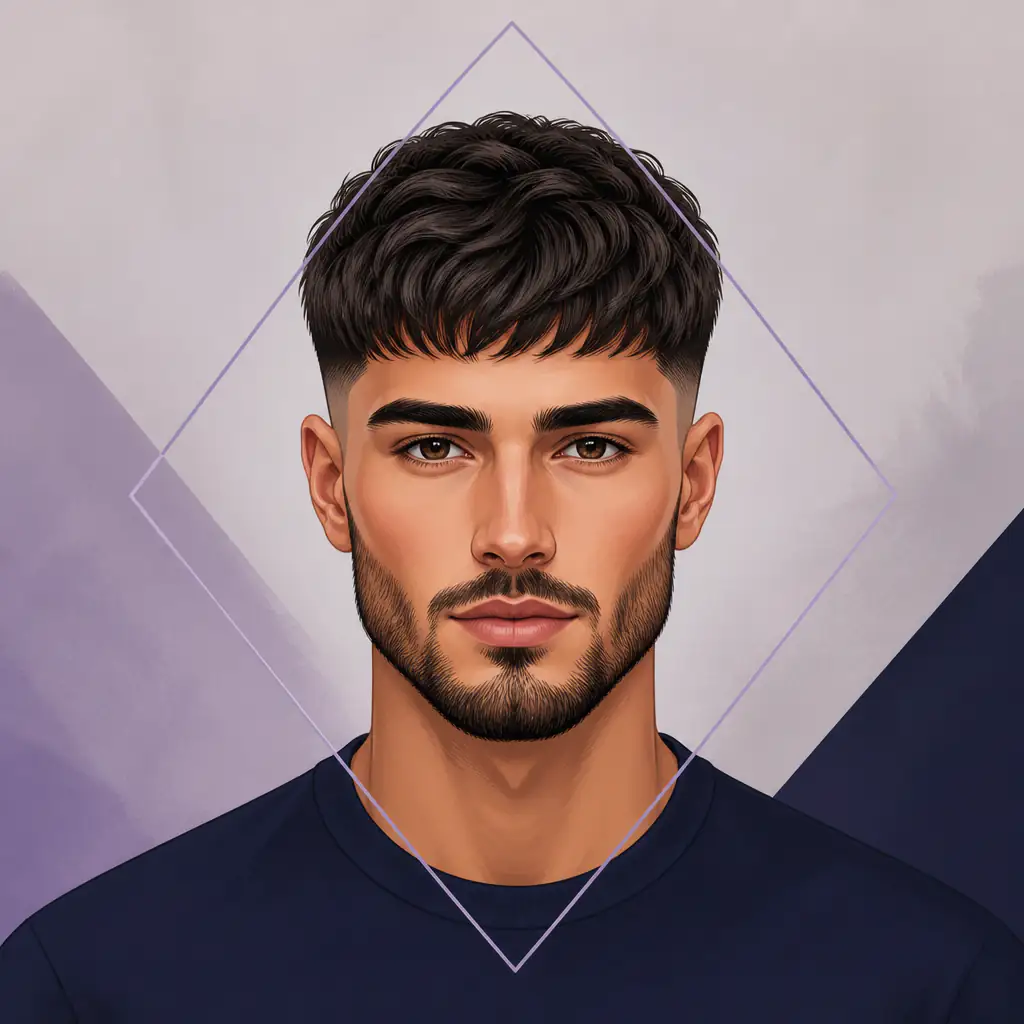
Diamond faces are the least common face shape, so generic haircut advice often misses them. Most guides are written for oval or square faces. As a result, men with prominent cheekbones and a narrow chin end up with cuts that make the face look pinched at the top and pointed at the bottom.
A diamond face is a strong starting point, though. High, wide cheekbones are one of the features people consistently rate as attractive. The right haircut works with that structure instead of fighting it.
This guide covers:
- How to confirm you have a diamond face
- The principle that makes a cut work
- Seven specific haircuts to ask for
- Which styles to avoid
- How facial hair fits in
What Makes a Face Diamond-Shaped
A diamond face has three defining traits:
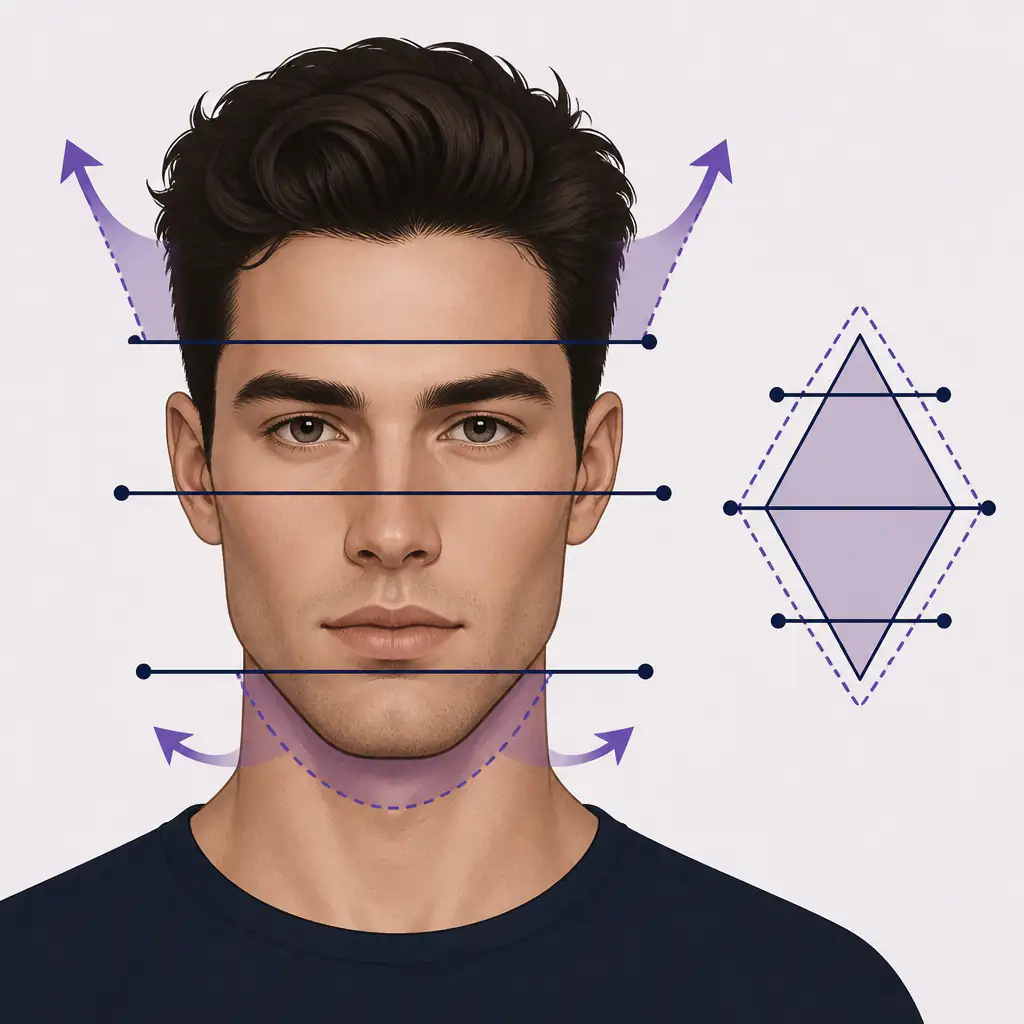
- Widest point at the cheekbones. The zygomatic arches sit noticeably wider than both your forehead and your jaw. These are the bony ridges running from beside your eyes toward your ears.
- Narrow forehead. The temples tend to angle inward, and the hairline is often narrower than the cheek width.
- Narrow, often pointed chin. The jawline tapers toward the chin rather than staying broad and square.
Face length is usually moderate to long. Two nearby shapes are easy to confuse with it:
- Oval or square: your forehead and jaw are close to the same width as your cheekbones.
- Heart: your forehead is wide and only your chin is narrow.
A Quick Self-Check
Pull your hair fully back and stand in front of a mirror in even lighting. Either trace your outline on the glass with a dry-erase marker or take a straight-on photo. Then compare three widths:
- Across the forehead at the temples
- Across the cheekbones
- Across the jaw, just below the ears
You likely have a diamond face if the cheekbone measurement is clearly the widest and the other two are narrower.
Mirror tracing is imprecise, especially when lighting casts shadows on the cheeks. For a more objective read, Aura analyzes a front-facing photo and breaks down your facial proportions, jawline, and overall harmony. That can help confirm your face shape before you commit to a new cut.
The Core Principle: Add Width Where You Are Narrow
Every good haircut for a diamond face follows the same logic:
- Widen the forehead visually.
- Soften the cheekbones slightly.
- Add perceived width at the chin.
You are not trying to hide your cheekbones. You are making the forehead and jaw catch up so the face reads as balanced.
In practice, that means four things:
- Fullness or texture at the forehead and temples. Fringes, side-swept hair, and forward texture all fill in the narrow upper third.
- Moderate sides, not skin-tight ones. Sides shaved to the skin at cheekbone level make the cheekbones the outermost point of your head’s silhouette, which exaggerates the diamond. Keeping some length, through a low taper or scissor-cut sides, smooths the transition.
- Controlled height on top. Some volume helps. A very tall style lengthens the face and makes the chin look even narrower.
- Width at the bottom, usually from facial hair. Short hair can’t do much for a narrow jaw, so a beard often does the heavy lifting.
7 Best Haircuts for Diamond Face Men
1. Textured Fringe (Modern French Crop)
The textured fringe is arguably the most reliable choice for a diamond face.
- The cut: 2 to 4 inches on top, point-cut or texturized to break up weight, pushed forward over the upper forehead.
- Why it works: the fringe covers the narrowest part of your face. It also creates a horizontal line across the forehead, which makes it look wider.
- Ask for: a low or mid taper on the sides rather than a high skin fade.
- Best for: straight to wavy hair, and men with higher hairlines or mild recession at the temples.
2. Classic Side Part with a Low Taper
A side part creates asymmetry across the forehead, and the sweep of hair across the top adds width where you need it.
- The cut: 3 to 5 inches on top so there is enough length to sweep, with scissor-cut or low-tapered sides.
- Why it works: the diagonal line of the part breaks up the vertical length of the face. The volume sweeping to one side broadens the upper third.
- Tip: a soft, natural part looks more modern than a hard shaved-in line. It also avoids adding another sharp angle to an already angular face.
3. Messy Forward Quiff
A traditional quiff pushes hair up and back, which can expose a narrow forehead. The forward quiff keeps the volume but directs it slightly forward and to the side.
- The cut: enough length on top for volume, styled so the front hangs over the hairline instead of lifting away from it.
- Why it works: you get the height and movement of a quiff without the face-lengthening effect of a tall, swept-back pompadour.
4. Medium-Length Flow
This is one of the most flattering options for diamond faces.
- The cut: hair grown to around ear or chin length, swept back loosely or tucked behind the ears.
- Why it works: side length frames the cheekbones and fills space around the jaw, adding width to the lower half of the face. Shorter cuts can’t do that.
- Keep it loose: avoid slicking it tight to the skull so the forehead keeps some fullness.
- Best for: men with thick, wavy hair and the patience to get through the awkward growing-out phase.
5. Curly or Wavy Top with Low Taper
If you have natural curls or waves, you have a built-in advantage, because curls create width and texture on their own.
- The cut: 2 to 4 inches on top with the curls falling forward, paired with a low taper.
- Why it works: curls sit wider than straight hair, which balances the cheekbones.
- Avoid: a very high fade, which turns the overall shape into a tall column.
6. Caesar Cut
The Caesar is short all over, with a horizontal fringe cut straight across the forehead. It is low-maintenance and works surprisingly well on diamond faces.
- Why it works: the straight fringe line adds width to the forehead and visually shortens the face.
- Ask for: sides kept slightly longer than a standard Caesar so the cheekbones aren’t fully isolated.
7. Textured Shag or Layered Mid-Length
A modern shag has a relaxed, lived-in look and suits wavy hair especially well.
- The cut: layers around the temples and ears, adding volume exactly where diamond faces benefit from it.
- Why it works: the layers build fullness at the forehead and around the jaw at the same time. That rounds out both narrow ends of the diamond.
Haircuts to Avoid (or Modify)
None of these are off-limits, but they tend to exaggerate the diamond shape rather than balance it:
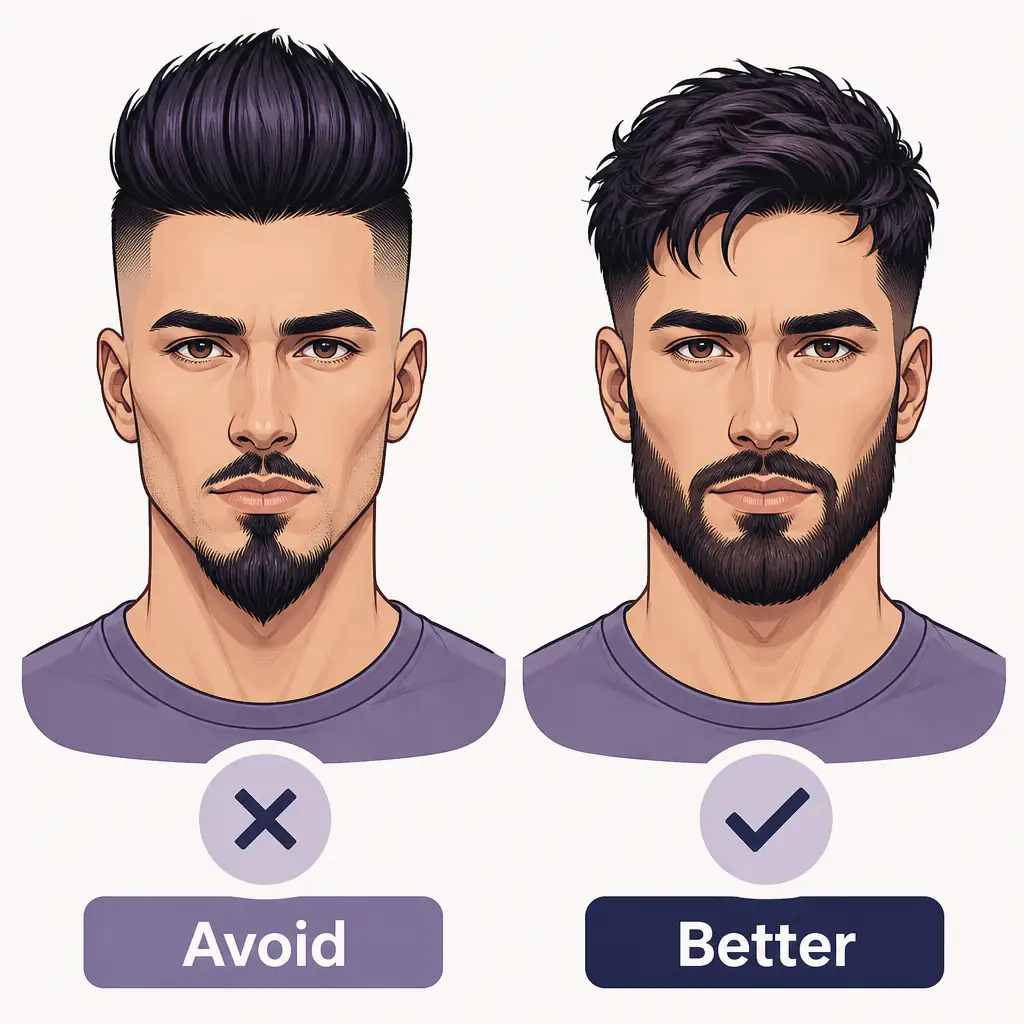
- High skin fade with a long top. Shaving the sides to the skin at cheekbone height makes the cheekbones the widest point by a large margin. If you like fades, choose a low or drop fade instead.
- Tall pompadour or spiky top. Extra height lengthens the face and makes the chin look narrower.
- Tight slick-back. Pulling everything back flat exposes the narrow forehead and temples. A looser, textured slick-back with some volume is a safer version.
- Center part with flat, straight hair. Hair hanging straight down on both sides forms a triangular frame that points straight at the narrow chin.
- Very short buzz cut. A buzz shows your bone structure with nothing to soften it. Some men with strong cheekbones and clear skin carry it well, but it does nothing to balance proportions.
Beards and Facial Hair for Diamond Faces
Facial hair is the most effective tool for the narrow lower third because a beard adds real, physical width along the jaw and chin.
What Works
- Full beard kept fuller at the chin and jaw. Keep the cheek line trimmed neatly and let length build along the jaw and chin. This adds width and squares off a pointed chin.
- Boxed beard. A short-to-medium beard with a slightly squared bottom creates a more angular lower jaw.
- Heavy stubble (3 to 5 mm). If you can’t grow a full beard, stubble still adds shadow along the jawline that suggests more definition.
What to Avoid
- Goatees and pointed chin styles. These lengthen the chin and sharpen the point, the opposite of what a diamond face needs.
- Beards that are full on the cheeks but thin at the chin. This adds width at the widest part of the face, so the cheekbones look wider still.
It helps to see how your jawline reads before and after growing a beard. Some users run the jawline analysis in Aura at both stages to check whether their facial hair is actually improving lower-face definition.
How to Ask Your Barber for the Right Cut
A great reference photo only gets you halfway. These steps help you walk out with a cut that actually suits a diamond face:
- Bring two or three reference photos of men with hair texture similar to yours. Texture matters more than face similarity for how the cut will actually look.
- Name the goal, not just the style. Tell your barber you want more width at the forehead and less exposure at the cheekbones. A good barber will adjust any style to match.
- Specify the fade height. Ask for a low taper or low fade explicitly, since many barbers default to mid or high.
- Ask for texture on top. Point-cutting or texturizing helps the top sit wider and move forward.
- Agree on fringe length. Depending on the style, it should land somewhere between the hairline and the eyebrows.
- Book the next cut in 3 to 5 weeks. Shorter cuts lose their shape quickly, and once the sides grow out unevenly, the balance disappears.
Practical Styling Tips
Even the right cut can look wrong if it’s styled against your face shape. Keep these in mind:
- Use a matte product. Clay, paste, or sea salt spray adds grip and volume without shine, so hair looks fuller. High-shine pomades tend to flatten hair against the head.
- Blow-dry forward and to the side. Directing low-heat airflow forward sets the fringe and adds lift at the roots in front.
- Don’t over-style. A slightly messy finish reads as width, while rigid, sculpted styles emphasize angles.
- Factor in your hairline. Receding temples make a fringe or forward texture even more valuable. They cover the exact spot where a diamond face is already narrow.
- Mind your glasses. Frames with a strong browline or a rounded shape can add width at the forehead and complement the haircut.
- Give it time. Hair often looks best a week after a cut, once it has settled. Judge a new style after a few days of styling it yourself, not straight out of the chair.
The Bottom Line
The best haircut for diamond face men follows one rule. Add fullness at the forehead and chin, keep the sides moderate, and avoid extra height on top.
Textured fringes, side parts with low tapers, forward quiffs, and medium-length flow all apply that rule in different ways. Pair the cut with a beard that builds width at the chin, and the diamond shape looks structured instead of sharp.
Your cheekbones are an asset. The goal is simply to let the rest of your face match them.
Frequently asked questions
What is the best haircut for a diamond face shape for men? +
A textured fringe with a low taper is the most reliable option because it widens the narrow forehead and keeps some length at the sides. Side parts, forward quiffs, and medium-length flowing styles also work well for the same reason.
Should men with diamond faces get a fade? +
Yes, but keep it low. A low taper or drop fade keeps some hair around the cheekbone area, while a high skin fade makes the cheekbones the widest point by a large margin and exaggerates the diamond shape.
Does a beard help a diamond face? +
Usually, yes. A beard kept fuller along the jaw and chin adds width to the narrow lower third and can make a pointed chin look squarer. Avoid goatees and styles that are full on the cheeks but thin at the chin.
Can men with diamond faces wear long hair? +
Long or medium-length hair often suits diamond faces very well because side length frames the cheekbones and adds width near the jaw. Keep it loose with some volume at the forehead rather than slicked tight against the head.
How do I know if I have a diamond face or a heart face? +
Compare your forehead and cheekbone widths. In a diamond face the cheekbones are clearly wider than the forehead, while in a heart face the forehead is about as wide as or wider than the cheekbones, with only the chin narrowing.