 Aura: Looksmaxxing
Best Haircut for a Heart Face: 7 That Suit It
Seven barber-tested cuts that balance a wide forehead against a narrow chin, the two styles to avoid, and the words to say at the chair.
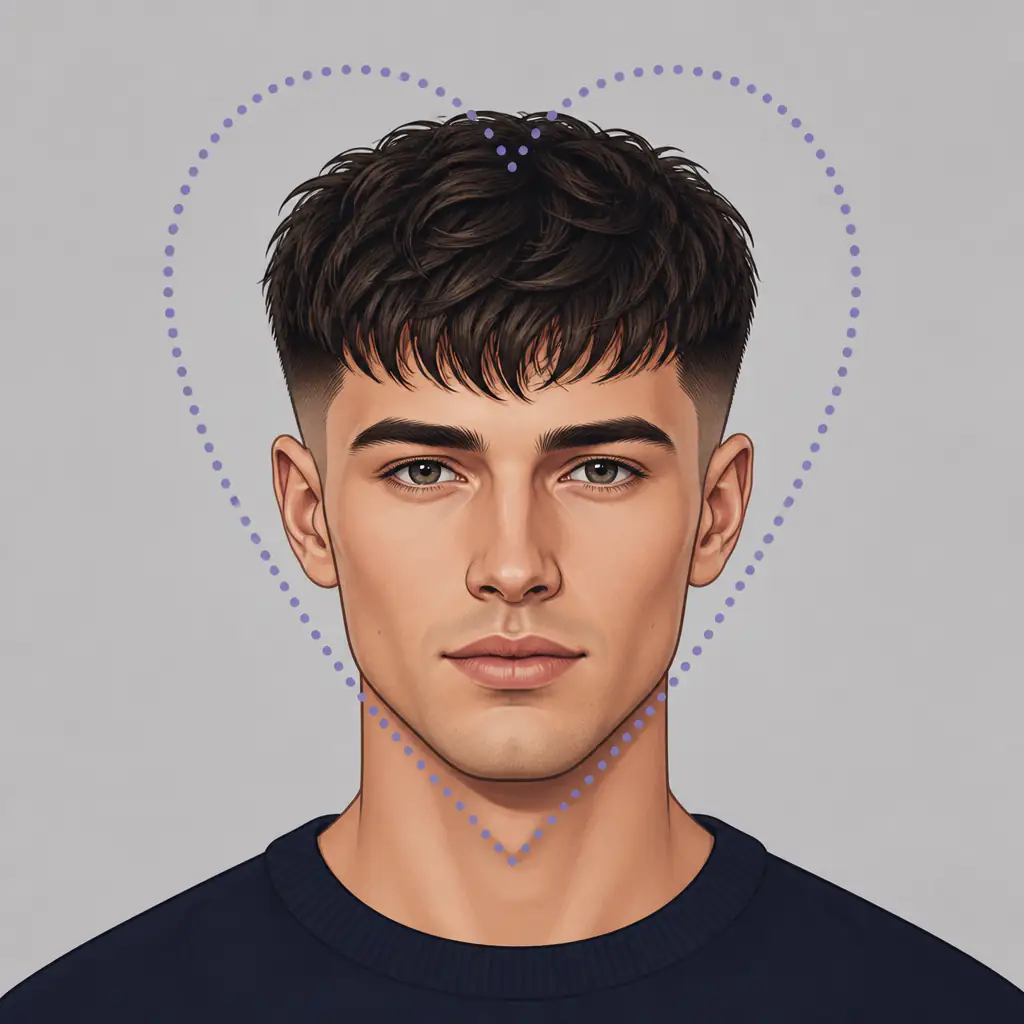
A heart-shaped face is one of the more distinctive face shapes a man can have. You usually get strong, defined cheekbones and a broad forehead, which photograph well. The tradeoff is a narrower jaw and chin that can make the lower face look underbuilt if your haircut is working against you.
The best haircut for heart face men does one job: it pulls visual weight away from the top of the head and redistributes it toward the lower face. Get that right and your cheekbones read as an asset instead of making your chin look small. Get it wrong, usually with a tall quiff and skin-tight sides, and you exaggerate the exact proportions you want to soften.
This guide covers how to confirm you actually have a heart-shaped face, the principle behind every good cut for it, seven specific styles, what to avoid, and how to brief your barber so you walk out with the right result.
How to Tell If You Have a Heart-Shaped Face
Face shape gets misdiagnosed constantly, mostly because people eyeball it in a bathroom mirror at a bad angle. Before you choose a haircut, confirm the shape with a few simple measurements.
The Four Measurements
Pull your hair back, stand straight in front of a mirror, and use a soft tape measure or a photo taken straight on at eye level.
- Forehead width: Measure across the widest part of your forehead, roughly between the outer edges of your eyebrows extended up to the temples.
- Cheekbone width: Measure across the most prominent point of the cheekbones (the zygomatic arches), usually just below the outer corners of the eyes.
- Jaw width: Measure from the angle of the jaw on one side (the gonial angle, the corner below your ear) to the same point on the other side.
- Face length: Measure from the center of your hairline to the bottom of your chin.
You likely have a heart-shaped face if:
- Your forehead and cheekbones are the widest points, with the forehead equal to or wider than the cheekbones.
- Your jaw is noticeably narrower than your forehead.
- Your chin tapers toward a narrower or slightly pointed tip.
- Face length is moderate, usually a bit longer than it is wide.
Many heart-shaped faces also have a widow’s peak, a V-shaped point in the center of the hairline. It isn’t required, but it’s common.
Heart vs. Inverted Triangle vs. Diamond
These three get mixed up because they all narrow toward the chin.
- Heart: Wide forehead, high cheekbones, gently tapered jaw, often a softer or pointed chin.
- Inverted triangle: Very similar, but the forehead is clearly the dominant widest point and the jaw is sharper and more angular. The haircut advice is nearly identical.
- Diamond: Cheekbones are the widest point, but the forehead is narrow as well as the chin. Diamond faces need more width at the forehead, which is the opposite of what heart faces need.
If you’re unsure, an objective read helps. Aura analyzes facial structure from a photo, including jawline definition and overall proportions, which gives you a clearer baseline than guessing from a mirror before you commit to a new cut.
The Core Principle: Rebalance a Top-Heavy Frame
Every recommendation in this guide comes back to one idea. A heart-shaped face is wider on top and narrower on the bottom. Your haircut should do the reverse.
That breaks down into three practical goals:
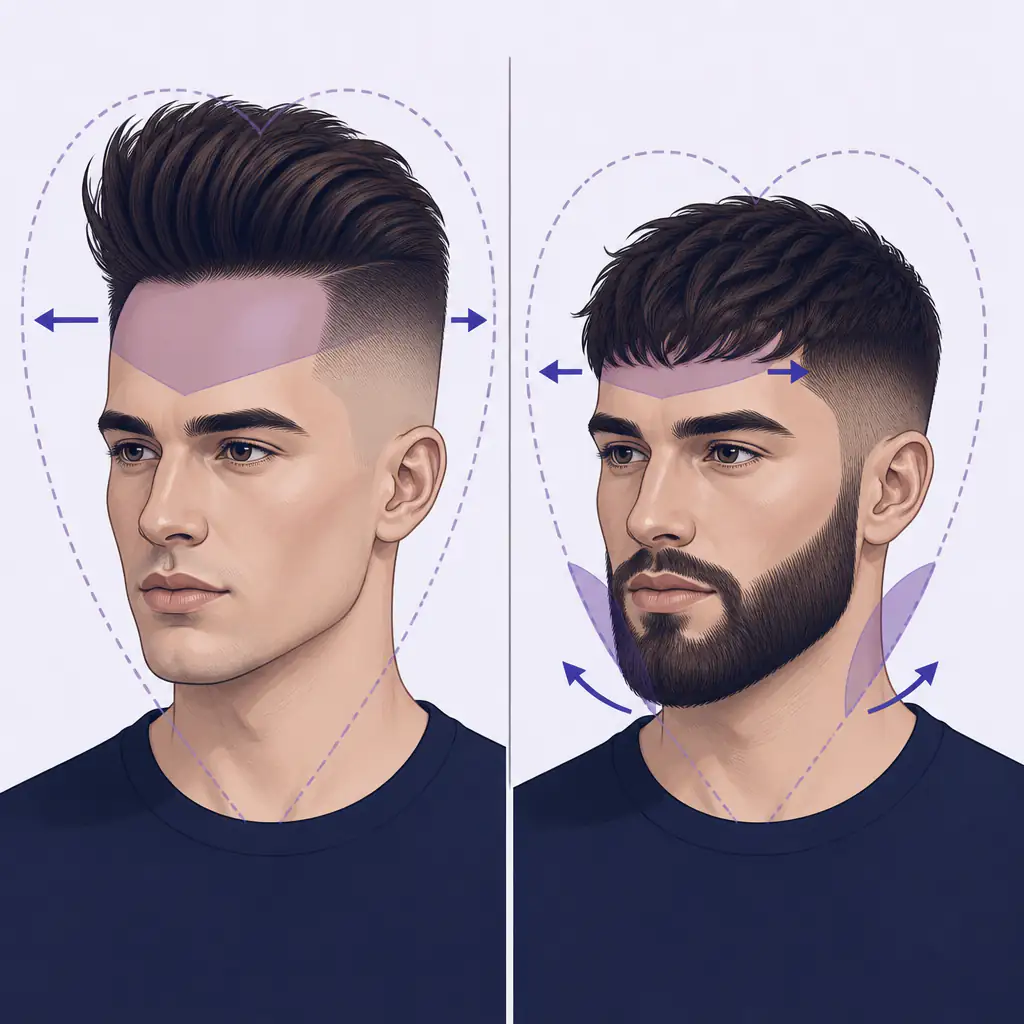
- Reduce perceived forehead width and height. Fringes, side sweeps, and texture that falls forward all cover part of the forehead and make it read smaller.
- Avoid extra width at the temples. Puffy, voluminous sides at the temple level stack width right where you already have the most.
- Add visual weight lower down. Leaving some length around the ears, the lower sides, and the nape helps fill out the space beside a narrower jaw. Facial hair does this even more directly.
A useful mental model: you want the overall silhouette of your head, hair included, to look closer to an oval. Height and width belong in moderation on top, with nothing that shoots upward or outward dramatically.
The 7 Best Haircuts for Heart Face Men
These cuts work across most hair types, with notes where texture changes the approach.
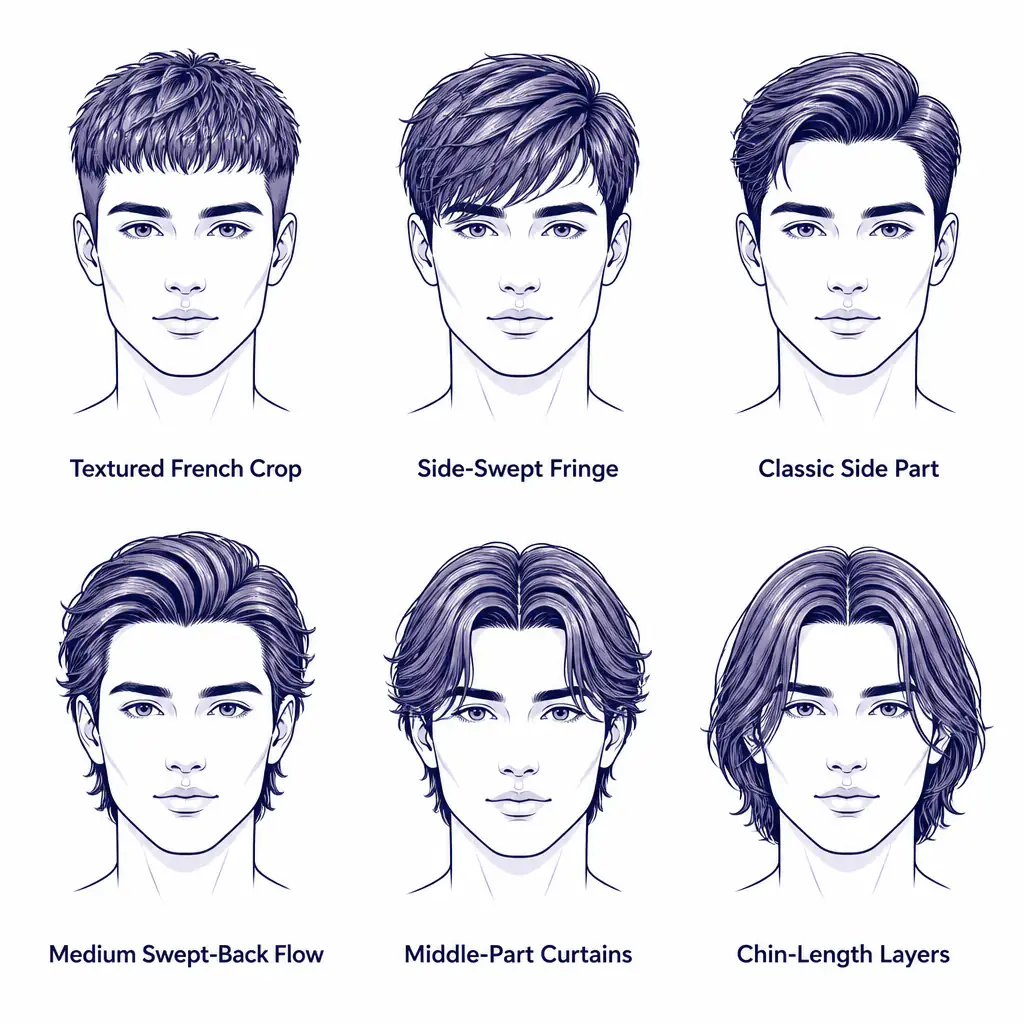
1. Textured French Crop with a Low Taper
The French crop is short, textured on top, and finished with a fringe that falls forward onto the forehead. For heart faces, it may be the single most reliable option.
Why it works: The fringe covers the upper forehead and breaks up its width, while the textured top avoids building height. A low taper (where the sides only get short near the ear and neckline) keeps some bulk lower on the head rather than hollowing out everything below the temples.
Ask for: 1 to 2 inches of choppy texture on top, a fringe that hits around mid-forehead, and a low taper or scissor-cut sides.
2. Side-Swept Fringe
A longer fringe brushed diagonally across the forehead.
Why it works: The diagonal line interrupts the horizontal breadth of the forehead and draws the eye across and down instead of straight across the widest part of your face. It’s especially effective for disguising a pronounced widow’s peak.
Ask for: 3 to 4 inches on top, longer at the front, with the fringe cut to sweep toward one side. Keep the sides medium length.
3. Classic Side Part with a Soft Taper
A timeless, professional cut with a defined part and the top combed to one side.
Why it works: The asymmetry softens the strong symmetry of a wide forehead, and a side part with moderate volume adds structure without height. It suits men who need a polished look for work.
Ask for: A natural part line (not a shaved hard part, which adds a sharp horizontal emphasis), 2 to 3 inches on top, and a gradual taper rather than a high skin fade.
4. Medium-Length Swept-Back Flow
Hair grown to roughly 4 to 6 inches and swept back loosely, with the ends curling around or behind the ears.
Why it works: Normally, swept-back styles expose the forehead, which isn’t ideal. But a loose, medium-length version lets the hair fall at the sides and settle near the jawline, adding width exactly where heart faces need it. The key is keeping it relaxed, not slicked tight to the scalp.
Ask for: Long layers, minimal shortening of the sides, and length kept around the ears and nape.
5. Middle Part (Curtains)
Hair parted down the center with each side falling toward the temples.
Why it works: The two curtains frame the forehead and cover its outer corners, effectively narrowing it. This style also works well with a widow’s peak, since the part can begin right at the peak.
Ask for: 4 to 6 inches at the front, slightly shorter toward the crown, with the sides left long enough to blend into the curtains.
6. Messy Textured Crop for Wavy or Curly Hair
If your hair has natural wave or curl, a textured crop that lets curls fall forward is often better than fighting your texture.
Why it works: Curls falling onto the forehead do the job of a fringe while adding soft, rounded volume. Keep curl volume controlled at the temples so the head doesn’t widen above the cheekbones.
Ask for: Curl-friendly cutting (dry cutting if your barber offers it), length on top to let curls form, and a low taper or longer scissor-cut sides.
7. Longer Layered Hair (Chin to Shoulder Length)
For men comfortable with long hair, chin-length to shoulder-length layers are a strong choice.
Why it works: Length that ends around the jaw literally adds width at the bottom of the face. This is the most direct hairstyle-based way to counterbalance a narrow chin.
Ask for: Face-framing layers that start around the cheekbones and fall to the jaw or below. Avoid one blunt length, which can look heavy and shapeless.
Haircuts to Avoid (or Modify)
No haircut is strictly forbidden, but some exaggerate heart-face proportions. If you love one of these, there are ways to adapt it.
- Tall pompadours and high quiffs: These add height and visual weight at the top of the head, emphasizing the wide upper face. Modification: lower the volume and push it slightly to the side.
- High skin fades with long tops: Shaving the sides down to skin all the way up to the temple line creates a top-heavy silhouette. Modification: drop to a mid or low taper.
- Tight slicked-back styles: These expose the full width of the forehead and the hairline. Modification: leave some texture and let a few pieces fall forward.
- Very short buzz cuts: With no hair to soften anything, the face shape is fully on display. This can work if you have a strong jaw or a beard, but on a heart face with a narrow chin it often makes the lower face look small. Modification: pair it with a full beard.
- Flat, blunt bangs straight across: A heavy, horizontal fringe can actually reinforce forehead width. Textured or angled fringes work better.
Using Facial Hair to Build the Lower Face
If your hair is doing its job up top, facial hair can finish the work at the bottom. For many heart-shaped faces, a beard is the single biggest upgrade available.
Best Beard Styles for Heart Faces
- Full boxed beard: Keeps fullness along the jaw and chin, adding width and squareness to the lower face.
- Short to medium stubble kept fuller at the chin: A lower-commitment option that still adds visual weight below the mouth.
- Extended goatee or anchor: Adds width and slight length at the chin. Useful if your cheek growth is patchy.
- Chinstrap with a fuller chin: Traces and widens the jawline when grown thick enough.
Beard Grooming Tips
- Keep the cheek line clean but natural. A very high cheek line adds width near the cheekbones, which you don’t need.
- Let the beard be slightly fuller at the jaw angles and chin than on the cheeks.
- Avoid trimming the chin into a sharp point, which can mimic and exaggerate a tapered chin.
If you want to see how much definition your jawline currently shows, Aura includes jawline analysis that can help you decide whether a beard is a cosmetic preference or a meaningful structural improvement for your face.
How to Brief Your Barber
The best haircut in the world fails if it gets lost in translation. Use these steps at your next appointment.
- Bring two or three reference photos of men with a similar face shape and hair texture wearing the cut you want. One photo is easy to misread. Several show the pattern.
- Name your goal, not just the style. Say something like, “I have a wider forehead and narrower chin. I want to soften the forehead and keep some weight lower on the sides.” A good barber will adjust technique around that.
- Specify the taper height. Ask for a low taper or scissor-cut sides. Say explicitly that you don’t want a high skin fade.
- Talk about the fringe. Tell them where you want it to land (mid-forehead, brow level, swept to one side) and that you want it textured, not blunt.
- Ask about your cowlicks and hairline. Widow’s peaks and crown swirls change how a fringe or part behaves. Let the barber decide which direction your hair naturally wants to fall.
- Book a follow-up in 3 to 5 weeks. Fringe-based styles lose their shape faster than short cuts. Regular maintenance keeps the proportions right.
Practical Styling Tips for Heart-Shaped Faces
A great cut still needs the right daily styling to keep its effect.
Products
- Matte clay or paste: Ideal for textured crops and fringes. It adds separation and hold without shine or height.
- Sea salt spray: Good for wavy hair and medium-length flow styles. Apply to damp hair for natural texture.
- Light cream: Best for longer styles and curls. It controls frizz without flattening.
- Avoid heavy pomades and high-hold gels for most heart-face styles. They encourage slick, high-volume shapes that expose the forehead.
Blow-Drying
Blow-dry your fringe forward and slightly to the side, not upward. Drying upward builds lift at the front, which adds height you’re trying to avoid. For curtains, dry each side down and outward from the part.
Hairline Considerations
If your hairline is receding at the temples, a heart-shaped face can look even wider on top. Fringe-forward styles like the French crop are especially helpful here since they cover the temple corners naturally. If thinning is a concern, talk to a qualified professional before considering any medical treatment, since options and suitability vary by individual.
Hair Type Quick Reference
- Straight, fine hair: French crop or side-swept fringe. Texturizing products prevent it from lying flat.
- Straight, thick hair: Side part or medium flow. Ask your barber to remove bulk at the temples.
- Wavy hair: Curtains, messy crop, or medium flow. Let the wave do the work.
- Curly or coily hair: Textured crop with forward-falling curls, or a rounded shape kept fuller lower than at the temples.
The Bottom Line
The best haircut for heart face men isn’t one specific style. It’s any cut that softens the forehead, keeps the temples controlled, and adds weight around the lower face. A textured French crop with a low taper is the safest starting point for most guys. Side-swept fringes, curtains, and medium-length flow styles are strong alternatives, and longer layers or a full beard can do even more to balance a narrow chin.
Start by confirming your face shape with real measurements, pick a cut that fits your hair type and lifestyle, and give your barber clear goals rather than just a style name. Small adjustments in taper height and fringe placement often matter more than the haircut’s name.
Frequently asked questions
What is the best haircut for a heart-shaped face for men? +
A textured French crop with a low taper is the most reliable option for most men with heart-shaped faces. The forward fringe softens a wide forehead while the low taper keeps some weight lower on the sides. Side-swept fringes and middle-part curtains are strong alternatives.
Should men with heart-shaped faces get a fade? +
Yes, but keep it low or mid. A high skin fade removes too much hair below the temples and makes the head look top-heavy, which exaggerates a narrow chin. A low taper or scissor-cut sides usually look more balanced.
Does a beard help a heart-shaped face? +
For many men, yes. A full boxed beard or stubble kept fuller at the chin and jaw angles adds visual width to the lower face, which balances a broad forehead. Avoid trimming the beard into a sharp point at the chin.
Can men with heart-shaped faces wear long hair? +
Long hair can work very well on heart-shaped faces. Chin-length to shoulder-length layers add width around the jaw, directly counterbalancing a narrower chin. Ask for face-framing layers rather than one blunt length.
How do I know if I have a heart-shaped face or an inverted triangle face? +
Both have a wide forehead and narrower jaw, but heart faces usually have a softer, more pointed chin while inverted triangles have a sharper, more angular jaw. The haircut advice for both is nearly identical, so the distinction matters less than confirming your forehead is wider than your jaw.