 Aura: Looksmaxxing
Best Beard for an Oval Face: 7 Styles Ranked
An oval face suits most beards, which makes length-to-width the thing to get right. Seven styles ranked, plus the two worth approaching carefully.

If you have an oval face, most beard guides open with the same line: almost anything works. That’s broadly true, but it doesn’t help you choose. You still have to decide between stubble and a full beard, a clean jawline and a goatee, a weekly trim and a monthly one.
This guide gives you a way to decide. It covers how to confirm you’re actually oval, the single principle behind almost every piece of oval-face beard advice, the styles that keep your proportions intact, and the ones worth approaching carefully. One caveat first: face-shape beard rules are styling conventions from barbers and grooming writers, not findings from controlled studies. Treat them as a sensible starting point, then let your own growth pattern and taste decide.
First, Make Sure You’re Actually Oval
A lot of people assume they’re oval when they’re closer to oblong or round. Because those shapes call for different beard choices, it’s worth checking.
The common description is consistent across sources. An oval face is slightly longer than it is wide, with a gently rounded jaw, cheekbones as the widest point, and a forehead marginally wider than the chin.
To check, take four measurements in a mirror or from a straight-on photo:
- Face length: center of the hairline to the tip of the chin.
- Forehead width: across the widest part of the forehead.
- Cheekbone width: across the high points of the cheekbones (the zygomatic arches, the bony ridges under your eyes that run toward your ears).
- Jaw width: across the lower jaw, near the angles below the ears.
Then divide face length by cheekbone width. This is where sources disagree, so don’t treat any single number as official:
- One face-categorizing patent defines its reference oval with a width-to-length ratio of 1:1.4, using cheekbone width as the base.
- One face-shape tool uses a 1.25 to 1.45 length ratio.
- Another sets oval between 1.3 and 1.5, and notes that a ratio right at 1.5 is where many systems start calling a face oblong instead.
The practical takeaway: if your ratio lands somewhere around the low-to-mid 1.4s, your cheekbones are the widest point and your jaw curves rather than squares off, you’re in oval territory. If you sit near 1.5 with fairly straight sides, read the oblong cautions below more carefully.
Editorial tip: measure with a clean shave or very short stubble. A grown-out beard changes what your jaw looks like, which is the whole point of this article, so it will skew the reading.
The One Rule Behind Every Oval-Face Beard
Almost every recommendation you’ll see comes from one idea. As one guide puts it, a beard moves the lower outline in two directions: length at the chin makes the face longer, and fullness at the sides makes it wider.
For round or oblong faces, the beard has a job. It adds length to a round face or width to a long one. Oval-face advice is different. It focuses on adding character while preserving existing balance, because nothing needs correcting.
That makes the main risk easy to state. The same guide calls it overcommitting: a long chin beard pushes an oval toward oblong, and bushy sides push it toward round.
Keep that rule in mind and you can judge any style yourself. Ask two questions:
- Does it add a lot of length below the chin?
- Does it stack a lot of volume on the sides or high on the cheeks?
If the answer to both is “not much,” the style will almost certainly sit well on an oval face.
The Best Beard Styles for an Oval Face
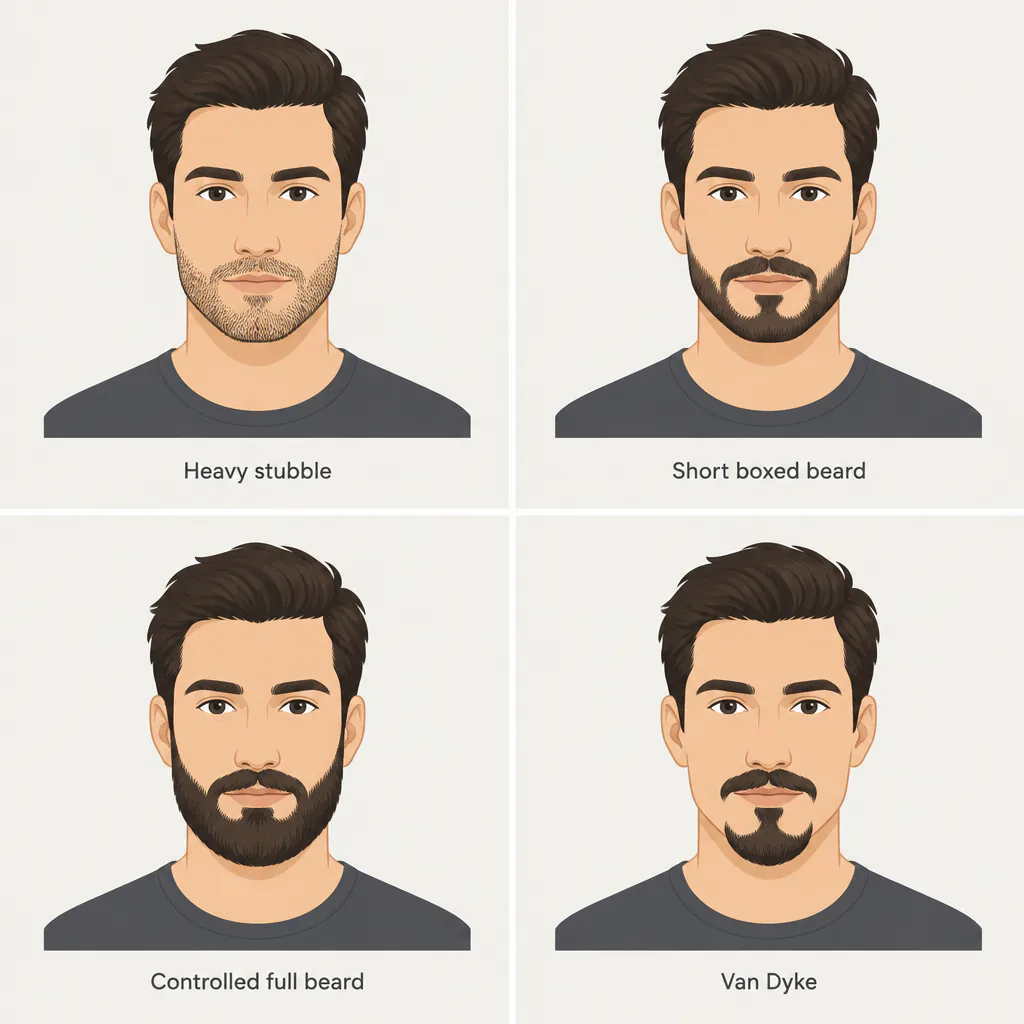
Grooming writers broadly agree on a core list. One guide names the full beard, short boxed beard, stubble, goatee, Van Dyke, Balbo and beardstache as options that complement an oval face without distorting it. Here’s how each one works in practice.
Heavy Stubble
Stubble is the lowest-commitment option. Because it barely changes the outline, it keeps your natural proportions visible while adding texture.
- Length range: one guide cites light or heavy stubble at 1 to 5 mm. At the shortest end, a five o’clock shadow needs only about 0.4 mm of growth.
- Best for: professional settings, warm climates, and anyone whose beard grows patchy at longer lengths.
- Maintenance: frequent, quick passes with a guarded trimmer, plus a clean neckline.
Short Boxed Beard
If you want one safe default, this is it. The short boxed beard is one of the best everyday options for oval faces, with a uniform short length and defined edges along the cheeks and neckline.
- Length range: one guide suggests 1 to 2 cm as a starting point.
- Why it works: it follows your jaw instead of reshaping it, so it adds structure without moving the outline far in either direction.
- Maintenance: moderate. The sharp edges are what make it look deliberate, so the lines need regular attention.
Controlled Full Beard
Oval faces can wear a full beard, but control matters. One guide warns that overly full, bushy beards can overwhelm the natural symmetry. The same source adds that a messy, unkempt full beard works against any face shape, oval included.
Editorial suggestion: keep the sides trimmed a little tighter than the chin, and keep the chin from turning into a long point. That way the beard adds presence without breaking the two-direction rule.
Goatee and Van Dyke
Both put the focus on the chin and mouth and leave the cheeks clean or nearly clean. A goatee covers the chin, often with a connected mustache. A Van Dyke pairs a chin beard with a mustache that typically doesn’t connect.
These work on oval faces because they add a focal point without widening anything. The thing to watch is chin length. A short, neat chin piece keeps your balance. A long, pointed one adds exactly the vertical length the rule warns about.
Balbo and Beardstache
The Balbo combines a chin beard and lower-jaw coverage with a separate mustache and no sideburns. The beardstache pairs a prominent mustache with short stubble across the rest of the face. Both suit you if you want something more styled than a boxed beard. Both also need precise, frequent edge work to look intentional rather than grown-out.
Styles to Approach With Care
No style is banned for an oval face, but a few push against the balance you already have.
- Long, pointed chin beards. These add length below the chin. One guide lists very long, pointed chin beards and heavy volume stacked high on the cheeks as the main things to avoid. The same source adds that this matters most if your face runs toward the longer end of oval.
- Heavy side volume. Bushy sides widen the lower face and can make an oval read rounder.
- The anchor beard (debated). Sources disagree here. One calls it particularly flattering for oval faces because it adds definition to the lower half of the face. Another lists anchor beards among styles that make an oval face look noticeably longer or wider. If you like it, keep the chin point short and judge it on your own face.
The pattern is consistent: trouble comes from extremes, not from any specific style name.
How to Choose: A Quick Decision Guide
Since most styles technically work, base the decision on your life and your growth, not on face shape alone. This is an editorial framework, not a measured ranking:
| Your priority | Good starting style | Upkeep |
|---|---|---|
| Minimal effort, office-friendly | Heavy stubble | Frequent, quick trims |
| One reliable everyday look | Short boxed beard | Regular line-up |
| More presence and maturity | Controlled full beard | Shaping plus daily brushing |
| A distinctive, styled look | Van Dyke, Balbo or beardstache | Precise, frequent edging |
| Patchy cheeks | Goatee, Van Dyke or short stubble | Low to moderate |
Two factors matter as much as face shape:
- Density and growth pattern. If your cheeks fill in sparsely, a full beard will read patchy at any length. Chin-focused styles avoid the problem.
- Your hair. One guide notes that for oval faces, coordination between hair length and beard density usually makes the biggest difference. A heavy beard under very short hair can look bottom-heavy. A light beard under a large hairstyle can look top-heavy.
Lines Matter More Than the Label
Walk into a barbershop and ask for “an oval-face beard” and you’ll get a vague result. One grooming guide makes the same point about face-shape labels in general: asking for ‘a beard shape for a square face’ gives a barber almost nothing to work with. Execution depends on your actual jaw, growth and density.
So describe the result, not the shape. Tell your barber:
- The style and length you want (for example, “short boxed beard, roughly 1.5 cm on the chin, a little shorter on the sides”).
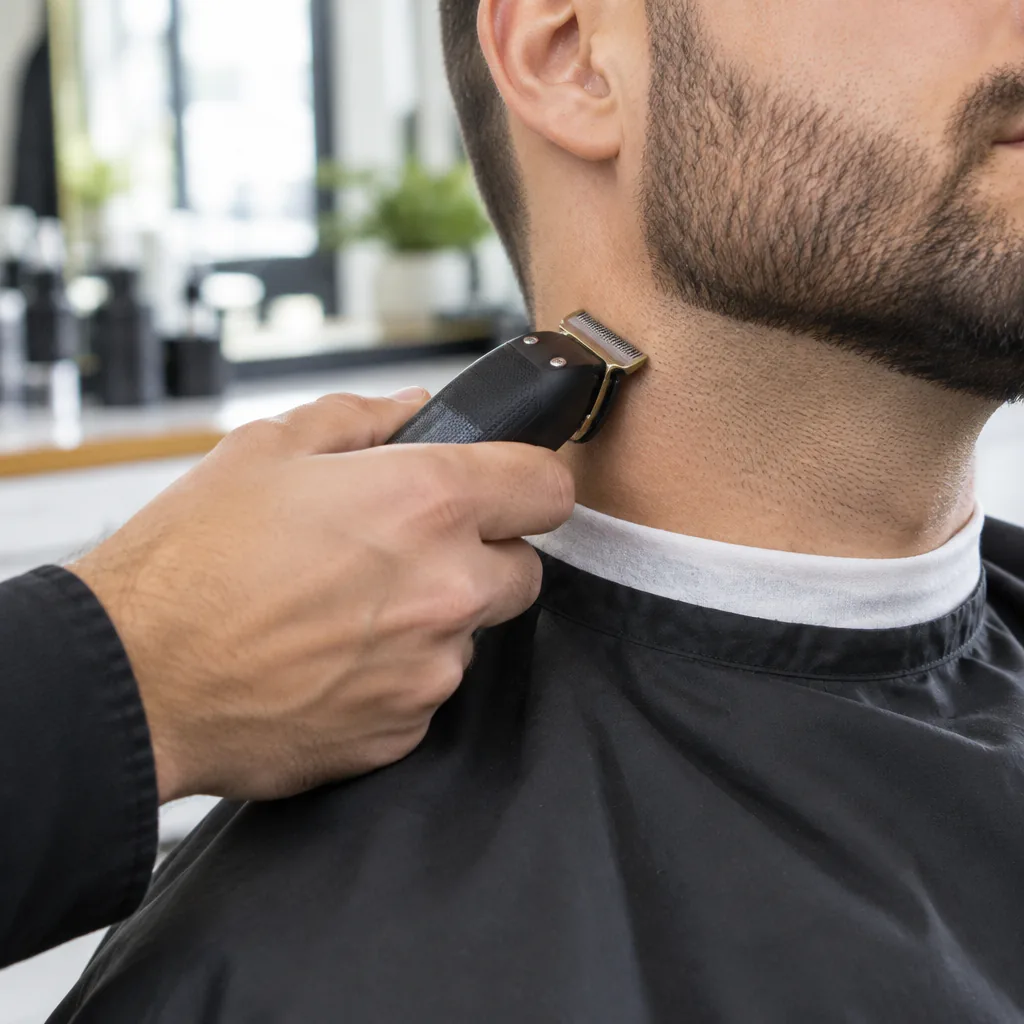
- Where you want the neckline. A neckline set too high can shrink the jaw visually. One set too low looks untidy.
- How sharp you want the cheek line. Natural and soft suits stubble and full beards. Crisp and defined suits boxed beards and Balbos.
- What to avoid (“don’t let the chin come to a point” or “keep the sides from getting bulky”).
These instructions put the two-direction rule into practice. You’re controlling length at the chin and fullness at the sides, which is the main thing an oval face needs.
Getting an Outside Read on Your Features
Mirrors are hard to judge yourself in, especially when you’re deciding between oval and oblong or trying to tell whether your jaw reads soft or defined. A second opinion from a barber or a photo-based tool can help you settle on a starting point.
If you’d like a structured overview, Aura’s AI Face Analysis looks at a straight-on photo and returns a facial profile, a feature breakdown and personal styling suggestions, which can include grooming direction. Keep its limits in mind. Any score is a subjective, photo-based estimate, not an objective measure of attractiveness. The free output is a styling-potential estimate, and the full breakdown is a paid unlock. Use it to inform your conversation with a barber, not replace it.
Practical Tips: A Simple Trial Routine
The advice above narrows your options. Only trying a style tells you whether it suits you. Here’s an editorial routine for testing a beard without committing to a bad grow-out:
- Start short. Begin with heavy stubble or a short boxed beard. Both keep length and width close to your natural proportions, so they make a low-risk baseline.
- Photograph your baseline. Take a straight-on photo in consistent lighting so you can compare honestly later.
- Grow before you shape. Let the beard fill in for a few weeks before cutting a defined shape. Early growth is uneven, and judging too soon leads to over-trimming.
- Set the neckline and cheek line first. Clean edges make even short growth look intentional, which makes the awkward phase easier to get through.
- Check the two directions. Each week, look front-on and in profile. Is the chin getting long and pointed? Are the sides getting bulky? Trim whichever is running ahead.
- Adjust one variable at a time. Change length or shape, not both at once, so you know what caused the difference.
- Re-evaluate with your hair. After a haircut, look again. A beard that worked with longer hair can look heavy with a short fade.
Oval faces genuinely do have the most room to experiment. The real decision isn’t which style is allowed. It’s which one fits your growth, your routine and the look you want, kept in proportion.
Sources & further reading
- Face categorizing method, face categorizing apparatus, categorization map, face categorizing program, and computer-readable medium storing program
- 7 Best Beard Styles for Oval Faces (And What to Avoid)
- Best Beard Styles for Your Face Shape: Men's Guide
- Beard Styles for Men
- Best Facial Hair Styles For Oval Faces: Discover Your Best Look
Frequently asked questions
What is the best beard style for an oval face? +
There's no single best one, because oval faces suit most beards. Heavy stubble and the short boxed beard are the safest defaults, since they add structure without changing your proportions much. A controlled full beard, goatee, Van Dyke or Balbo also work if kept neat.
What beard styles should I avoid with an oval face? +
Be careful with very long, pointed chin beards and heavy volume on the sides or high on the cheeks. Chin length makes the face look longer and side bulk makes it look wider, so extremes in either direction can push an oval toward oblong or round.
How long should a beard be for an oval face? +
Most lengths work, but a common starting point is stubble or a short beard of about 1 to 2 cm, as suggested by one grooming guide. From there, adjust based on your density and what you like, keeping the chin and sides roughly in proportion.
How do I know if my face is oval or oblong? +
Divide your face length (hairline to chin) by your cheekbone width. Sources disagree on exact cutoffs, but oval usually sits below about 1.5, with the cheekbones widest and a curved jaw. If you're near or above 1.5 with fairly straight sides, you may be closer to oblong.