 Aura: Looksmaxxing
 MTN vs HTN: Which Tilt Improves Your Look?
MTN vs HTN explained: learn how maxillary and horizontal tilt affect facial attractiveness, PSL scoring, and which to prioritize for looksmaxxing.
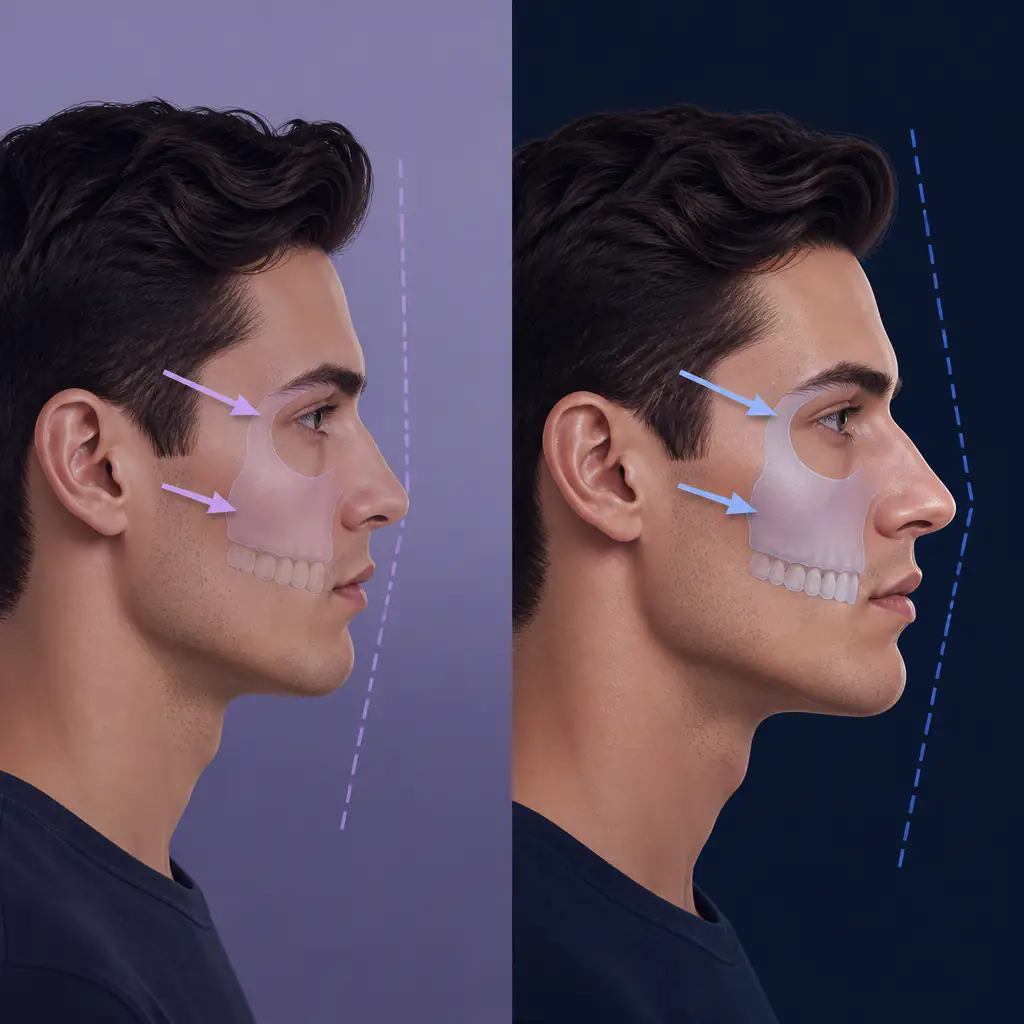
If you’ve spent any time researching facial aesthetics, you’ve likely encountered the abbreviations MTN and HTN. Both refer to specific angular measurements of facial bones, and both carry real implications for how attractive a face reads at a glance. The confusion between them is common because they overlap in the midface region and both influence features people care about deeply: eye tilt, cheekbone projection, and overall facial harmony.
This article breaks down exactly what each term means, how they differ, how they interact, and what, if anything, you can do to address them.
What Is MTN (Maxillary Tilt)?
MTN stands for maxillary tilt negative, though in many discussions it’s used simply to describe the angular orientation of the maxilla (upper jaw bone) relative to the Frankfurt Horizontal plane. The maxilla is one of the most influential bones in facial aesthetics because it forms the base of the nose, supports the upper teeth, and directly underpins the orbital rims (the bony frames around your eyes).
When people say someone has a “negative maxillary tilt,” they mean the maxilla is angled such that it recedes or slopes downward toward the back of the face rather than projecting forward and slightly upward. This matters for several reasons:
- Infraorbital rim support: A recessed maxilla provides less support beneath the eye socket, which can make the under-eye area look hollow or create a “tired” appearance.
- Midface projection: Low forward projection in the maxilla flattens the midface and reduces cheekbone prominence.
- Nasolabial angle: The angle where the nose meets the upper lip is partially determined by maxillary position and tilt.
A “positive” maxillary tilt, sometimes written informally as MTP, implies the opposite: the maxilla projects well forward and has an upward angular orientation, supporting fuller orbital rims, higher-looking cheekbones, and a more defined midface overall.
What Is HTN (Horizontal Tilt Negative)?
HTN stands for horizontal tilt negative and refers to the downward cant of specific facial features when viewed from the front. The most commonly discussed application is eye tilt: whether the outer corner of the eye (lateral canthus) sits higher or lower than the inner corner (medial canthus).
- Positive horizontal tilt (HTP): The outer corner of the eye sits higher than the inner corner, producing the “hunter eye” or upward-slanting eye shape often associated with a dominant, assertive appearance.
- Negative horizontal tilt (HTN): The outer corner sits lower than the inner corner, creating a droopy or “sad eye” appearance. This is the look often described as “prey eyes” in facial aesthetics communities.
HTN isn’t limited to the eyes. The same concept applies to the mouth corners and even the general plane of the zygomatic arches (cheekbones). When multiple features share a downward cant, the cumulative effect on perceived attractiveness can be significant.
It’s worth noting that HTN is partly skeletal (driven by orbital bone shape and lateral orbital rim height) and partly soft-tissue (influenced by the lateral canthus ligament attachment and eyelid structure). This distinction matters a lot when you’re thinking about interventions.
Key Differences: MTN vs HTN Side by Side
| Feature | MTN (Maxillary Tilt Negative) | HTN (Horizontal Tilt Negative) |
|---|---|---|
| Primary bone involved | Maxilla (upper jaw) | Orbital rim, zygomatic arch |
| Plane of measurement | Sagittal and coronal (front-to-back and depth) | Coronal (front-facing, left-right axis) |
| Main visible effect | Flat midface, hollow under-eyes, weak cheek support | Downward-slanting eyes, droopy eye corners |
| Soft tissue impact | Nasolabial folds, under-eye hollowing | Lower eyelid position, lateral canthus position |
| Mewing relevance | High, maxilla responds to tongue posture over time | Indirect, through orbital rim remodeling |
| Surgical correction | Orthognathic surgery, Le Fort osteotomy, implants | Canthoplasty, lateral wall orbital recontouring |
| Non-surgical options | Mewing, chewing, facial exercises, fillers | Eye exercises (limited evidence), fillers, tape techniques |
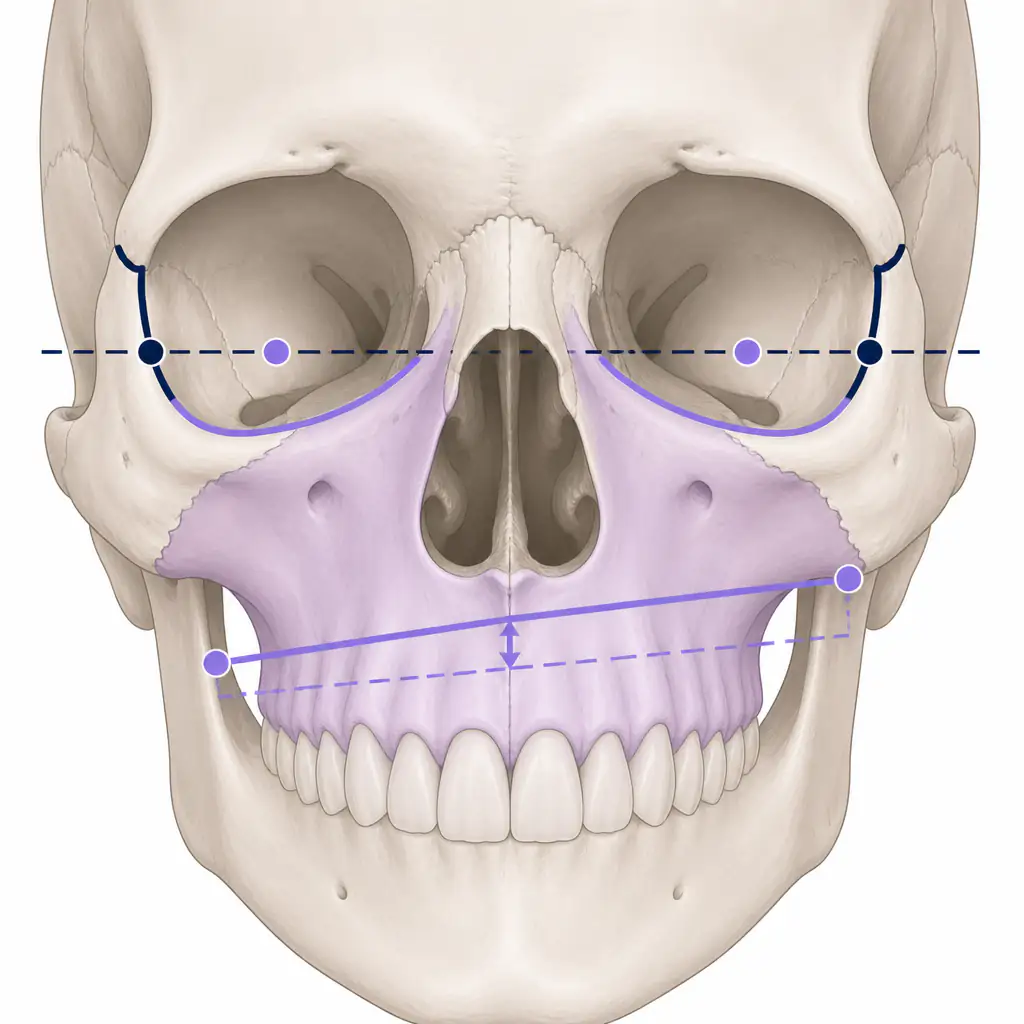
The two conditions frequently co-occur. A recessed maxilla often fails to provide adequate lateral orbital rim support, which contributes directly to HTN. This is why addressing MTN, whether through posture-based methods or structural ones, may also partially improve eye tilt appearance.
How MTN and HTN Interact
Think of the midface as a scaffolding system. The maxilla is the central pillar. When it tilts negatively (recedes and drops), it reduces support for the structures built on top of it, including the orbital floor, the lateral orbital rim, and the zygomatic body.
This is why some individuals who address maxillary projection, through either long-term mewing or orthognathic intervention, report improvements not just in midface flatness but also in the apparent tilt of their eyes. The orbital rim lifts slightly with better maxillary support, nudging the lateral canthus into a more favorable position.
The reverse relationship is less direct. Correcting HTN through a soft-tissue procedure like canthoplasty won’t move the maxilla. So if your HTN is primarily skeletal in origin, a purely soft-tissue approach addresses the symptom rather than the source.
Reading Your Own Face
Before deciding which issue is more relevant to you, it helps to assess your face objectively. A few practical self-checks:
- Infraorbital rim test: Place your finger horizontally under your eye. If your finger rests against your cheek well below the eye socket, you likely have some degree of infraorbital rim retrusion, which is a hallmark of MTN.
- Eye tilt check: Look straight into a mirror. Draw an imaginary line from your inner eye corner to your outer corner. If that line tilts downward toward the outer corner, you have measurable HTN.
- Profile assessment: From a side view, check whether your midface (from the base of the nose to the cheekbone) projects forward past your chin. A recessed midface profile is consistent with MTN.
For a more calibrated read, tools like Aura can analyze your facial geometry from photos, score specific features including eye tilt and midface projection, and give you a concrete starting point before you make any decisions about intervention.
Practical Approaches to Addressing MTN
Addressing maxillary tilt negative ranges from completely non-invasive lifestyle habits to major surgical intervention. The right level of intervention depends on the severity of the issue and your goals.
Non-Surgical
- Mewing (correct tongue posture): Placing the tongue flat against the roof of the mouth applies upward and forward pressure on the maxilla. Research into orthotropics, the field pioneered by John Mew, suggests this may support maxillary development when practiced consistently, particularly in younger individuals. Adults may see more modest effects.
- Chewing tougher foods: Some evidence suggests that masticatory force (the mechanical stress from chewing) stimulates bone density and can influence facial structure over time. Switching to harder food textures may help maintain structural integrity.
- Dermal fillers: Hyaluronic acid fillers placed at the infraorbital rim or cheeks can compensate for the visual effect of MTN without touching bone. Results are temporary, typically lasting 9 to 18 months.
- Custom implants: Infraorbital rim and cheek implants are a semi-permanent way to add projection where the maxilla falls short.
Surgical
Orthognathic surgery, including Le Fort I or Le Fort III osteotomies, physically repositions the maxilla. These are major procedures with real recovery times and risks. Talk to a qualified maxillofacial surgeon before considering any surgical option.
Practical Approaches to Addressing HTN
Non-Surgical
- Lateral canthus tape: Some people use specialized tape to mechanically lift the outer corner of the eye. This is purely cosmetic, temporary, and used mainly for photos or specific events.
- Makeup and grooming: Upward-wing eyeliner, lifted eyebrow tails, and strategic contouring can create the visual impression of a more positive eye tilt.
- Fillers at the lateral orbital rim: Placing filler along the upper outer orbital rim can add height and subtly lift the appearance of the eye’s outer corner.
Surgical
- Canthoplasty / canthopexy: Canthoplasty surgically repositions the lateral canthus to a higher point on the orbital rim. Canthopexy is a less invasive version that tightens the existing attachment without detaching and reattaching it. Both are outpatient procedures but carry risks including scarring, asymmetry, and changes to tear drainage. Consult a board-certified oculoplastic or plastic surgeon before pursuing either.
- Lateral orbital rim recontouring: In skeletal HTN cases, bone work at the lateral orbital rim can raise the attachment point for the canthus.

Which Should You Prioritize?
If you’re trying to decide which issue to focus on first, the answer usually comes down to root cause:
- If your HTN is primarily skeletal (low lateral orbital rim, shallow orbit): addressing MTN may provide some upstream benefit to eye tilt, and any soft-tissue fix for HTN will be more stable on a better skeletal foundation.
- If your HTN is primarily soft-tissue (the rim height is adequate but the canthus sits low): soft-tissue approaches to HTN are more directly targeted.
- If MTN is your dominant issue (flat midface, hollow under-eyes, and poor profile projection): start there. The visual improvement from better midface support often makes eye tilt appear less severe without any direct intervention on the eyes.
For most people working with non-surgical methods, focusing on mewing and diet for MTN is the more accessible entry point. HTN non-surgical fixes are mostly cosmetic workarounds rather than structural changes.
If you want to track whether your efforts are having any measurable effect on your facial geometry, periodic photo analysis through Aura can provide objective scoring on features like eye tilt and orbital support so you’re not guessing.
FAQ
Q: Can you have both MTN and HTN at the same time? Yes, and they frequently occur together. Because the maxilla provides structural support for the lateral orbital rim, a recessed or negatively tilted maxilla often contributes to the low canthus position that characterizes HTN. Addressing one may partially improve the other.
Q: Does mewing fix HTN? Not directly. Mewing targets maxillary position and tilt (MTN), and if improved maxillary projection raises orbital rim support, there may be a secondary effect on apparent eye tilt. But mewing is not a direct treatment for HTN, especially in cases where soft tissue or canthus attachment is the primary factor.
Q: Is canthoplasty the only surgical fix for HTN? No. Lateral orbital rim recontouring can address skeletal HTN by raising the bony attachment point. Canthoplasty and canthopexy work on the soft tissue. A surgeon may recommend one, the other, or a combination depending on your anatomy. Always consult a qualified oculoplastic or plastic surgeon before considering any procedure.
Q: How do I know if my eye tilt is HTN or just naturally low-set eyes? The distinction often comes down to where the lateral canthus attaches relative to the orbital rim. A true HTN involves the outer canthus sitting at or below the level of the medial canthus when viewed frontally. An objective facial analysis tool or an in-person consultation with a surgeon can give you a more precise answer than self-assessment alone.
Frequently asked questions
Can you have both MTN and HTN at the same time? +
Yes, and they frequently occur together. Because the maxilla provides structural support for the lateral orbital rim, a recessed or negatively tilted maxilla often contributes to the low canthus position that characterizes HTN. Addressing one may partially improve the other.
Does mewing fix HTN? +
Not directly. Mewing targets maxillary position and tilt, and if improved maxillary projection raises orbital rim support, there may be a secondary effect on apparent eye tilt. But mewing is not a direct treatment for HTN, especially in cases where soft tissue or canthus attachment is the primary factor.
Is canthoplasty the only surgical fix for HTN? +
No. Lateral orbital rim recontouring can address skeletal HTN by raising the bony attachment point for the canthus. Canthoplasty and canthopexy work on the soft tissue. A surgeon may recommend one, the other, or a combination depending on your specific anatomy. Always consult a qualified oculoplastic or plastic surgeon before considering any procedure.
How do I know if my eye tilt issue is HTN or just naturally low-set eyes? +
The distinction often comes down to where the lateral canthus attaches relative to the orbital rim height. A true HTN involves the outer canthus sitting at or below the level of the medial canthus when viewed frontally. An objective facial analysis tool or an in-person consultation with a surgeon can give you a more precise answer than self-assessment alone.