 Aura: Looksmaxxing
Most Attractive Face Shape for Men: The Studies
No single face shape wins. What studies say about jaw width, averageness and masculinity, and how to style the shape you actually have.
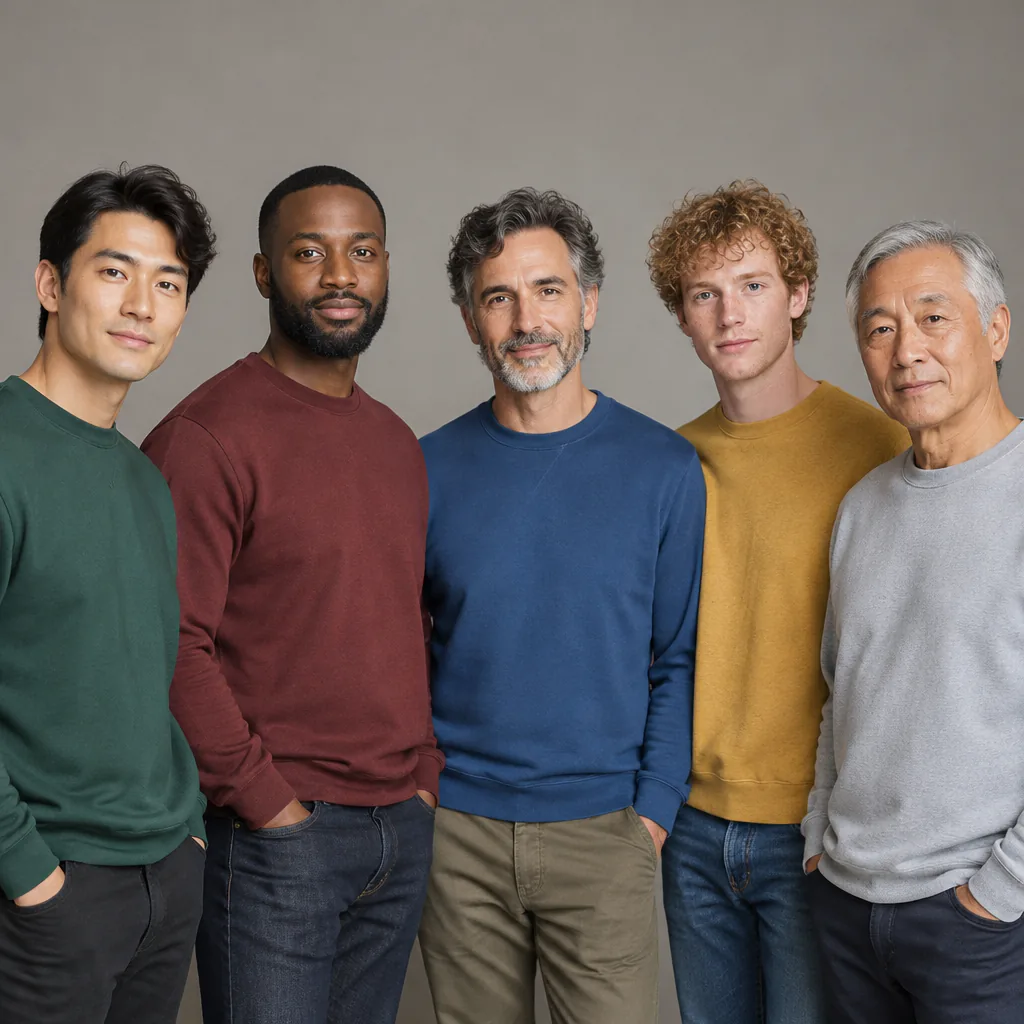
Search for the most attractive face shape for men and you will find a lot of confident answers. Square jaw. Oval is ideal. Diamond is rare and elite. Most of these lists read like settled science. They are not.
Academic studies of male attractiveness don’t rank labels like oval, round or diamond. They measure continuous traits: how close a face is to the population average, how prominent the jaw is, how wide the face is relative to its height, and how masculine the overall shape reads. On several of these traits, the findings disagree with each other.
This guide covers what holds up, what doesn’t, and why studies conflict. It ends with how to use your face shape where it does matter: haircuts, beards and glasses.
The Short Answer: No Single Shape Wins
No study we found crowns one categorical face shape as the most attractive for men. The most consistent finding is not about a shape at all. It is about averageness, meaning how close a face’s proportions sit to the typical face in a population.
The popular square-jaw ideal has mixed support. Some studies link masculine features to attractiveness. Others find no link, or even a negative one. One clearer pattern runs through the literature: features that make a man look dominant are not always the features that make him look attractive.
If someone tells you your face shape caps your attractiveness, they are claiming more certainty than the evidence gives.
What Researchers Measure Instead of “Face Shapes”
The face shape categories you see online (oval, square, round, oblong, diamond, heart, triangle) are styling shorthand. Barbers and eyewear brands use them to pick cuts and frames. Researchers usually work with facial landmarks: dozens of points mapped across the brow, cheekbones, jaw and chin. They then analyze how shape varies statistically. This approach is called geometric morphometrics.
Three traits come up again and again.
Averageness
In a study published in Scientific Reports, averageness of face shape had a significant positive relationship with attractiveness ratings. In the same analysis, masculinity of face shape was not significantly correlated with male attractiveness, and symmetry was not significantly correlated with attractiveness either.
Average does not mean bland. An averaged face tends to have balanced proportions with no single feature dominating. That balance can occur in an oval face, a square face or a rectangular one.
Masculinity and the Jawline
Sexual dimorphism refers to the shape differences between typical male and female faces. Men’s faces tend to have a more prominent brow ridge, a larger chin and a more defined jaw. The question is whether pushing a face further in the masculine direction makes it more attractive.
The evidence splits:
- In one study using a morphological measure of masculinity, there was no relationship between morphological masculinity and rated attractiveness. Skin colour, which the authors describe as a fluctuating, condition-dependent cue, did predict attractiveness.
- A facial anthropometry study found that, in both sexes, facial attractiveness was negatively associated with facial masculinity, and that preference was not associated with symmetry.
- A different study found that male attractiveness was positively predicted by masculinity, symmetry and averageness.
- A conjoint study found that eyebrow thickness and jawbone prominence mattered more to overall attractiveness than cheekbone prominence and eye size. A masculine jaw was rated more attractive on male faces than on female faces.
So a defined jaw can count in your favor in some study designs. It is not a universal rule.
Face Width: The fWHR Question
The facial width-to-height ratio (fWHR) is the width of the face divided by the height of the upper face. Width is measured across the cheekbones. Height runs roughly from the brow to the upper lip. It has been one of the most studied face metrics.
The same meta-analysis found that individuals with larger fWHRs were judged as less attractive, especially when women made the judgments.
A speed-dating study complicates this. Men with higher fWHR were rated as more dominant, were more likely to be chosen for a second date, and were rated more attractive for short-term relationships. A later study found that fWHR was not reliably linked to raters’ judgments of male faces for any of the 13 trait inferences tested.
The practical reading: a wider face reads as more dominant in some studies. That does not reliably translate into being seen as more attractive.
Why the Studies Disagree
If one study says masculine faces are more attractive and another says they are less attractive, method is one likely reason.
Edited Faces vs. Natural Faces
Many studies took one face and digitally morphed it to look more or less masculine. The Scientific Reports authors point out that studies finding masculinity effects typically used stimuli in which shape characteristics were experimentally manipulated. They suggest this may help explain conflicting results. But measuring natural variation does not settle the question: one study found masculinity positively predicted male attractiveness, while others found no link or a negative one.
A review paper makes a related point. It re-evaluates claims that women see masculine-faced men as less likely to invest in relationships, partly on methodological grounds.
Dominance Is Not Attractiveness
One of the steadier findings is that masculine features and attractiveness are separate dimensions:
- A combination of masculine features, including a square jaw and thick eyebrows, raised dominance ratings of male faces.
- In a geometric morphometrics study, male physical strength was more strongly associated with face shapes linked to perceived masculinity and dominance than with attractiveness. Highly attractive men in that sample tended toward longer, narrower face shapes rather than the broadest ones.
- A meta-analysis found a small but significant positive relationship between men’s fWHR and aggression. That is a weak link, and it is not a feature most people are looking for in a partner.
Many online rankings blend “looks tough” with “looks attractive.” The research treats them as different things.

Context and Who Is Rating
Preferences shift with context, such as short-term vs. long-term interest, as the speed-dating result shows. Facial cues of muscle mass in men predict how masculine women perceive a face to be, but perceived masculinity is not the same as attractiveness. Samples also vary by country, age and rater group, so a result from one population may not transfer to another.
Where the Square-Jaw Ideal Comes From
The idea that square faces are best has some real data behind it, but the context matters.
An AI analysis of male celebrity faces found that square or trapezoidal facial shapes were perceived as more attractive across most ethnic groups, with Asian populations tending to favor a slightly more triangular outline. These were faces the media had already deemed attractive. That tells you about the media standard, not about what ordinary raters prefer in everyday life.
The ideal also shows up in how men see themselves. In one study, men favored a well-defined chin, flatter cheeks and cheekbones, and more pronounced brow ridges, nose and mid-forehead when rating their own attractiveness. That measures self-perception, not how others rate you.
A separate study of 208 men looked at external ratings. It found that attractive male faces tended to show an angular, well-defined structure, less fullness at the sides and slightly greater lower-face height. Read the word tended: this describes a pattern in one sample, not a requirement.
Put together, there is a recurring preference for definition and balance. That is a long way from “square beats oval.”
What Actually Changes How Your Face Reads
Your bone structure is mostly fixed. How it comes across is not. These are editorial suggestions about presentation, not measured attractiveness effects:
- Skin condition. In the morphological masculinity study, skin colour was a significant predictor of attractiveness, and the authors describe it as a fluctuating, condition-dependent cue. A consistent basic routine of cleanser, moisturizer and sunscreen is a reasonable place to start.
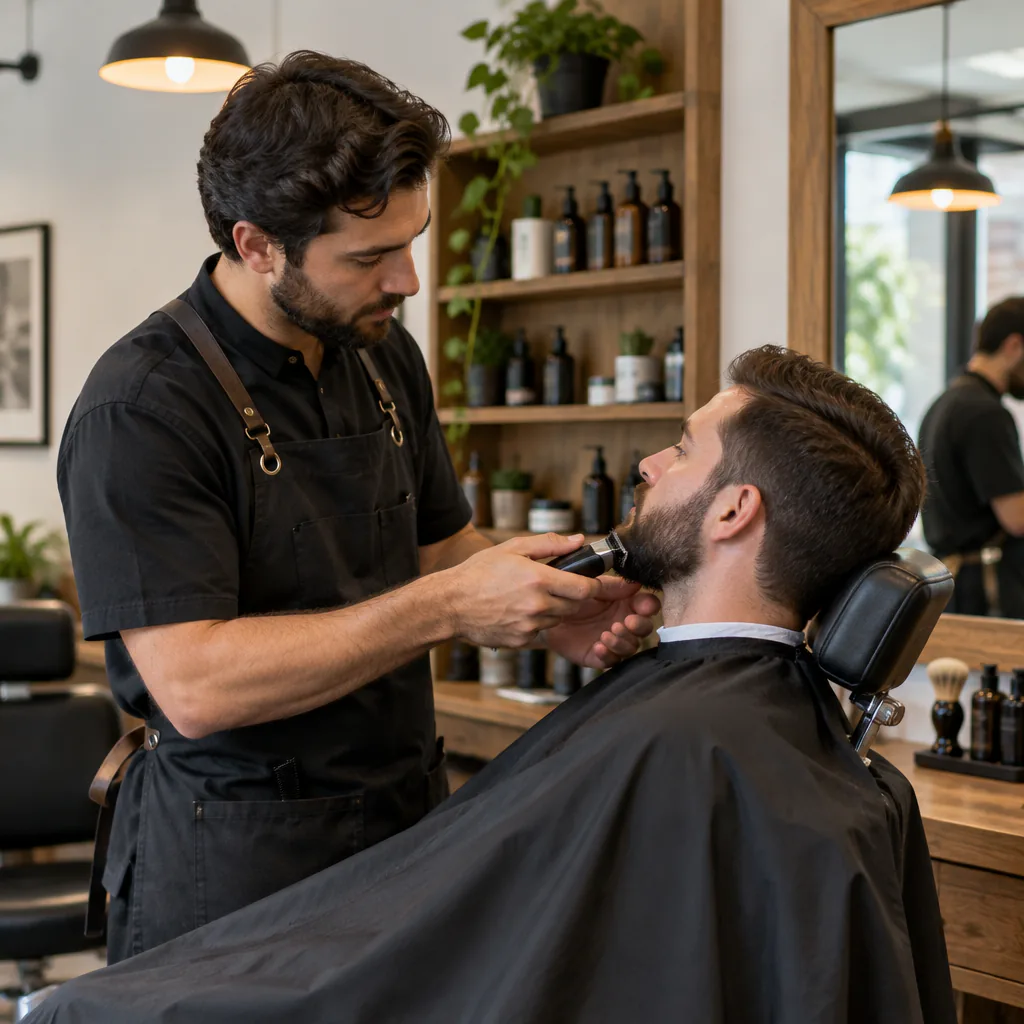
- Haircut proportions. Volume on top lengthens a face. Volume at the sides widens it. A good barber uses this deliberately.
- Facial hair as framing. A beard can visually extend a short chin or sharpen a soft jawline. Clean edges at the neckline and cheek line matter more than length.
- Eyebrow grooming. Eyebrow thickness was one of the more salient features in the conjoint study. Tidy strays, but don’t over-thin.
- Glasses and frame shape. Frames add lines to your face. Picking frames that contrast with your face shape is a long-standing eyewear convention.
How to Use Your Face Shape for Styling
This is where face shape categories earn their keep. They give you and your barber a shared starting point. The suggestions below are common stylist conventions, not research findings.
| Likely face shape | Typical traits | Haircut ideas | Beard and frames |
|---|---|---|---|
| Oval | Balanced length and width, softly rounded jaw | Most cuts work; textured crops, side parts | Most beard styles; most frame shapes |
| Square | Wide, angular jaw, forehead and jaw similar width | Short sides with some top height, or softer texture | Light stubble or short boxed beard; rounder frames |
| Round | Similar length and width, soft jawline | Height on top, tighter sides | Beard longer at the chin to add length; rectangular frames |
| Rectangular / oblong | Longer than wide, straight sides | Avoid excess height; fringe or side volume | Fuller sides on the beard; deeper frames |
| Diamond | Wide cheekbones, narrower forehead and chin | Fringe or textured top to widen the forehead | Fuller chin beard; browline or oval frames |
| Triangle | Jaw wider than forehead | Volume on top and upper sides | Keep jaw-side beard short; top-heavy frames |
Most faces are a blend, so treat any single label as approximate. If you aren’t sure which row you fit, Aura’s Face Shape Finder gives a likely face shape with stated uncertainty. It explains how your forehead, cheek and jaw proportions compare and suggests haircut and accessory options. It does not give calibrated measurements or an attractiveness score. You upload a photo before signing up. The free output is an on-device preview of your face shape and proportions; the full findings are part of Aura Pro ($9.99 a month or $49.99 a year).
Getting a Useful Read at Home
If you’d rather check manually:
- Pull your hair back and take a straight-on photo at eye level, in even light, with a neutral expression.
- Compare the widths of your forehead, cheekbones and jaw. Which is widest?
- Compare overall face length to cheekbone width. Is it clearly longer, or close to equal?
- Look at your jaw angle. Is it sharp and defined, or rounded?
- Match the pattern to the closest row in the table. Then bring the photo to your barber and ask what they see.
Myths to Drop
- “Oval is scientifically the best shape.” We found no study ranking shape labels.
- “Women universally prefer a square jaw.” Some studies find null or negative effects for masculinity, while others find positive ones.
- “A wider face makes you more attractive.” The meta-analytic evidence leans the other way. The positive speed-dating result was limited to short-term contexts.
- “Symmetry is everything.” Several of the studies above found no significant symmetry effect.
- “Celebrity ratios are a target.” Proportions measured on media-selected faces describe a media standard, not a goal for your face.
The Bottom Line
There is no single most attractive face shape for men. The research points to balance and averageness over any one outline. A defined jaw counts in your favor in some studies and not in others. A wide, dominant-looking face is not the advantage it is often sold as.
The useful part is practical. Learn your likely face shape, use it to pick haircuts, beard lines and frames, and take care of the condition-dependent things like skin. That is a better use of your energy than worrying about a ranking the evidence doesn’t support.
Sources & further reading
- Further evidence that averageness and femininity, rather than symmetry and masculinity, predict facial attractiveness judgments
- Male facial attractiveness: evidence for hormone-mediated adaptive design - ScienceDirect
- Does Masculinity Matter? The Contribution of Masculine Face Shape to Male Attractiveness in Humans
- Predictors of facial attractiveness and health in humans
- The Relative Contribution of Jawbone and Cheekbone Prominence, Eyebrow Thickness, Eye Size, and Face Length to Evaluations of Facial Masculinity and Attractiveness: A Conjoint Data-Driven Approach
Frequently asked questions
What is the most attractive face shape for men? +
No study we found ranks face shape labels like oval or square for male attractiveness. The most consistent finding is that faces closer to the population average are rated more attractive. Effects of masculinity and jaw shape are mixed across studies.
Is a square jaw more attractive? +
It depends on the study. In one study, a combination of masculine features including a square jaw raised dominance ratings. A conjoint study found jaw prominence mattered for attractiveness, and another found masculinity positively predicted male attractiveness, but other studies found no link between masculinity and attractiveness, or a negative one.
Does a wider face make a man more attractive? +
Not reliably. A meta-analysis found people with larger width-to-height ratios were judged less attractive, especially by women. A speed-dating study found wider-faced men were rated more attractive for short-term relationships. A later study found no reliable link between fWHR and judgments of male faces.
Can I change my face shape? +
Your underlying bone structure is largely fixed, but how it reads can change. Haircut proportions, beard lines, eyebrow grooming and frame choice all shift how your face comes across. Skin colour, a condition-dependent cue, was a significant attractiveness predictor in one study.
How do I find out my face shape? +
Take a straight-on photo at eye level with your hair pulled back. Then compare the widths of your forehead, cheekbones and jaw, and your overall face length. Most faces are a blend, so treat any label as an approximate starting point for styling.