 Aura: Looksmaxxing
 How to Fix Negative Canthal Tilt: Your Full Guide
Learn how to fix negative canthal tilt with proven methods from mewing to surgery. Understand what causes it and which options may actually help.
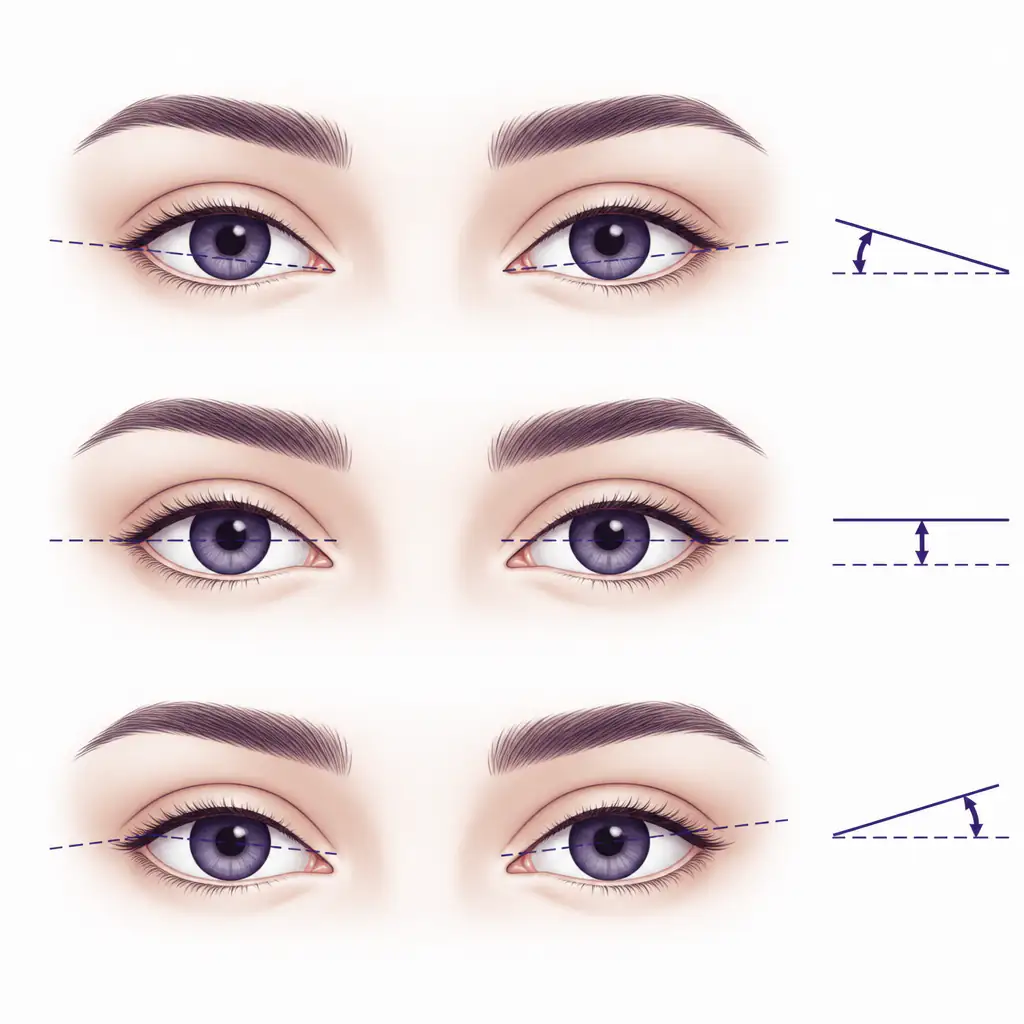
Negative canthal tilt is one of the most searched topics in facial aesthetics for a reason. The outer corners of the eyes sitting lower than the inner corners creates a drooping, tired appearance that can significantly affect how your face reads to others. Whether you noticed it in photos, a mirror, or through a face analysis tool, you are not imagining its impact.
This guide breaks down what negative canthal tilt actually is, why it happens, and what options exist to address it, from daily habits to clinical procedures. No guesswork, no hype, just a clear-eyed look at the options.
What Is Negative Canthal Tilt?
The canthal tilt refers to the angle formed by an imaginary line drawn between the inner corner of the eye (the medial canthus) and the outer corner (the lateral canthus).
- Positive canthal tilt: The outer corner sits higher than the inner corner. This is associated with an alert, sharp, or “hunter eye” appearance.
- Neutral canthal tilt: Both corners sit at roughly the same horizontal level.
- Negative canthal tilt: The outer corner sits lower than the inner corner. This creates a softer, more downward-slanting eye shape.
A tilt of even 2 to 3 degrees in either direction is enough to noticeably change how the eye area reads. Negative canthal tilt is often described as making the eyes look sad, tired, or less intense, though it is worth noting this is an aesthetic judgment, not a measure of health or worth.
What Causes Negative Canthal Tilt?
Understanding the root cause matters because it determines which interventions are realistic for you.
Genetics and Bone Structure
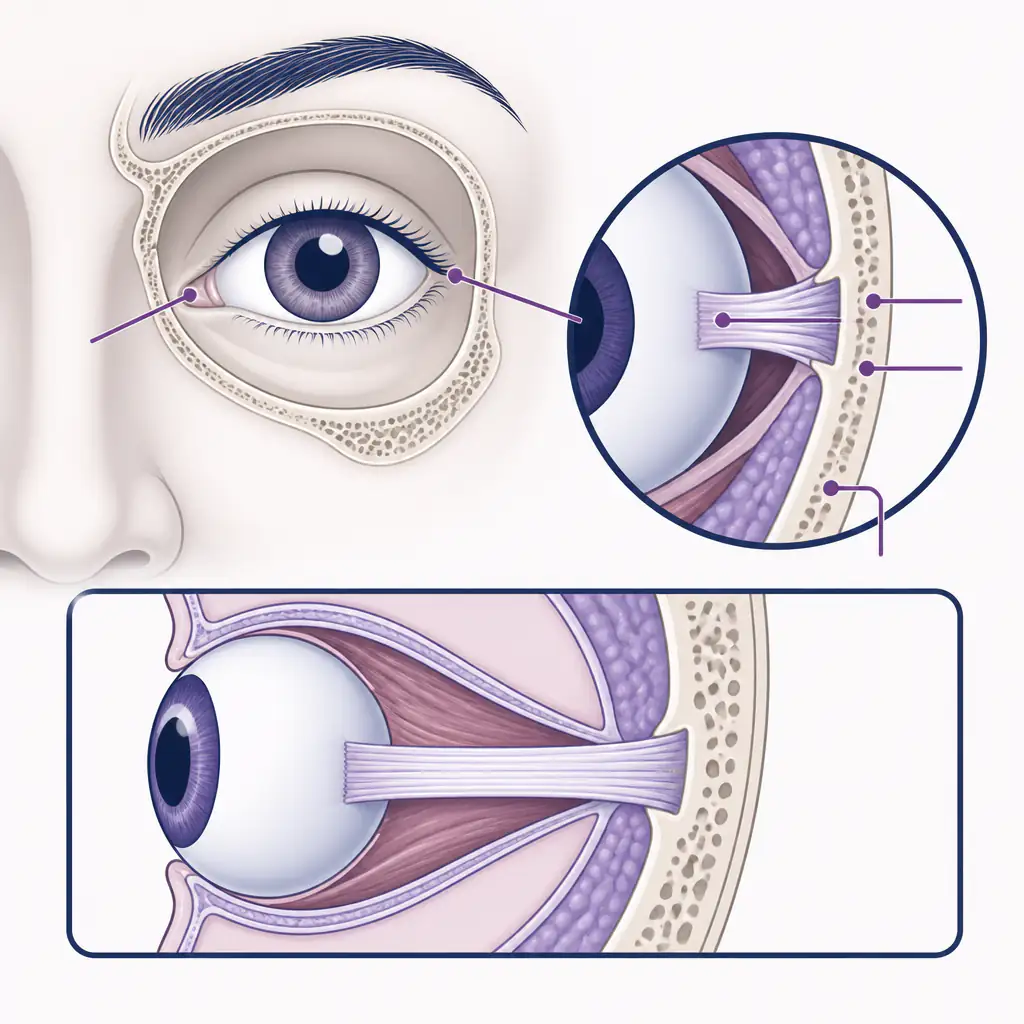
The primary driver is the shape and position of the underlying bones, specifically the lateral orbital rim (the outer edge of the eye socket). If this rim is underdeveloped or positioned lower, the lateral canthus tends to follow. This is largely genetic and cannot be changed with soft-tissue approaches alone.
Soft Tissue Descent
With age, the lateral canthal tendon, which anchors the outer corner of the eye to the orbital rim, can stretch or loosen. The surrounding soft tissue also loses volume and elasticity, allowing the outer corner to drift downward over time. This is why negative canthal tilt becomes more pronounced as people age.
Eyelid Structure
A combination of excess upper eyelid skin (dermatochalasis) and lower eyelid laxity can contribute to the appearance of a downward tilt even when the bony structure is neutral. The optical illusion created by heavy lids can mimic or worsen the visual effect of negative canthal tilt.
Orbital Fat Distribution
The way periorbital fat (fat surrounding the eye socket) sits can influence the apparent tilt. Under-eye fat prolapse or hollowing beneath the lateral orbit can make the tilt look more pronounced than the canthal angle itself actually is.
How to Assess Your Canthal Tilt Accurately
Before pursuing any intervention, get a clear and honest baseline. Take a relaxed, neutral-expression photo in good lighting with the camera at eye level. Do not tilt your head. Analyze the line between your medial and lateral canthus on both sides, as asymmetry is common.
If you want a more structured assessment, tools like Aura can analyze your eye area, detect canthal tilt, and give you a breakdown of how it factors into your overall facial harmony. Having an objective starting point is useful before committing to any approach.
Non-Surgical Options: What May Actually Help
Not every case of negative canthal tilt requires surgery. Several non-invasive approaches may improve the appearance of the eye area, though it is important to be honest about their limits.
1. Mewing and Oral Posture
Mewing refers to maintaining correct tongue posture on the roof of the mouth, combined with proper lip seal and nasal breathing. The proposed mechanism is that consistent maxillary (upper jaw) development over time may push the midface upward and forward, which could theoretically improve periorbital support.
The evidence here is largely anecdotal and limited to adolescents whose bone sutures are still open. In adults, bony change from mewing is considered minimal by most orthodontists. That said, correcting forward head posture and oral posture costs nothing and may help with overall facial tension and symmetry.
2. Face Yoga and Orbicularis Oculi Exercises
Some practitioners recommend exercises targeting the orbicularis oculi (the muscle ring surrounding the eye) to lift and tone the surrounding tissue. Research suggests facial exercises may modestly improve skin thickness and perceived youthfulness, but specific canthal tilt change from exercise is not well-documented.
Consistent practice over months may provide subtle improvements in lid tone and periorbital volume, but this will not move a bony lateral orbital rim.
3. Skincare and Retinoids
Improving skin quality around the eyes, particularly collagen density and elasticity, may reduce the degree to which soft tissue laxity exaggerates existing negative tilt. Retinol or prescription tretinoin applied carefully around the orbital area (avoiding direct contact with the lids) may help with this over time. Consult a dermatologist before starting retinoids near the eye area.
4. Strategic Makeup
For those who use makeup, cat-eye liner technique and upward-flicked eyeliner at the outer corner can optically correct the appearance of downward slant. Lifting the outer brow slightly with grooming or brow products also creates the illusion of a more positive tilt. This is not a structural fix, but it is immediate and reversible.
5. Sleep Position and Lifestyle
Chronic fluid retention, poor sleep, and high salt intake can worsen periorbital puffiness and make the outer eye area appear heavier and more drooped. Addressing these factors will not correct structural tilt but may reduce the visual severity of mild cases.
Minimally Invasive Clinical Options
If non-surgical methods are not producing the results you want, there are clinical options that sit between daily habits and full surgery.
Important: Always consult a qualified, board-certified medical professional before pursuing any clinical or surgical procedure. The information here is educational only.
Botox for Brow Tail Lifting
Strategically placed botulinum toxin injections can relax the depressor muscles pulling down on the lateral brow, allowing the brow tail to lift. This indirectly creates the visual impression of a slightly more positive canthal tilt by changing the frame around the eye. Results typically last 3 to 4 months.
Thread Lifts
Barbed thread lifts in the lateral orbital area can temporarily suspend soft tissue and create a mild lifting effect at the outer corner of the eye. Some practitioners report success with this approach for mild to moderate soft tissue descent, though longevity varies and results are generally less predictable than surgical options.
Filler in the Lateral Orbit
Small amounts of hyaluronic acid filler placed along the lateral orbital rim may add structural support and improve the perceived tilt by adding volume where bone is deficient. This is a technique-sensitive procedure and should only be performed by an experienced injector familiar with periorbital anatomy.
Surgical Options for Negative Canthal Tilt
For structural cases, surgery offers the most definitive correction. These are serious procedures requiring thorough consultation, realistic expectations, and a qualified oculoplastic or craniofacial surgeon.
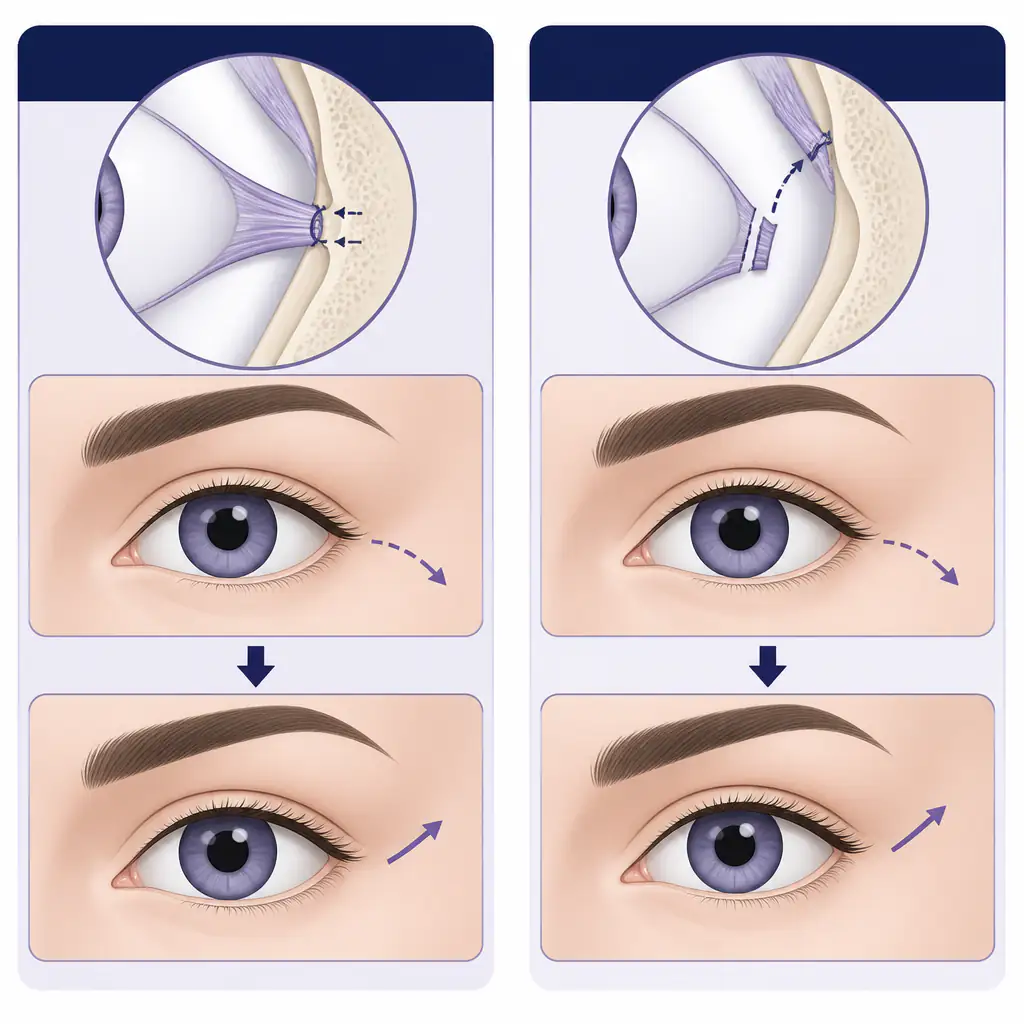
Canthoplasty and Canthopexy
These are the most direct surgical approaches to canthal tilt:
- Canthopexy: The lateral canthal tendon is tightened and repositioned without cutting it. Less invasive, better suited for mild laxity.
- Lateral canthoplasty: The tendon is detached, repositioned higher on the orbital rim, and re-anchored. This can meaningfully raise the outer corner of the eye and create a more positive tilt.
Results from well-performed canthoplasty can be significant and long-lasting. Risks include asymmetry, scarring, dry eye, and changes to the eye shape that may not be reversible. Choosing a surgeon with specific experience in this procedure is non-negotiable.
Orbital Rim Augmentation
For cases where the issue is fundamentally bony, orbital rim implants or fat grafting along the lateral orbital rim can provide structural support. This is less commonly performed than canthoplasty but may be appropriate when bone deficiency is the primary driver.
Fox Eye Procedure
The “fox eye” or “cat eye” procedure involves a combination of temporal brow lifting and canthal repositioning to create an almond-shaped, upwardly slanted eye appearance. Some versions are done with threads (temporary) and others with surgical techniques (more permanent). Outcomes depend heavily on individual anatomy and surgical technique.
Choosing the Right Approach for Your Situation
The correct path depends entirely on the cause and severity of your canthal tilt.
- Mild, soft-tissue-related tilt: Start with non-invasive approaches. Makeup, skincare, lifestyle optimization, and possibly Botox or threading are reasonable first steps.
- Moderate tilt with tendon laxity: Canthopexy or conservative canthoplasty may be appropriate after a thorough surgical consult.
- Significant tilt with structural bone deficiency: Orbital rim augmentation or more involved canthoplasty. Requires specialist evaluation.
- Age-related descent: A combination of soft tissue support (filler, thread) or surgical lifting may be appropriate depending on overall facial aging.
If you are unsure where your case falls, getting an objective facial analysis first is a practical step. Aura can assess your eye area geometry and canthal tilt as part of a broader facial evaluation, which can help you go into any consultation with clearer information.
What to Realistically Expect
Negative canthal tilt is partially structural and partially optical. Even surgical correction has limits set by individual anatomy. A few honest points:
- Non-surgical methods can reduce the appearance of negative tilt but rarely change the underlying angle measurably.
- Surgical options offer real structural change but come with recovery time, cost, and surgical risk.
- Mild negative canthal tilt is extremely common and does not need correction unless it genuinely bothers you.
- Pursuing any change from a grounded, informed place leads to better outcomes than chasing perfection under external pressure.
Focus on improving what is reasonably improvable and building your approach on accurate information about your specific anatomy.
Frequently asked questions
Can negative canthal tilt be fixed without surgery? +
Mild cases may be visually improved through makeup techniques, brow shaping, Botox, or soft tissue fillers. These approaches change how the eye area looks without altering the underlying bone or tendon structure. For significant or structurally caused negative canthal tilt, surgical options like canthoplasty are typically the only way to achieve meaningful change.
Does mewing fix negative canthal tilt? +
Mewing may support proper midface development in adolescents whose facial bones are still growing, which could indirectly influence periorbital support over time. In adults, the evidence for bony change from mewing alone is minimal. It is unlikely to correct established negative canthal tilt on its own, though maintaining correct oral posture is still generally beneficial for facial structure.
What is the difference between canthopexy and canthoplasty? +
Canthopexy tightens and reinforces the lateral canthal tendon without cutting it, making it a less invasive option suited for mild laxity. Canthoplasty involves detaching the tendon, repositioning it higher on the orbital rim, and reattaching it, offering more significant correction for moderate to severe negative canthal tilt. Both procedures should only be performed by an experienced oculoplastic or craniofacial surgeon.
Is negative canthal tilt permanent or does it get worse with age? +
Negative canthal tilt caused by genetics remains relatively stable, though soft tissue aging can make it appear more pronounced over time as the lateral canthal tendon loosens and periorbital volume decreases. Age-related worsening is common and is one reason canthal descent correction is a frequent component of facial rejuvenation procedures.