 Aura: Looksmaxxing
Canthal Tilt in Women: What the Studies Found
What studies on women's eye angles actually found, why the famous 93 percent figure came from edited photos, and practical brow and makeup ideas.
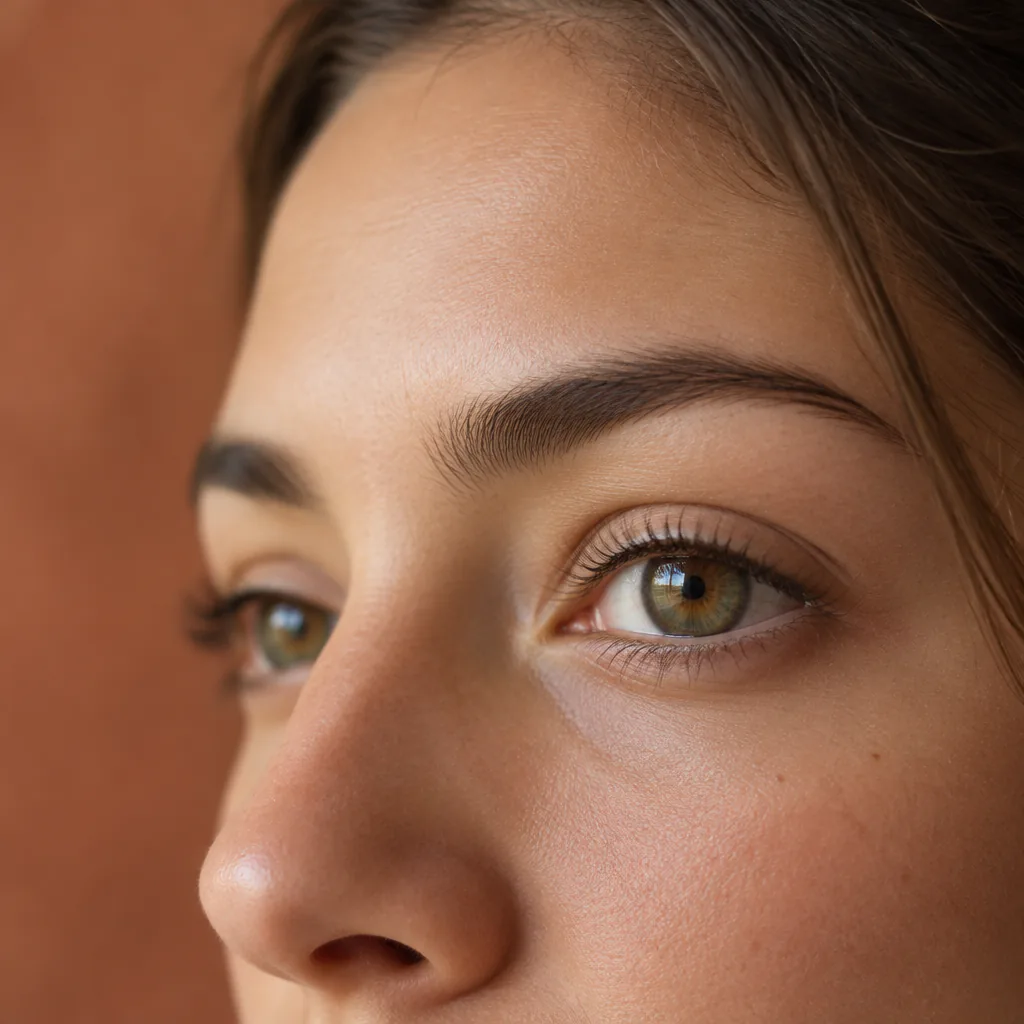
Search “canthal tilt female” and you land in two very different conversations. In one, TikTok filters and forum threads treat the angle of your eye corners as a beauty score. In the other, a handful of real studies say something narrower and more useful.
This guide sorts the two apart. It covers what canthal tilt is, what research on women’s faces actually tested, and why your selfie number is probably off. It ends with practical styling ideas if you care about how your eyes read.
What canthal tilt actually measures
Picture a line from the inner corner of your eye to the outer corner, then compare it with a horizontal line.
- The inner corner is the medial canthus.
- The outer corner is the lateral canthus.
- The angle between that corner-to-corner line and the horizontal is your canthal tilt.
The sign convention is simple. A positive value means the outer corner sits higher, and a negative value means it sits lower (PinkMirror).
Positive, neutral and negative
- Positive tilt: the outer corner is higher, so the eye slopes up toward the temple. This is the shape social media calls “fox eyes” or “almond eyes”.
- Neutral tilt: the two corners sit at roughly the same height.
- Negative tilt: the outer corner is lower, giving a gently downturned shape.
You will also see the term palpebral fissure inclination. The palpebral fissure is the opening between your eyelids, and its inclination is how much that opening slants. In practice the two terms overlap heavily.
One point to keep in mind before going further: there is no single correct value, and the measurement says nothing about your health (Canthal Tilt Test).
What the research on female faces found
Most online claims about canthal tilt trace back to a small number of papers. Each one is worth reading closely, because the details change what you can conclude.
The edited-faces study behind the “93%” number
Bashour and Geist published a study in an ophthalmology journal. Judges made a forced choice between two versions of the same female face:
- an unmodified photo, and
- a version with the medial canthal tilt accentuated in Photoshop.
The edited versions were preferred 93% of the time (PubMed). The authors linked this to palpebral fissure inclination, which they describe as both:
- neotenic, meaning associated with youthful features, and
- sexually dimorphic, meaning it tends to differ between the sexes.
What the study does not show matters just as much. It used edited images and a two-option choice. It did not compare naturally different faces, and it did not test where a preference might stop.
The celebrity measurement study
A study using AI landmark software analysed 100 facial points in 42 Caucasian celebrities (PMC). It found:
- Women: average canthal tilt of 8.50° ± 2.10°.
- Men: average canthal tilt of 6.51° ± 2.67°.
- Comparison: both groups were higher than the 4.12° figure the authors cite for the general Caucasian population.
The authors read this as a sign that greater tilt is considered attractive. That is an inference from a small, hand-picked group of famous faces from one ethnic background. It is not a test in which people rated tilt directly.
Where more lift stops helping
A rating study indexed on ScienceDirect points in a different direction. Its abstract states that elevating the lateral canthal angle “sharply reduces the attractiveness in male and female faces” (ScienceDirect).
A summary at Trymaxxing describes this work as directly complicating the 93% result. It also highlights eyebrow height alongside lateral canthal elevation.
There is also a notable gap. As Looksmaxxing.com points out, none of the studies it reviewed included faces with a natural negative tilt. That means there is no direct evidence on negative tilt either way.
The honest summary:
- Mildly upturned eyes show up often in faces that are labelled attractive.
- In edited experiments, pushing the outer corner well past its natural position lowered ratings.
- More tilt is not automatically better, and a lower tilt has not been shown to be a flaw.
What counts as normal (spoiler: there is no single number)
Published averages vary with the group being measured and the method used. A roundup compiled by Lookist lists two examples:
| Group studied | Average tilt reported |
|---|---|
| 200 South Indian adults aged 18 to 26 | 6.1° in women, 5.1° in men |
| 76 Korean patients with an average age of 23 | about 8.4° |
Another summary notes that published averages run from about 4 to 10 degrees, depending on the group studied (Attractiveness Test).
So a reading of 4° and a reading of 9° can each be typical, depending on ancestry and method. The same source also describes a negative tilt as one of the ordinary ways an eye can sit. Nobody has set a number at which a woman’s eyes become “wrong”.

How to check your canthal tilt without fooling yourself
If you want a rough number for your own curiosity, setup matters more than the app you use. The camera angle alone can shift the reading by about as much as the differences being compared (Attractiveness Test).
A clinical photography paper adds a specific warning. Tilting your head downward exaggerates a positive tilt, and the authors note that models often pose this way (PMC).
The steps below are an editorial suggestion for a fairer reading, not a clinical protocol:
- Hold the camera at eye height. Prop it on a shelf or ask someone else to take the photo, so your chin stays level.
- Look straight into the lens with a relaxed face. Smiling and squinting change how the lids sit, so keep your expression neutral.
- Take off heavy eye makeup. Liner and lashes can hide where the lids actually meet.
- Mark the true corners. Use the point where the upper and lower lids join, not the edge of your liner or lashes.
- Measure both eyes. Small differences between the left and right sides are common, so record both values.
- Repeat with three or four photos. Treat the result as a range rather than one exact figure.
- Ignore filter outputs. A filter built for entertainment is not a measurement.
Tilt is one part of the eye area, not the whole story
The same clinical photography paper describes the youthful attractive female eye using several traits together (PMC):
- less pretarsal show, which is the strip of upper-lid skin visible between the lash line and the crease,
- a greater positive tilt, and
- a specific angle at the inner end of the brow.
In other words, people see the eye region as a whole. Brow shape, how much lid shows, lash direction and even the hair around your face all shape how your eyes read. Canthal tilt is only one input.
That is also why the makeup artist quoted in a Yahoo Lifestyle piece on the TikTok trend began with a reminder: “your eye shape does not quantify your beauty or level of attractiveness.”
Styling around your eye shape
None of the techniques below change anatomy. They change the visual lines around your eyes. Treat them as editorial suggestions to experiment with, not proven effects.
If you want a more lifted look
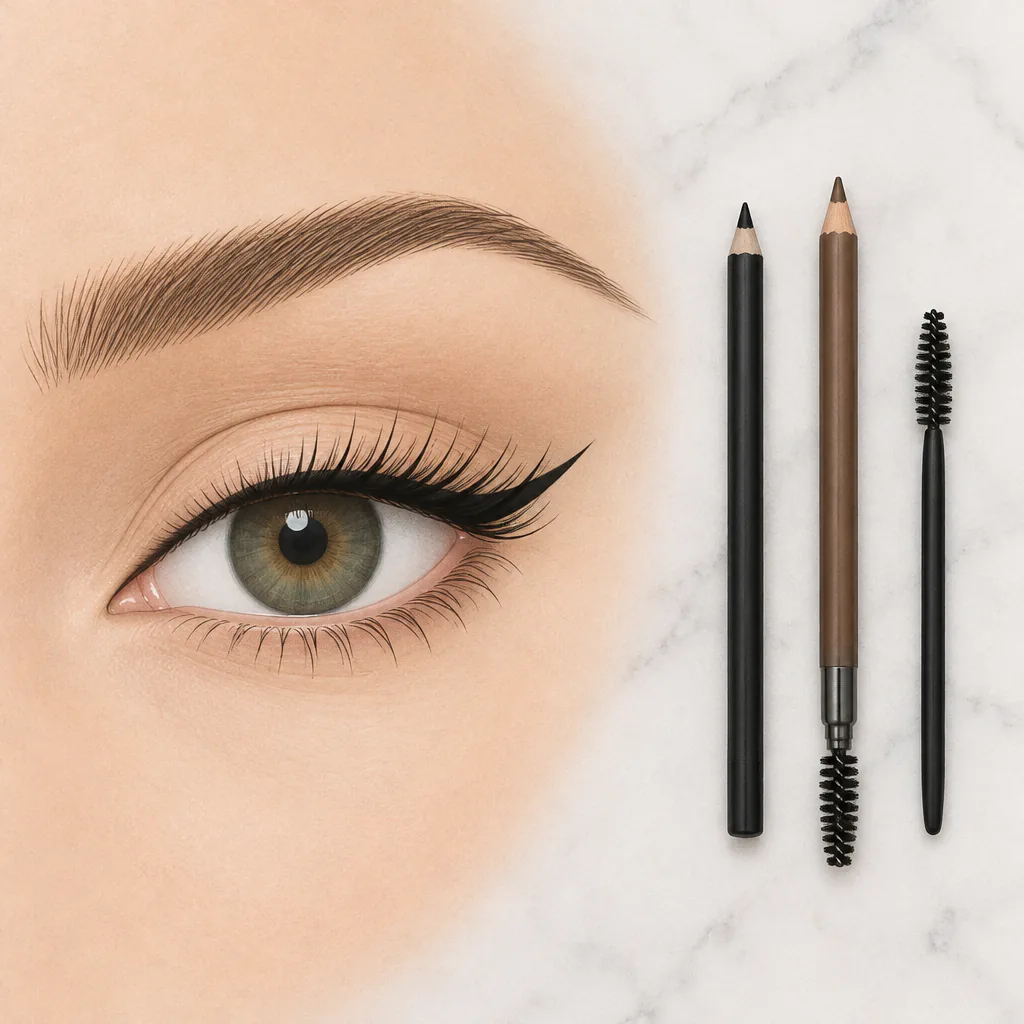
- Angle the liner wing toward the end of your brow. Keep it thin and start it from the upper lash line. Following the lower lid can pull the line down.
- Focus darker shadow and mascara on the outer third. Brush outer lashes up and outward.
- Go light on liner along the outer lower lash line. Heavy liner there tends to weigh the corner down.
- Keep the brow tail from sitting lower than the brow head. A slightly lifted tail frames the outer corner. Avoid extreme arching, since the rating work above links extra height with a downside.
If you like a softer, downturned look
A gently downturned eye is a style many people choose on purpose. To lean into it:
- smudge a soft liner along the lower outer lash line,
- keep the brow shape fuller and straighter, and
- skip sharp wings.
You do not need to “correct” a shape you like.
Hair framing
- Face-framing layers that start around the cheekbones draw the eye outward.
- Curtain bangs can soften a strong brow line.
- Heavy, blunt fringes sitting right on the brows change how much of the upper eye area shows, so try your parting both ways in photos.
If you want a structured overview of how your features, brows and hair fit together, Aura’s Face Analysis for Women covers this. It is built around the style goals you set and returns three sections: a facial profile, hair and brow ideas, and your personal priorities.
It gives a subjective styling read, not a calibrated canthal tilt measurement. The free part is an on-device preview of your eye geometry; the full findings are part of Aura Pro ($9.99 a month or $49.99 a year).
A note on procedures
Some surgical procedures reposition or tighten the outer corner of the eye, often under the name canthoplasty. We don’t recommend them for appearance. They can leave the eye looking unnatural or uneven, the lower lid pulled down, and the eyes dry, and the changes can be permanent.
Talk to a qualified professional before considering this. If you do book a consultation, a board-certified oculoplastic or facial plastic surgeon can explain:
- what is realistic for your anatomy,
- what the risks are, and
- what happens if you want to undo the result.
Keep the rating research in mind as well. In edited experiments, lifting the outer corner well past its natural position scored worse, not better.
The bottom line
Canthal tilt is a real, measurable angle, and women’s eyes tend to sit slightly upturned on average. The studies behind the hype are narrower than social media suggests:
- one used Photoshop edits and a forced choice,
- one measured 42 celebrities, and
- at least one found that too much lift backfires.
Normal ranges vary across groups, and your selfie angle can easily move the number. If you care about how your eyes read, brows, liner placement and hair framing give you plenty to work with, and none of them require chasing a specific degree.
Sources & further reading
- Is medial canthal tilt a powerful cue for facial attractiveness? - PubMed
- Using Artificial Intelligence to Quantify Sexual Dimorphism in Aesthetic Faces: Analysis of 100 Facial Points in 42 Caucasian Celebrities - PMC
- Understanding the impact of eyebrow and lateral canthal height on the perception of character traits: A rating-based analysis of 2081 participants - ScienceDirect
- The Influence of Sagittal Head Tilt on Periorbital Appearance: Implications for Clinical Photography and the Evaluation of Postoperative Results
- Canthal Tilt: Negative vs Positive and How to Measure It
Frequently asked questions
Do women have a more positive canthal tilt than men? +
In one study of 42 Caucasian celebrities, women averaged 8.50° and men 6.51°. A study of South Indian adults also reported a slightly higher average for women. The difference is small and individual faces vary widely.
Is a negative canthal tilt unattractive on women? +
No study has shown that. None of the studies reviewed in one summary included faces with a natural negative tilt, so there is no direct evidence either way. A downturned eye is one of the ordinary ways eyes sit, and many people style it on purpose.
Where does the claim that 93% prefer a positive tilt come from? +
It comes from a study in which judges chose between unmodified female faces and versions edited in Photoshop to accentuate the medial canthal tilt. The edited faces were preferred 93% of the time. The result applies to edited images in a two-option test, not to natural variation between real faces.
Why does my canthal tilt look different in every photo? +
Camera angle and head position change the reading a lot, and tilting your head down makes a positive tilt look stronger. For a fairer estimate, use several straight-on photos taken at eye level with a neutral expression, then treat the result as a range.
Can makeup change canthal tilt? +
Makeup cannot change the anatomy of your eye corners. It changes the visual lines around them, such as the direction of your liner, where you focus mascara and how your brow tail sits. Treat the techniques as styling choices, not corrections.